EU’s sluggish economy faces moderate growth slowdown from US trade tensions
Transatlantic trade tensions are contributing to a moderate deceleration in near-term economic growth in the European Union and euro area by around 0.4pps, even in a baseline scenario of the United States and the EU reaching a preliminary trade agreement.
An initial US-EU deal appears increasingly likely. The recent trade agreement reached between the US and Japan has increased pressure on the EU and other trading partners to pursue a similar arrangement.
Ongoing negotiations suggest that a 15% levy on most EU exports to the US might be introduced, with EU officials pushing to have this rate applied to certain sectors, including automobiles. Steel and aluminium imports above a certain quota might face the current higher levy of 50%.
President Donald Trump has persisted with his policy of imposing higher tariffs on trading partners, so the EU faces a potential 30% tariff without an agreement, up from the 20% tax imposed in April and then paused, although still below the 50% rate threatened in May.
The EU has avoided direct retaliation to date. Scope Ratings (Scope) expects this cautious approach to continue, even as the EU prepares possible counter-measures. Nevertheless, the approach risks growing tariff asymmetries particularly if US levies on EU goods rise more quickly than EU levies on US exports.
Scope’s model-based estimates suggest that the implementation of a 15% US tariff would trim euro area and EU growth within a year by increasing the effective US tariff on EU exports by around 16pps, excluding the proposed across-the-board 30% rate. This estimate assumes threatened levies on pharmaceutical exports go into effect.
The most-exposed EU economies are those with a large trade surplus and/or significant trade with the US, such as Germany and Ireland, with the impact of higher tariffs also felt indirectly through their effect on global supply chains.
Among the EU’s four largest economies – Germany, France, Italy and Spain – Germany and Italy are the most vulnerable, each facing an estimated short-term output loss of 0.4pps. The higher tariffs will reduce Spain’s output by a moderate 0.3pps in the medium run. France is expected to experience a more modest cumulative reduction in output of 0.2pps in the medium term.
Trade tensions underpinned the reduction last month in Scope’s forecast for euro area growth for 2025 by 0.5pps to 1.1% though growth is expected to improve to 1.5% next year, lifted by fiscal stimulus in Germany and higher defence spending across the EU.
US tariff rises set back growth in the largest EU economies
Cumulative impact on real output (percentage-point change) assuming a 15% levy on EU exports
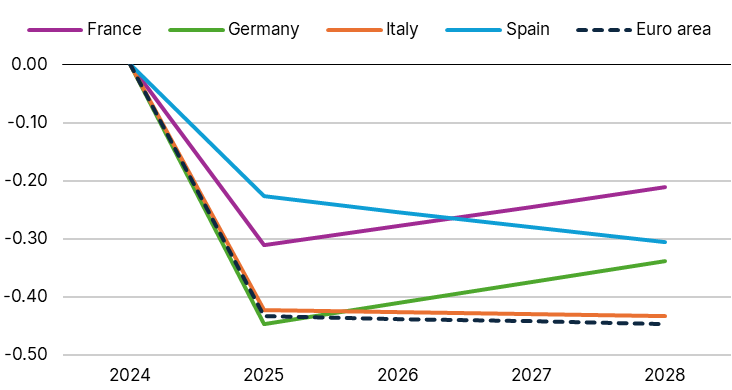
Note: this scenario for the impact of US levies on the EU is based on the measures already in force or announced by the US since the start of Trump’s second administration and the counter-measures from trading partners, including the agreements announced between the US and its trading partners and a hypothetical 15% rate on EU exports to the US. Source: Scope Ratings.
Threatened 30% levies would raise economic costs for the EU economy
Alternatively, should the US go ahead with the threatened imposition of 30% tariffs on the EU on 1 August, equivalent to a rise in the effective US rates by around 26pps in aggregate this year, and the EU adopts counter-measures, the adverse effect on growth in the EU would clearly be more significant.
For illustrative purposes, if both the 30% levies imposed by the US and EU counter-measures come into force on or shortly after 1 August and hypothetically stayed at the higher rates in the years ahead, Scope’s estimates suggest an aggregate output loss of 0.6pps by 2028 for the euro area and 0.5pps for the EU economy.
EU, euro area economies are vulnerable to the imposition of much higher US levies
Cumulative effect on real output (percentage-point change) in a scenario of 30% US tariff, EU counter-measures
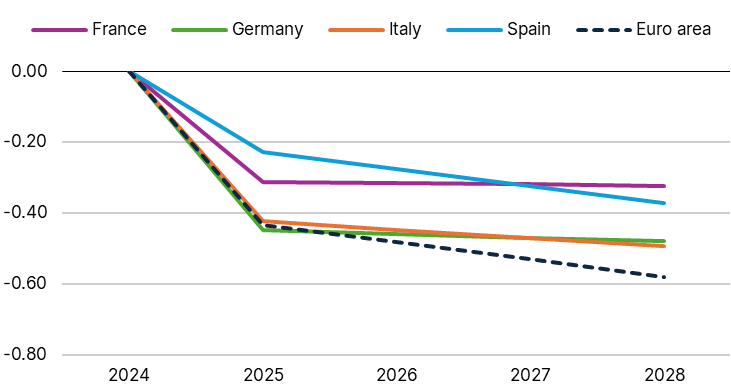
Note: this scenario incorporates the effects of an incremental 20pp levy on goods entering the US from the EU on top of the 10% across-the-board tariffs announced in April, plus the assumption of EU counter-measures of an incremental 13.3pps on American goods entering the EU. Source: Scope Ratings.
Averting this potentially damaging trade outcome for Europe depends on the negotiations underway in which the EU, even as the world’s largest and most-open trading bloc, is at a disadvantage partly due to the greater importance of the US for its exporters than vice versa. This is even as the EU seeks to bolster trade cooperation with other trading partners.
US market more important for EU exporters than vice versa
%; the dot sizes represent the dollar value of exports to the US, 2024
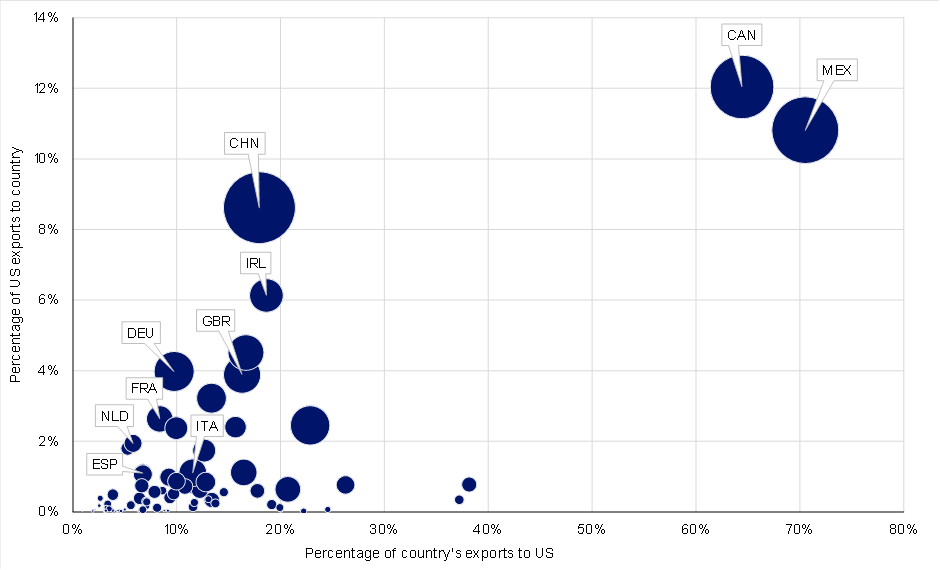
Source: Financial Times, OECD, Scope Ratings estimates
US-EU preliminary agreement probable
Considering this, it appears likely that the US and EU achieve some form of a framework agreement, even if this involves average US levies of above 10%. A preliminary agreement by 1 August remains firmly possible. Nevertheless, given the seesawing US trade policies of the recent months, the White House might in an alternative scenario firstly impose the 30% levies, maybe temporarily, as leverage in negotiations before settling on an agreement after 1 August.
Any preliminary agreement is likely to contain many caveats and carve-outs – with limited enforceability – serving only to avert further worst-case escalation and act as the starting point for further negotiations.
The EU has several ways to retaliate in the scenario of a worsening trade war, from the newly introduced but yet-to-be-used anti-coercion mechanism to possible tariffs on American exports and the imposition of export controls, though Scope expects any such retaliation to remain gradual.
(Arne Platteau, analyst in credit policy at Scope Ratings, contributed to this research)
Author

Dennis Shen
Scope Ratings
Dennis Shen is Chair of the Macroeconomic Council and Lead Global Economist of Scope Ratings, the European rating agency, based in Berlin, Germany.