EUR/USD rally above 1.1100 likely to resume bullish appetite [Video]
![EUR/USD rally above 1.1100 likely to resume bullish appetite [Video]](https://editorial.fxstreet.com/images/Markets/Currencies/Majors/EURUSD/chart-in-newspaper-gm495109066-77816221_XtraLarge.jpg)

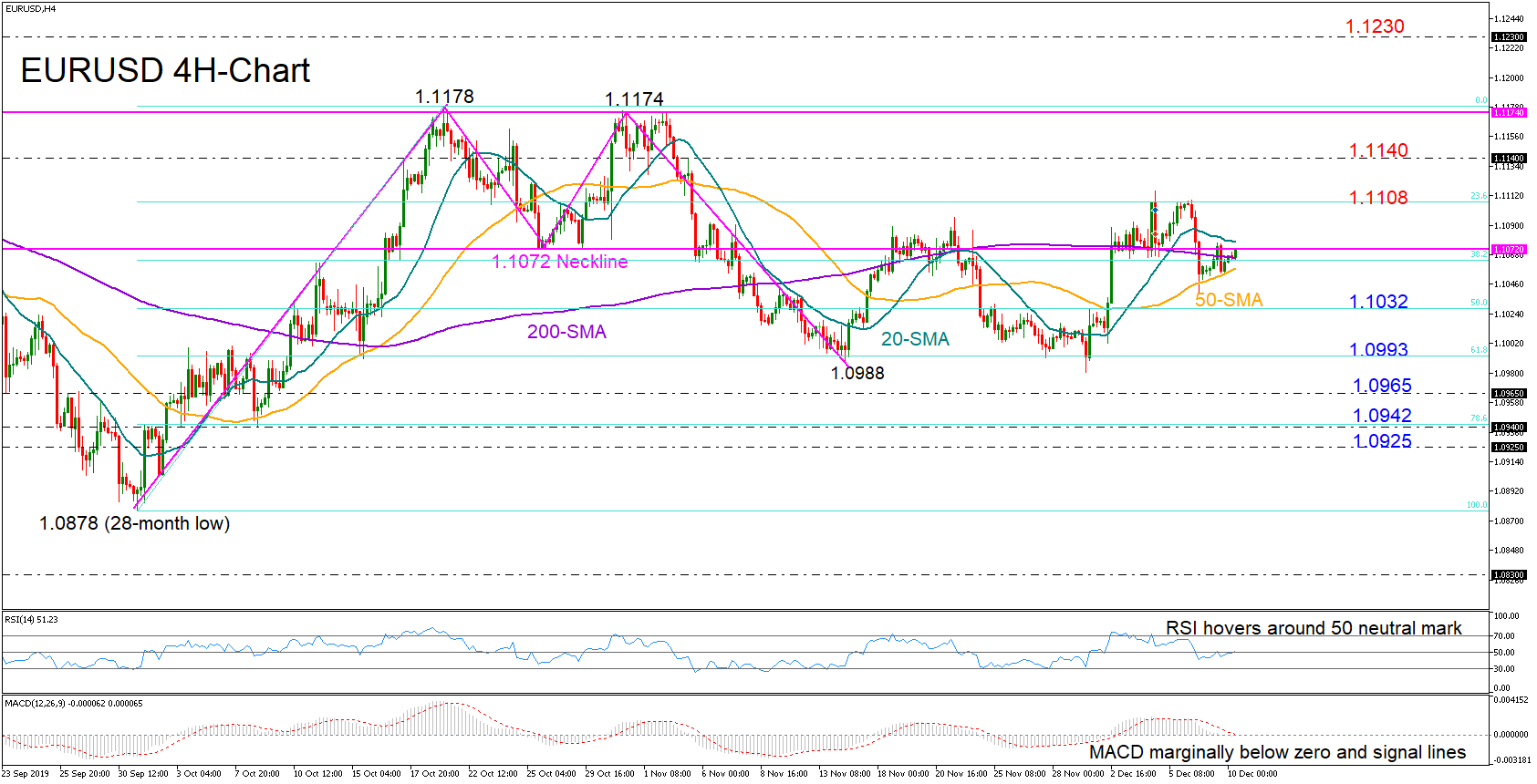
EURUSD slipped back into the 1.1000 region after the 23.6% Fibonacci of 1.1108 of the upleg from 1.0878 to 1.1178 ceased last week’s rally that surpassed the neckline of the double top bearish formation in the four-hour chart.
The 50-period simple moving average (SMA) is keeping sellers under control this week, though the momentum indicators have yet to enter the bullish territory to signal improvement in the market. With the RSI hovering around its 50 neutral mark and the MACD fluctuating barely in the negative neighborhood and slightly below its signal line, the short-term bias is viewed as rather neutral at the moment.
Should the price hold above the 50-period SMA, buyers would like to see a closing price above the 23.6% of 1.1108 to increase exposure in the market – the area has been a key support back in May as well. Such a strength may then face resistance around 1.1140, where any break higher would open the door for the tops around 1.1174. If the market manages to clear its recent peaks too, positive momentum could stretch somewhere near 1.1230.
On the other hand, a decline below the 50-period SMA may stall around the 50% Fibonacci of 1.1032. Still, the bears may not attempt a full charge unless the price retreats below the 61.8% Fibonacci support of 1.0993, shifting attention to 1.0965 and then into the 1.0942-1.0925 region.
Looking at the bigger picture, the pair is in consolidation, moving sideways within the 1.0878-1.1178 boundaries and only a violation at these edges would adjust the outlook accordingly.
In brief, EURUSD is lacking convincing positive signals in the four-hour chart, with short-term and medium-term traders waiting for a rally above 1.1108 and 1.1174 respectively to resume buying appetite.
Author
Christina joined the XM investment research department in May 2017. She holds a master degree in Economics and Business from the Erasmus University Rotterdam with a specialization in International economics.