Eurozone: The bulk of the decrease in borrowing costs is behind us


In August 2025, the decrease in market rates (Euribor, swap, etc.), which began in October 2023, had been passed on in full to the rates on new bank loans to corporations and households in the Eurozone.
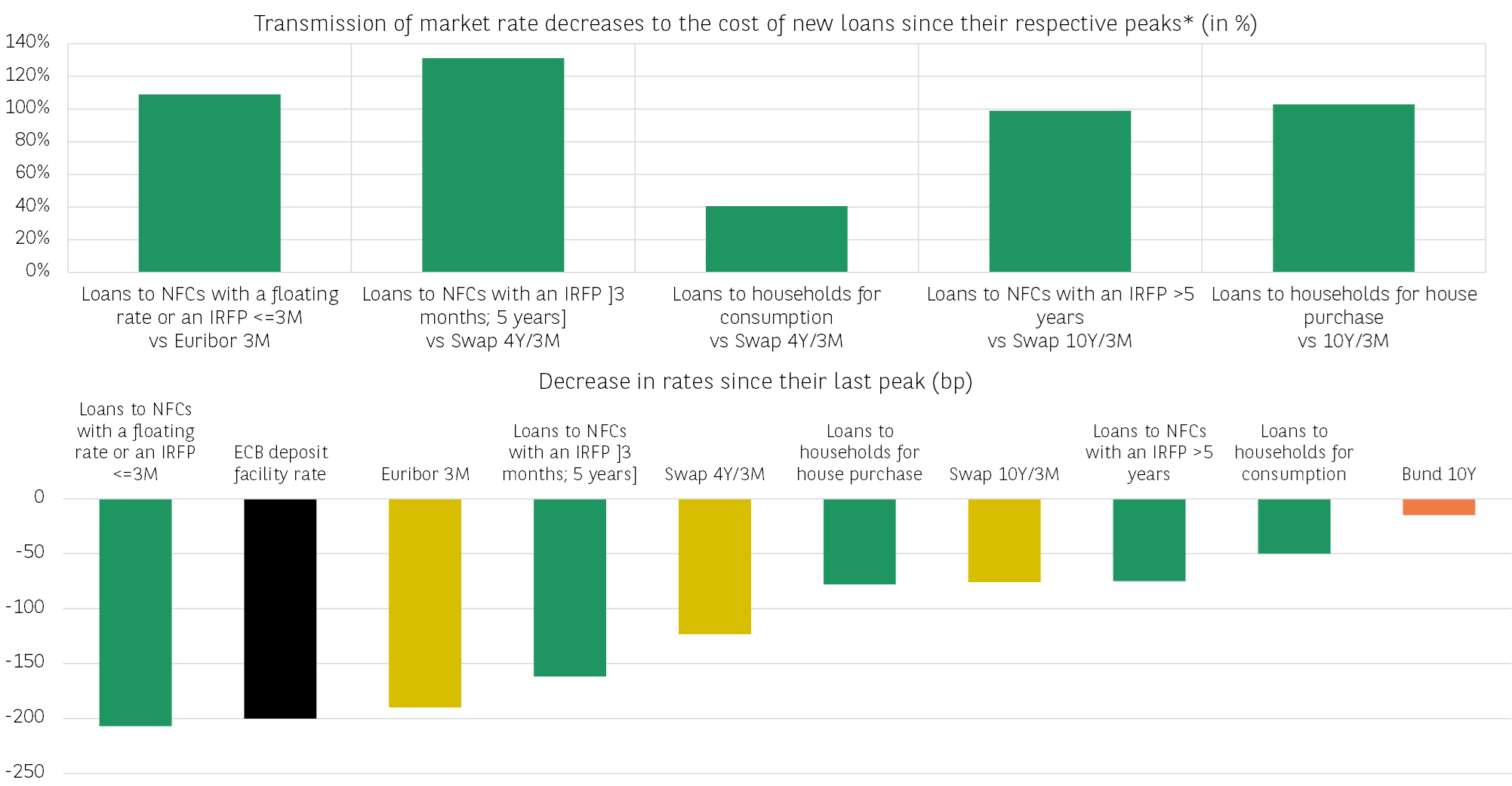
*09/2023 for swap rates, 10/2023 for Bunds and loans to NFCs with a maturity of more than 5 years, 11/2023 for loans to NFCs ]3 months; 5 years] and loans to households for house purchase, 01/2024 for loans to households for consumption and 03/2024 for the Euribor 3M and floating rate loans to NFCs, and 05/2025 for the ECB deposit facility.
Reading of the chart: The reference rate for new loans to NFCs with a floating rate or an IRFP<=3M is the Euribor 3M. The Euribor 3M fell by 190 bp between March 2024 and August 2025. The rate on new loans to NFCs with a floating rate or an IRFP<=3M fell by 207 bp between March 2024 and August 2025. The transmission rate is therefore 109%. Retaining the peaks allows the transmission lag to be incorporated and avoids overestimating the transmission rate.
Source: ECB, BNP Paribas
Banks generally tend to adjust the pricing of new loans to the cost of their resources with comparable maturities. Swap rates are good reference rates in this respect, as they provide a reliable approximation of what the market considers to be the expected path of short-term rates for a wide range of horizons. The ECB's key interest rate cuts between June 2024 and June 2025 (which directly affect only – very short-term – money market rates via the interest rate channel) therefore had a modest impact on the pricing of long-term bank loans. This reference to swap rates also helps to explain why long-term lending rates have fallen more than the 10-year Bund rate (which even rose slightly between December 2023 and August 2025), which is the main benchmark rate of comparable maturity in the Eurozone.
The transmission of market rates is assessed by comparing the decrease in the rates of several categories of loans with that of a market rate of comparable maturity, from their most recent peak[1] to August 2025. For example, the average rate on new loans to households for house purchase[2] fell by 78 basis points between November 2023 and August 2025, to 3.36%, while the 10-year versus 3-month swap rate fell by 76 basis points between September 2023 and August 2025 to 2.62%. The transmission rate is therefore 103%.
However, the cost of bank resources is not the only variable explaining credit pricing. Unlike the benchmark market rates used, bank lending rates are not risk-free rates. The bank interest margin includes a risk premium reflecting the risk associated with the borrower. Thus, the 2.1 pp increase between Q3 2023 and Q2 2025, to 11.7%, in the share of consumer loans that are under-performing but not yet non-performing (stage 2 according to IFRS 9) would help explain the less efficient transmission (41% according to our calculation) to this category of loans. While long-term rates are likely to remain on an upward trend, a further decline in short and long-term bank rates seems unlikely. Above all, household lending rates already appear to be on the rise again.
Author
BNP Paribas Team
BNP Paribas
BNP Paribas Economic Research Department is a worldwide function, part of Corporate and Investment Banking, at the service of both the Bank and its customers.

















