Eurozone bond market spillovers from the jump in Bund yields


On Wednesday 5 March, the 10-year Bund yield increased 30bp, the biggest rise since the fall of the Berlin Wall. It continued to move higher the following days, reaching a peak on 11 March. The trigger was the announcement by Friedrich Merz (CDU) and the heads of the CSU and SPD during an evening press conference on Tuesday 4 March 2025 that they agreed to reform the debt brake, that defence spending above 1 percent of GDP would be exempt from this debt brake and that a EUR 500bn fund for infrastructure investments would be created. The developments in the German bond market had sizeable spillover effects across markets in the Eurozone. This didn’t come as a surprise.
Higher Bund yields trigger a portfolio rebalancing because yield-targeting investors need less exposure to higher-yielding markets to meet their objective when German long-term rates have become more attractive. It seems that this arbitrage behaviour of investors has become more prominent in recent years, considering that since February 2022 -when Bund yields moved back in positive territory- bilateral correlations with the German market are significantly higher than before. In Italy for instance, three quarters of the weekly change in yields are explained by changes in German yields. For other countries, the numbers are even higher, reaching 95% in the Netherlands and Belgium and 91% in France (table 1, column e). The regression beta -the change in bond yields for a given change in German yields- is also close to one for the various countries (column d), implying, a priori, full transmission of Bund yield changes.
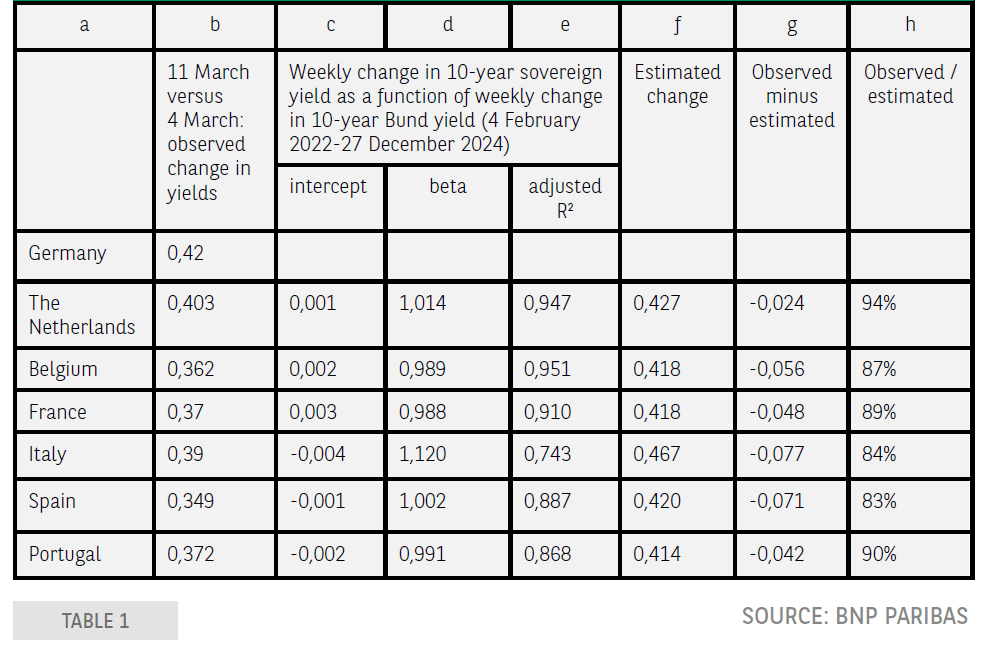
As shown in chart 1, since the latter part of 2021, the beta has increased structurally and the dispersion between the country betas has narrowed significantly. This means that yields in Eurozone markets move much more in tandem than before.
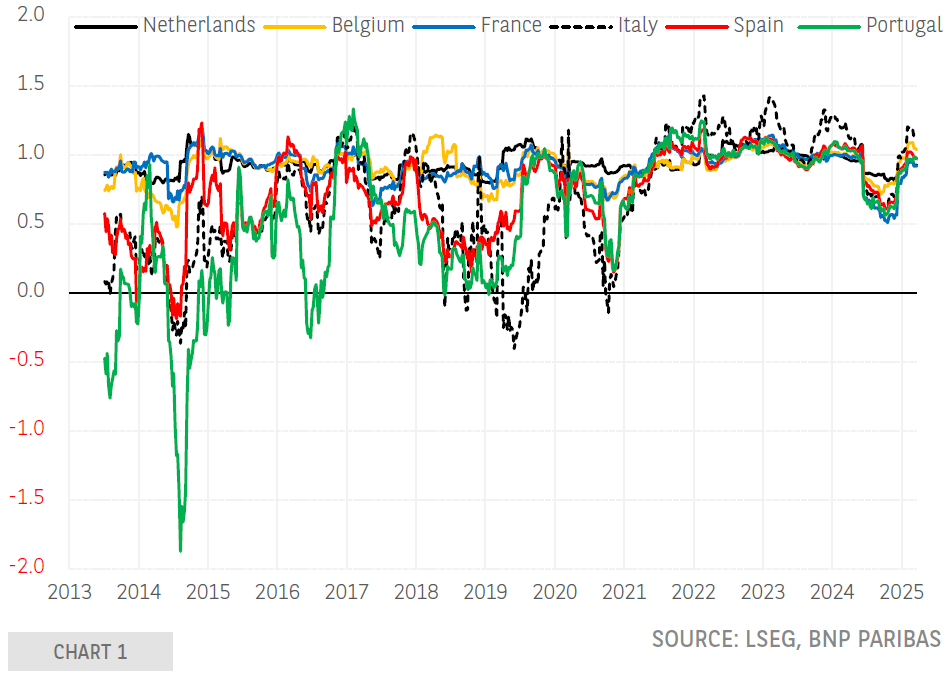
This statistical relationship allows us to assess whether, given the change in Bund yields, the change in other markets has been in line with expectations (table 1, column h). It seems that the different markets have witnessed some underreaction compared to what happened in Germany. This was especially the case in Italy and Spain, where the increase in yields corresponded to 83%, respectively 84%, of what was expected based on the regression analysis. Nevertheless, these countries, just like the others, suffered from a significant spillover from the announcements made in Germany. It remains to be seen whether this negative financial spillover (higher borrowing costs) will be compensated, at least in part, by positive spillovers from increased trade with Germany following the fiscal boost in that country. An ECB occasional paper presents model-based simulations showing that an increase in German public investment by 1% of GDP for two years raises German output by almost 1.5% but the impact on the rest of the euro area is less than 0.1%. This limited spillover is due to the rise in official interest rates in reaction to the fiscal expansion. If monetary policy is not tightened, the domestic impact on growth is somewhat higher than 1.5% and the spillover is higher as well (about 0.25%). All in all, it seems that the real spillovers should be limited. Assessing the net effect on growth outside Germany is very challenging because it depends on the sensitivity of final demand to interest rates, the size of the German spending boost and the (non-European) import content of the extra expenditures. Confidence effects (a revival of animal spirits) could also play a role.
Author
BNP Paribas Team
BNP Paribas
BNP Paribas Economic Research Department is a worldwide function, part of Corporate and Investment Banking, at the service of both the Bank and its customers.