Europe’s challenges


Europe is in the middle of a second wave of Covid-19 infections
The prospect of another hit to the economy in Q4 still leaves ECB and fiscal authorities in crisis mode, but positive news on the vaccine front leaves investors looking ahead to the recovery. However, once the focus shifts it will also become increasingly apparent that the rise in sovereign debt and private debt through the crisis will leave not just banks vulnerable to a likely rise in non-performing loans, it also leaves the risk of another debt crisis on the table if and when the ECB tries to reign in stimulus.
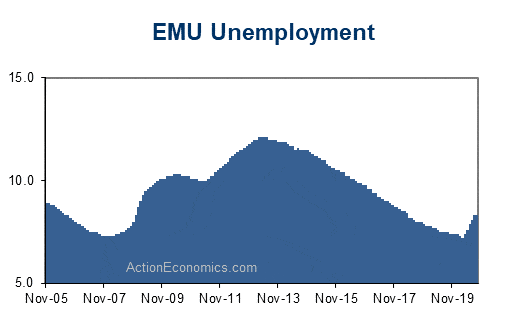
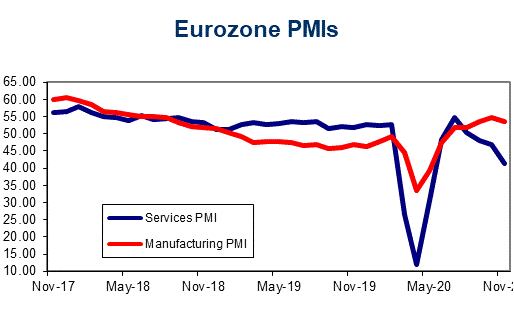
The first wave of the pandemic saw central banks and governments going into crisis mode and a large part of the preferential and subsidised loans to help companies afloat through the crisis. Measures like the subsidised wage scheme helped employers to keep on skilled staff through lockdowns, which in turn allowed a quick restart of activity once economies re-opened. That has been particularly effective for the manufacturing sector, especially as major export partners continue to expand and demand picked up pretty quickly again. It also helped to keep consumption underpinned and put a lid on unemployment.
Looking past the crisis, however, it is clear that governments as well as companies will have to pay back debt accumulated during the crisis and the ECB’s latest Financial Stability Report today highlighted not only that the strength in asset prices and renewed risk taking leave some markets increasingly susceptible to corrections, but also highlighted “rising fragilities among firms, households and sovereigns amid higher debt burdens”.
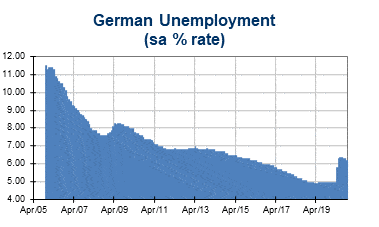
Some banks already struggle with the “hangover” of non-performing loans accumulated during the financial crisis and not only has the reduction of NPL levels come to an end banks are also likely to face a rise in non-performing loans as not all companies that have been kept alive with the help of crisis loans will survive the pandemic and not all households will be able to cope with the accumulated debt burden amid the rise in jobless numbers. The banking system as a whole has already started to increase provisions at the start of the pandemic, but developments are uneven across countries and at the same time the nightmare of the Eurozone sovereign debt crisis is also raising its head again.
According to the ECB “banks’ exposures to domestic sovereign debt securities have risen almost 19% in nominal amount – the largest increase since 2012”. This reflects to a large extend the sharp rise in sovereign debt issuance that was necessary to finance crisis measures, which was not only snapped up by the central bank, but also by banks. Again, cross-country differences, which were already large before the crisis, have become even more pronounced.
So far this hasn’t been a problem, thanks to the ECB’s asset purchase program, which is keeping demand for sovereign debt underpinned and spreads narrow, despite the sharp differences in debt burdens. The EU’s proposed recovery fund, which transfers some of the financing responsibility for the necessary recovery programs to EU level and thus allows for debt sharing to a limited extend, also helped markets to look past vulnerabilities at country level that are likely to increase going forward.
As long as that remains the case and spreads remain low, it is unlikely there will be a problem. However, developments highlight risks going forward once the focus of markets and investors moves away from immediate crisis measures and central banks in particular try to reign in stimulus measures. Joint financing of the proposed recovery fund may have been an important step, but it does not constitute a move towards general debt sharing the finalisation of a banking union.
For now the ECB’s PEPP program, which also removes the need to distribute purchases according to the ECB’s capital key is helping to gloss over the issue. The books have to be balanced though at the end of the program, which currently is set for June next year. However, while even if vaccine developments offer a glimmer of hope for a recovery next year and ECB officials seem to try and dampen speculation of additional stimulus, the above highlights that in Italy in particular, the risk of a negative feedback loop between sovereign and bank debt is still high and rising. So rebalancing the books won’t be easy and if nothing else, the ECB will push out the end date of the program. Indeed, unless there is a move to joint financing and debt sharing in the Eurozone, which currently seems unlikely, the temptation to push out the end of PEPP indefinitely will be high.
Author
Having completed her five-year-long studies in the UK, Andria Pichidi has been awarded a BSc in Mathematics and Physics from the University of Bath and a MSc degree in Mathematics, while she holds a postgraduate diploma (PGdip) in

















