European union imports disrupted by Chinese industry moving up the value chain


Since China’s accession to the World Trade Organisation (WTO) in December 2001, the European Union’s bilateral deficit1 with the country has widened from EUR 39 billion to EUR 292 billion in 2023 (Eurostat data). This is by far the largest deterioration recorded by the Old Continent with a trading partner, even though, as a whole, the EU’s trade balance with the rest of the world returned to surplus in 2023.2
The balance of trade between the two countries was already in China’s favour before the latter’s entry into the WTO, but it was to a very limited extent and mainly in segments of everyday consumer goods. In 2001, almost two-thirds (EUR 23.8 billion) of the EU’s bilateral deficit with China came from so-called “miscellaneous“ manufactured goods, a category that mainly includes low-value-added consumer goods (toys, travel goods and clothing). Initially, the deficit continued to widen – it tripled between 2002 and 2015 – before stagnating for almost a decade. Today, this category accounts for only a quarter of the EU’s bilateral deficit with China.
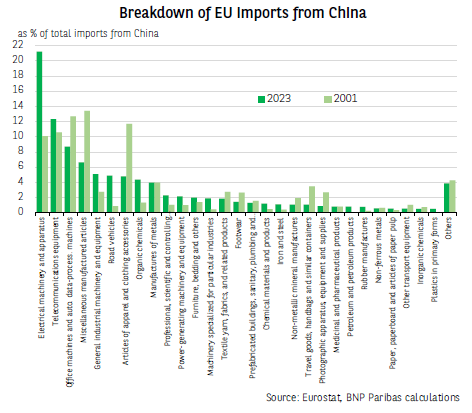
The improvement in the quality of Chinese exports has occurred in parallel with the development and expansion of the global production system. It has resulted over the years in an evolution of trade relations between the two blocs, which have moved from a complementarity to a more direct competition. The composition of EU imports from China reflects this evolution. Europeans still import consumer goods in abundance, but they now import more phones and motor vehicles: these two segments accounted for 17% of EU imports from China in 2023. In addition, the share of electrical machinery and equipment in EU imports from China has more than doubled in twenty years and now accounts for the majority of products imported from China (21% in 2023). It is in this segment that the EU’s bilateral deficit with China widened the most between 2001 and 2023, from EUR 3.5 billion to EUR 83.2 billion. This deterioration is mainly due to the sharp increase in imports of photovoltaic panels (+EUR 20.6 billion deficit) and electric batteries (+EUR 24.2 billion).3
Author
BNP Paribas Team
BNP Paribas
BNP Paribas Economic Research Department is a worldwide function, part of Corporate and Investment Banking, at the service of both the Bank and its customers.