EURNOK – Stay Long?

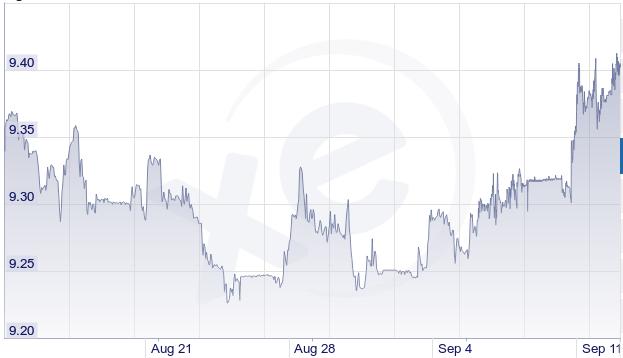
Following Monday's victory for Erna Solberg's Norwegian coalition of predominantly centre right political parties, and a campaign fought predominantly on issues surrounding taxation and Norway's energy sector, EURNOK has, interestingly, been climbing. Since Solberg's re-election, the Krone value of the Euro has climbed by just over NOK 0.10. Indeed, since the 26th of August the Euro has risen by just under NOK 0.18, nearly a 2% rise in just eighteen days. Moreover, the yearly picture, since February, shows a significant rise in the value of the Euro against the Norwegian currency. EURNOK currently trades almost 7% higher than its February level. It is of course true that this climb is emblematic of both the difficulties the Norwegian economy has faced of late, and the strongly improved sentiment surrounding the Euro in 2017, yet given that last two times the Euro has traded at similar levels to the Krone there has been a decline within the short to medium term, it might be time to start assessing whether current Euro strength in the EURNOK currency pair might soon show some signs of weakening.
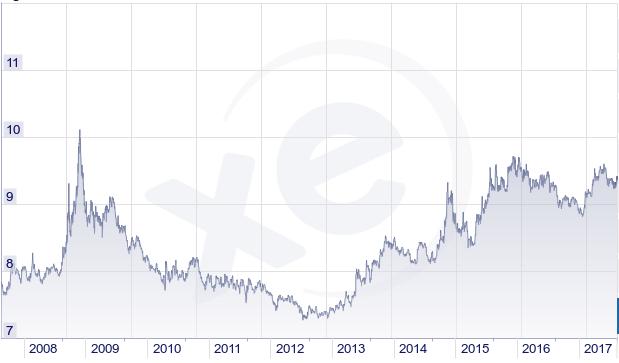
It is certainly, in present circumstances, a good idea to consider the last three times that EURNOK traded at levels similar to today's. In February 2016, the EURNOK exchange rate stood at almost NOK 9.70, whilst by April this figure stood at NOK 9.24. In August of 2016 ,the exchange rate returned to levels above NOK 9.40, yet by the end of September this figure was close to NOK 9.00, and the currency fell further, to NOK 8.85, before 2017's turn-around. Considering the longer term, at the end of December 2008 one Euro fetched just over NOK 10, yet by early February 2009 this figure stood at NOK 8.73, a 13% fall. Yet, although it is always risky to bet in favour of the sustaining of long-term highs, as Danske Bank recognise, near term downside potential for the currency pair may be more limited than might usually be expected, owing to below target Norwegian inflation, a cooling housing market, and the unlikelihood of an imminent Norwegian rate hike. Furthermore, although there may be some upside potential for the Norwegian currency with regards to a rising oil price, the likelihood is that supply increases will stifle most of any potential price surge for the commodity. Danske Bank do, however, recognise the long potential of the Krone, but suggest that medium-term movements will be concentrated in the NOK 9.25-9.45 range.
What is interesting is that since the election of a pro-market government for a second term; the first time this has happened in Norway since 1985; NOK has weakened by just over 1%. The broader analysis, whilst accepting that over the coming years Norway's conservative coalition is likely to encourage cuts, rate rises, and the growth of a leaner meaner post-“recessionary” Norway, must, however, include the fact that Solberg's government's role in the country's recent economic upturn, following the '14-'15 oil price plunge, includes record use of Norway's sovereign wealth fund to push back against strong market headwinds. Solberg's is a government that has shown itself very much willing to sweeten the medicine, and this must be taken into account when considering the Krone's medium term strength. Furthermore, recent data from Norway has suggested that there might yet be trouble lurking for Solberg's second term administration. August's CPI data, for instance, was lower than expected, falling to 1.3%, from 1.5%, rather than climbing to 1.7%, and given the Norwegian government's desire to boost inflation, such data is likely to encourage a looser monetary policy that will be Euro positive in the EURNOK pair. Indeed, should September's data, due October 10th, similarly disappoint, regardless of the pro-business outlook of the returned Norwegian government, EURNOK might just start to test levels last seen in 2015, of near NOK 9.70.
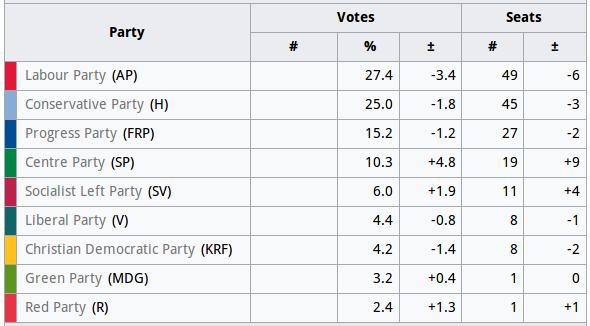
Indeed, with regards to Norway's recent election, despite the market positive potential of a continued conservative government, Solberg's populist approach, her willingness to significantly loosen the purse strings, and her coalition's less than firm grasp on power, given its potential political instability, lessens any NOK positive sentiment that may have been likely to see the currency strengthen against the Euro.
The Longer Term Picture

Despite the present outlook for the Norwegian Krone, not least in the EURNOK pairing, being essentially moderately downbeat, there appears to be no major reason to believe that the currency will suffer a dramatic further slump, and although very NOK negative scenarios may see a EURNOK exchange rate of NOK 10 as a possibility, such a rate would, historically, and given present Eurozone growth levels, be extremely unlikely to be anything more than an unusual peak. What seems far more likely is that EURNOK is likely to trade in or around current levels, with a possible testing of the 9.70 mark, until the Krone starts to appreciate once again. Thus, although the NOK long position is crowded, there is certainly an argument that if you've already taken such a position, recent Euro highs may provide an opportunity to double down. Granted, analysts such as Robin Winkler of Deutsche Bank, suggest that the EURSEK pair offers more interesting opportunities for short-term gain in the Scandinavian market, but this ought not mean that EURNOK gets pushed to the back burner. Many analysts appear to believe that the important EURNOK 9.00 mark will be tested, and perhaps broken within the next twelve months, a possibility very much worth keeping an eye on. Long on the Krone at present Euro highs may not be the most exciting trade, but it is one that appears highly likely to ultimately bear fruit.
Author
Oisin Breen
Accendo Markets

















