EUR/CHF stalks 1.20 - breakout, shakeout or correction?


EUR/CHF sheepishly ‘broke’ above 1.20 today for the first time since Jan 2015. A level which likely still haunts many trading floors, we ponder whether it will prove to be a breakout, shakeout or the pre-lude for a correction.
When SNB unpegged the Swiss franc, it caused outright havoc for trading floors the world over. Despite convincing markets in the days leading up to the carnage they wouldn’t abandon the peg, SNB did just that. Traders, who’d become accustomed to 1.20 being the ‘floor’ for EUR/CHF, were treated to a near-20% drop beneath 1.20 in around 15-minutes. It’s the kind of situation one remembers what they were doing at that moment in time, years from now.
The point we’re building up to here is that markets have a memory, which contributes towards support and resistance levels in the future. And when the memory is so deeply embedded into traders’ minds, it makes the return to 1.20 particularly interesting. So, let’s weigh a few things up here.
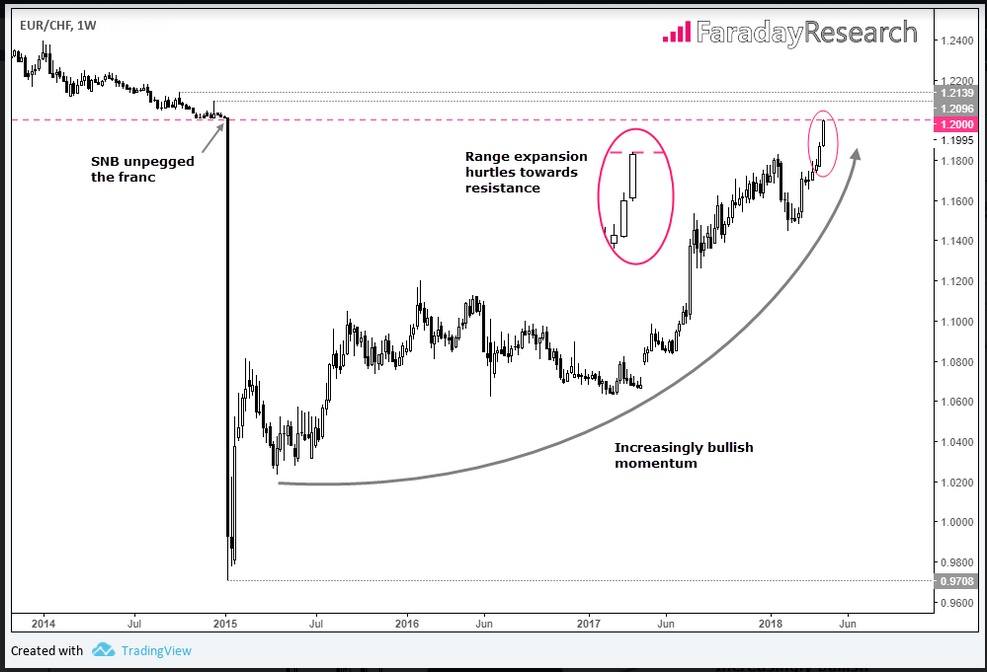
The trend structure on the weekly chart screams bullish. With increasingly bullish momentum and range expansion candles, the bullish trend doesn’t appear the slightest bit rattled by 1.20. Furthermore, we’re yet to see any signs of exhaustion on price action. From this alone we’d expect prices to eventually break higher from here, but that’s not to say the potential for at least a correction could be nearing.
On the daily chart, EUR/CHF had stalled just beneath 1.20 and formed a narrow-range session as of yesterday’s close. Price is accelerating away from its 50-day average to underscore that bullish momentum is on the increase, but is this sustainable? Some metrics suggest not.
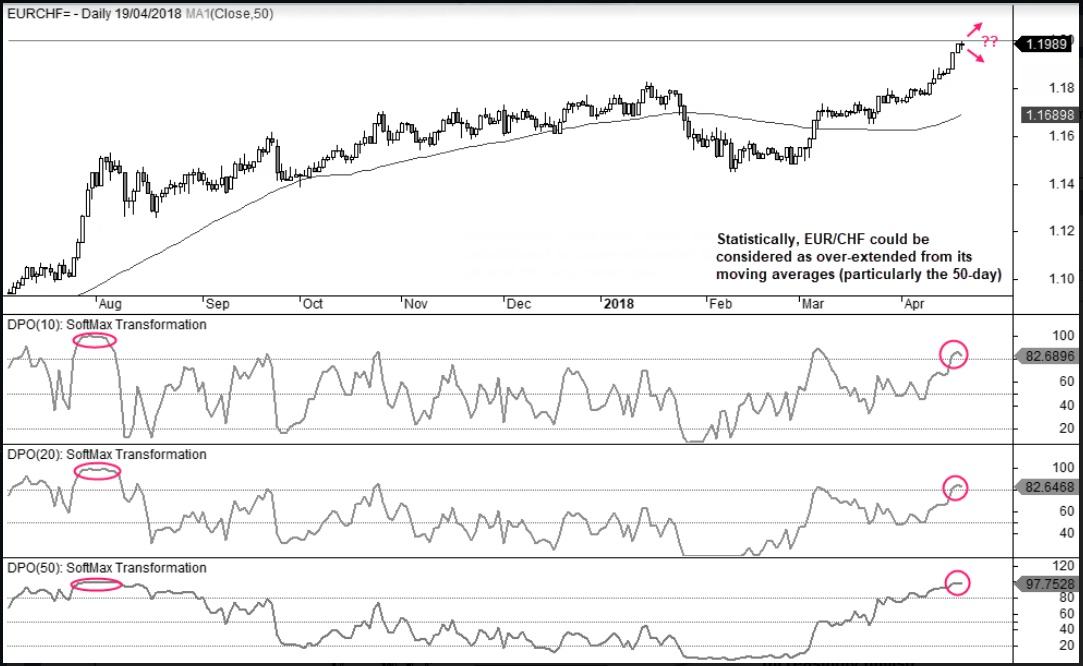
The indicators below the chart represent a %DPO (detrended price oscillator) which measure the percentage between closing price and moving average. Considered a momentum indicator, it can also assess overbought / oversold conditions. However, as the traditional DPO is an unbounded indicator (not bound within a fixed range) we modified it with a statistical tool called the SoftMax function to perform two basic tasks; bound the indicator between 0-100 and squash outlier data beyond 3 standard deviations. This makes it easier to identify potential extreme values in a quantified method.
Using 10, 20 and 50-day modified DPOs we can see that all three are nearing extremes to suggest EUR/CHF could be overbought on a near, medium and longer-term basis. At 97.8, the 50-DPO is the most extreme and very close to moving beyond its 3rd standard deviation. Or simply put, the probability of EUR/CHF reverting to its 50-day average is increasing. That all three DPOs are near extreme levels around 1.20 may well be music to bearish ears. However, we should also point out that this is merely an indication of overbought and not a market-timing tool. Price action remains king, so a break to new highs in line with dominant momentum is of interest for bullish setups.
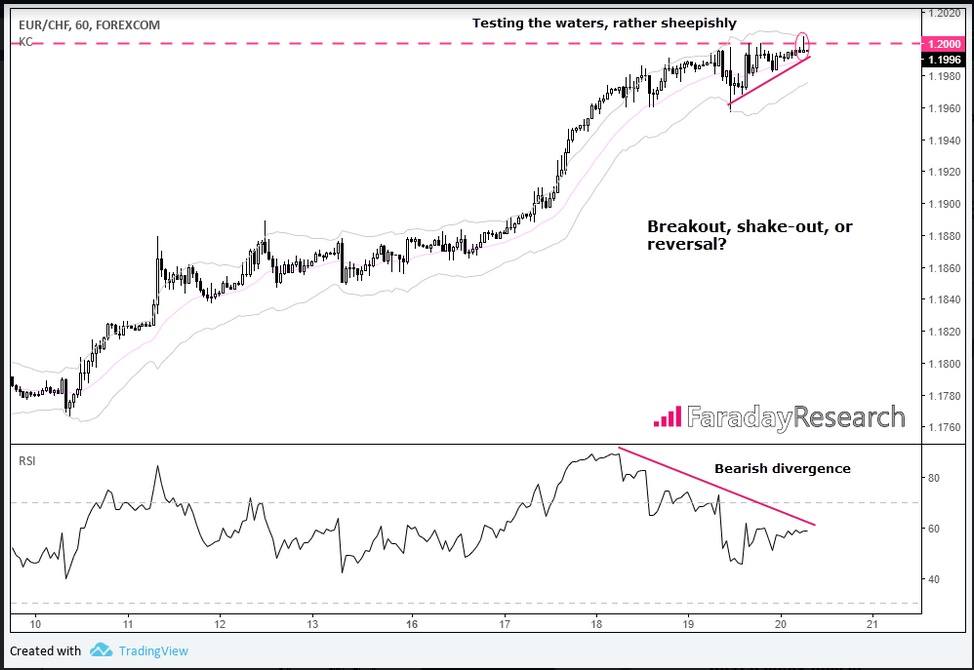
Due to the significance of 1.20, we could well see some whipsaws or shakeouts. We can already see how EUR/CHF sheepishly crept up to 1.20 and tried to sneak over it when it thought nobody was looking. Still, an ascending triangle could pave the way for a break higher, unless the rising trendline is broken of course. But until a break is seen, we prefer to watch. And if we see bearish momentum return we’ll probably just grab the popcorn and let price action tell us if it will be a minor correction, or something larger and more sinister like our modified DPO’s are hinting.
Author
Matt Simpson, CFTe, MSTA
CityIndex
Matt Simpson is a certified technical analyst who combines charts and fundamentals to generate trading themes.