EUR/USD Weekly Forecast: The US labor market is not tight, now what?
- The Nonfarm Payrolls report resulted in a game-changer after a hawkish Federal Reserve.
- US President Donald Trump announced massive, widespread tariffs that spurred risk aversion.
- EUR/USD trimmed half of its weekly losses, aims to recover its bullish poise.


The EUR/USD pair bottomed at 1.1391 on the first day of August, its lowest in over a month. The US Dollar (USD) found legs regardless of the market sentiment, maintaining its positive momentum throughout quite a busy week, but finally gave up on Friday after dismal United States (US) data. The pair finally settled at around 1.1550, still holding onto substantial weekly losses.
Trade war back and forth
The US and the European Union (EU) reached a trade deal that sets a 15% tariff for most exports into the US, as well as calling for EU investments in various American sectors. A 50% levy will remain in place for EU exports to the US on steel, aluminium and copper. Additional details are still missing, and European Commission President Ursula von der Leyen noted such levies are subject to reciprocal tariffs, although without providing much detail on whether or when the EU would announce them.
The deal was widely criticised by European leaders, with German Chancellor Friedrich saying it will cause "considerable damage" and French Prime Minister François Bayrou calling it "a dark day" for the EU.
Mid-week, US President Donald Trump announced a 50% levy on all Brazilian imports into the US, a “punishment” to the lefty government. The White House also announced a universal 50% tariff on imports of semi-finished copper products and copper-intensive derivative products.
Finally, the August 1 deadline came into effect on Friday, leading to widespread fresh tariffs. With neighbour Mexico, Trump agreed to a 90-day extension in levies for additional negotiations but hit Canada with a 35% tariff. Stock markets collapsed ahead of the weekly close, reflecting the market’s concerns about the potential effect of this decision on global economic progress.
Federal Reserve’s rebellion
Also mid-week, the Federal Reserve (Fed) announced its decision on monetary policy. As widely anticipated, policymakers left the benchmark interest rate unchanged, floating between 4.25% and 4.50%. The decision, however, included a surprise. For the first time in decades, there were two dissenters: Governors Christopher Waller and Michelle Bowman voted to reduce borrowing costs.
Nevertheless, Chair Jerome Powell explained that such a decision resulted from the persistent uncertainty related to the tariffs’ impact on inflation. Powell also explained that with inflation still above the Fed’s 2% goal and the labor market still tight, the central bank should keep rates at their current levels. The decision, according to Powell, leaves policymakers well-positioned to respond in a timely way.
Powell gave no hints on a potential interest rate cut when they meet in September, preferring to stick to his wait-and-see stance.
The decision triggered another tantrum from President Trump, who has long been demanding lower rates. He used social media to attack the Fed’s head, calling Powell “Too Late,” and claiming his decision costs billions of dollars.
Jerome “Too Late” Powell, a stubborn MORON, must substantially lower interest rates, NOW. IF HE CONTINUES TO REFUSE, THE BOARD SHOULD ASSUME CONTROL, AND DO WHAT EVERYONE KNOWS HAS TO BE DONE!
Data-packed week ending with a bang
European data released these days showed the Old Continent is coming out of the woods, helped by the European Central Bank’s (ECB ) massive interest rate reduction.
Germany released the preliminary estimate of the Q2 Gross Domestic Product (GDP), which showed the economy contracted by 0.1% in the three months to June after advancing 0.4% in the previous quarter. The country also released the preliminary estimate of the July Harmonized Index of Consumer Prices (HICP), which rose at an annualized pace of 1.8%, easing from the 2% posted in June. Retail Sales in the country were up 4.9%, almost doubling the previous 2.6% advance.
The EU flash Q2 GDP posted a 0.4% quarterly gain, better than the 0.2% expected, while the annual advance was 1.4%, beating estimates of 1.2%. On a negative note, the HICP held at 2% YoY in July according to preliminary estimates, against an expected 1.9%. The core annual reading also remained unchanged at 2.3%.
The US calendar was packed with employment-related data, ahead of the almighty Nonfarm Payrolls report. But the country also released the flash estimate of the Q2 GDP, which showed the US economy grew at an annualized rate of 3%, much better than the 0.5% decline from the first quarter and better than the 2.4% expected. The upbeat figure fueled demand for the USD, which was later exacerbated by a hawkish Fed.
Regarding employment figures, the June Job Openings and Labor Turnover Survey (JOLTS) indicated that the number of job openings on the last business day of June stood at 7.43 million, below the 7.77 million openings (revised from 7.76 million) recorded in May and came in below the market expectation of 7.55 million.
The ADP Employment Change report released on Wednesday was more encouraging, as it showed that the private sector added 104,000 new job positions in July, while the June loss was revised to 23,000 from the previous estimate of -33,000. Finally, the Challenger Job Cuts showed US-based companies announced 62,075 job cuts in July, compared with almost 25,900 a year earlier. The reading was well above the 47,999 announced in June, as is the second-highest for a July in the past decade.
The NFP finally came out, and all hell broke loose: the country added a measly 73,000 new positions in July, while the June reading was downwardly revised to 14,000 after previously reporting 147,000. In fact, revisions showed roughly 260,000 fewer job positions than previously estimated in the last few months.
Additionally, the Unemployment Rate rose to 4.2% from 4.1% in July, as expected, while the Labor Force Participation Rate ticked down to 62.2% from 62.3%. Finally, annual wage inflation, as measured by the change in the Average Hourly Earnings, rose to 3.9% from 3.8%.
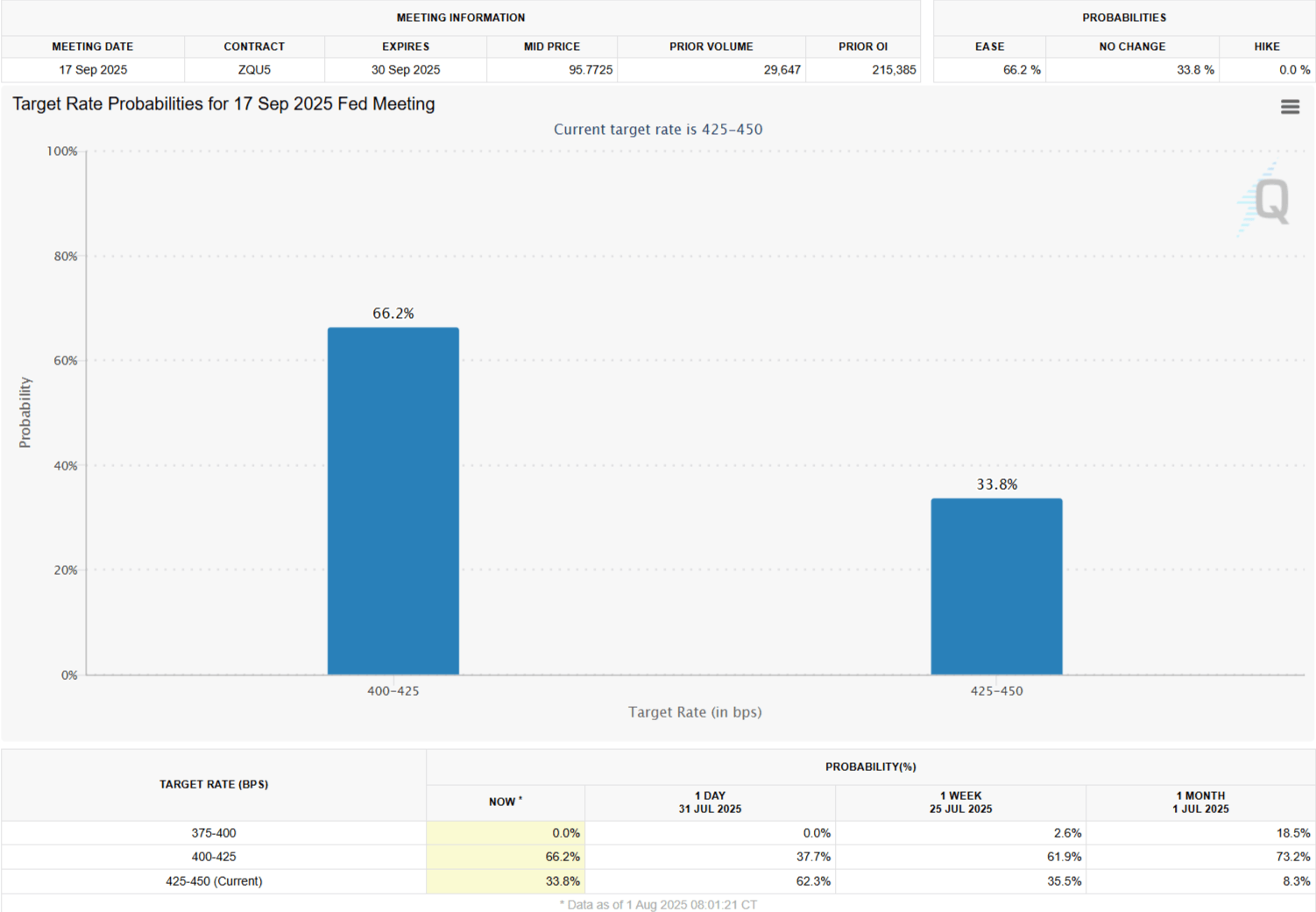
The news put the US Dollar in sell-off mode. Following the Fed’s monetary policy announcement, speculative interest ran to bet on an on-hold decision in September, with the odds for a no-change surging to roughly 60%. However, the awful monthly employment report flipped the sentiment, and market players now believe there is more than a 66% chance of a rate cut at the upcoming Fed meeting, according to the CME FedWatch Tool.
It is worth adding that, ahead of the weekly close, the US also published the July ISM Manufacturing Purchasing Managers Index (PMI) that unexpectedly contracted to 48 from the 49 posted in June, also missing expectations of 49.5. The Michigan Consumer Sentiment Index, in the meantime, was downwardly revised to 61.7 in July, following a preliminary estimate of 61.8 while below the 62.0 anticipated.
By the end of the week, stocks retain substantial tariff-inspired losses, reflecting tariff-related concerns. Regardless of the loosening labor market, the risk of higher inflation remains the same. With that in mind, the Fed may well hold back its fire once again in September.
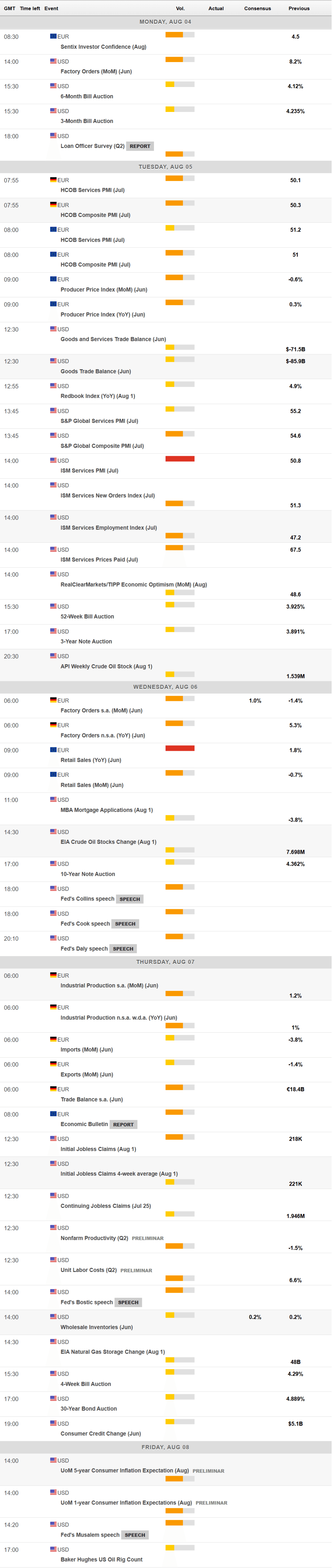
In the upcoming days, the macroeconomic calendar will have little to offer. The most relevant figures will be the US July ISM Services PMI and the EU June Retail Sales. That said, the trade war will likely retake centre stage.
EUR/USD technical outlook
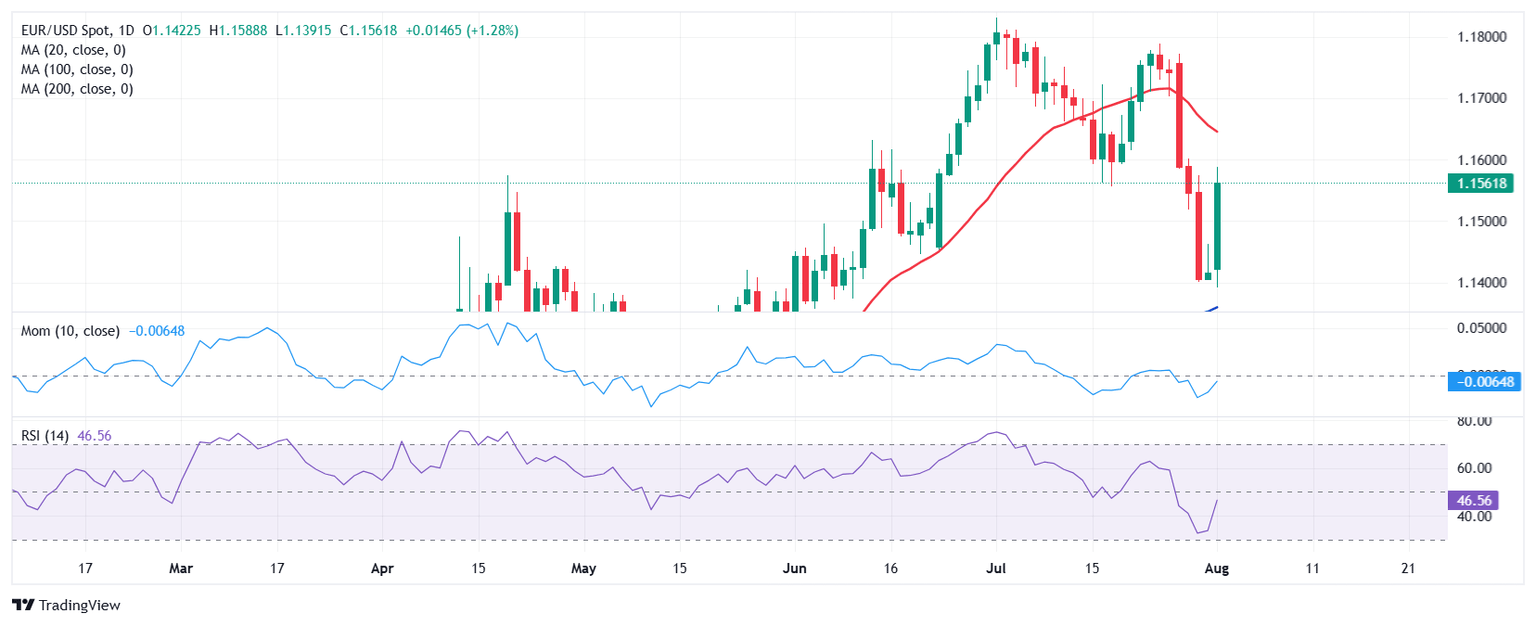
The weekly chart for the EUR/USD pair shows it trimmed half of its losses, yet sellers are still around. The pair bounced sharply after testing a bullish 20 Simple Moving Average (SMA) at around 1.1390. At the same time, the 100 SMA timidly advances above a directionless 200 SMA, both far below the shorter one. Technical indicators in the meantime retain sharp downward slopes, although holding above their midlines, not enough to anticipate a steeper decline ahead.
EUR/USD bounced from near a bullish 100 SMA on the daily chart, but it remains below a bearish 20 SMA, providing dynamic resistance near 1.1640. Finally, technical indicators have bounced sharply from near oversold readings, maintaining their upward slopes but within negative levels.
A recovery above the aforementioned 1.1640 region should lead to a test of the 1.1700 mark, while once above the latter, the recovery could continue toward the yearly high at 1.1830. The main support is the 1.1470 price zone, with renewed selling interest below it exposing the recent low in the 1.1390 area.
Tariffs FAQs
Tariffs are customs duties levied on certain merchandise imports or a category of products. Tariffs are designed to help local producers and manufacturers be more competitive in the market by providing a price advantage over similar goods that can be imported. Tariffs are widely used as tools of protectionism, along with trade barriers and import quotas.
Although tariffs and taxes both generate government revenue to fund public goods and services, they have several distinctions. Tariffs are prepaid at the port of entry, while taxes are paid at the time of purchase. Taxes are imposed on individual taxpayers and businesses, while tariffs are paid by importers.
There are two schools of thought among economists regarding the usage of tariffs. While some argue that tariffs are necessary to protect domestic industries and address trade imbalances, others see them as a harmful tool that could potentially drive prices higher over the long term and lead to a damaging trade war by encouraging tit-for-tat tariffs.
During the run-up to the presidential election in November 2024, Donald Trump made it clear that he intends to use tariffs to support the US economy and American producers. In 2024, Mexico, China and Canada accounted for 42% of total US imports. In this period, Mexico stood out as the top exporter with $466.6 billion, according to the US Census Bureau. Hence, Trump wants to focus on these three nations when imposing tariffs. He also plans to use the revenue generated through tariffs to lower personal income taxes.
Premium
You have reached your limit of 3 free articles for this month.
Start your subscription and get access to all our original articles.
Author
Valeria Bednarik
FXStreet
Valeria Bednarik was born and lives in Buenos Aires, Argentina. Her passion for math and numbers pushed her into studying economics in her younger years.