EUR/USD Weekly Forecast: Optimism not enough to take the US Dollar down
- Inflation in the United States and the Euro Zone was not as hot as anticipated, relief returned to financial markets.
- United States ADP survey and Nonfarm Payrolls report in the docket next week.
- EUR/USD corrective advance could become more relevant if the pair advances beyond 1.0700.

The EUR/USD plummeted to 1.0487 on Wednesday, its lowest since early March, as investors continued to seek refuge in the US Dollar. Financial markets were in risk-averse mode following central banks’ monetary policy decisions from earlier this month, as despite holding fire, most policymakers reaffirmed the inflation risks remain high and rates should stay higher for longer to maintain price pressures under control.
The absence of relevant news throughout the first half of the week maintained the USD on the bullish side, but extreme overbought conditions and better-than-anticipated inflation-related figures put near-term pressure on the Greenback.
Not-so-hot inflation
Germany published the preliminary estimates of the September Harmonized Index of Consumer Prices (HICP) on Thursday, which resulted up by 4.3% YoY, below the 4.5% anticipated by market participants, and much better than the 6.4% posted in August. The Euro Zone HICP in the same period was also lower than anticipated. The European Central Bank's (ECB) preferred gauge of inflation rose by 4.3% YoY in September, down from 5.2% in August, while the core annual HICP rate printed at 4.5% against the 4.8% expected and below the previous 5.2%.
Across the pond, the United States (US) released the August Personal Consumption Expenditures (PCE) Price Index on Friday, the Federal Reserve's (Fed) favorite inflation reading. According to the US Bureau of Economic Analysis (BEA), the annual core PCE price index rose by 3.9%, down from the July rate of 4.3%, while the monthly increase printed a modest 0.1%.
Speculative interest was concerned overheating price pressures could lead to more aggressive central banks’ actions in the near future, which, in turn, fuels the odds of a steep economic setback.
Softer-than-anticipated inflation-related figures point in the opposite direction. Central banks could maintain the wait-and-see stance recently adopted while holding one more rate hike in reserve but hoping not to use it.
The macroeconomic calendar will offer some interesting figures next week, starting with the September US ISM Manufacturing PMI. S&P Global will also release the September Manufacturing PMIs for the EU and the US. Later in the week, S&P Global will publish the Services and Composite PMIs for both economies, while the US will unveil the official ISM Services index.
Additionally, the EU will publish August Retail Sales and the Producer Price Index (PPI) for the same month. Across the pond, the focus will shift to employment, as the US will publish the September ADP survey on private job creation ahead of the Nonfarm Payrolls (NFP) report for the same month. The latter is expected to show the country added 150K new positions in September, while the Unemployment rate is foreseen easing to 3.7% from 3.8% in August.

EUR/USD technical outlook
The better market mood weighed on the American currency ahead of the weekly close, although EUR/USD closed in the red for the eleventh straight week. The pair trades around 1.0580 despite the renewed optimism, as the US economic resilience skews the scale in the USD favor.
From a technical point of view, the weekly chart suggests additional declines are likely, as EUR/USD remains below bearish moving averages, with the 100 Simple Moving Average (SMA) providing dynamic resistance at around 1.0720. Technical indicators, in the meantime, keep heading south below their midlines, with the Relative Strength Index (RSI) indicator currently at 37.
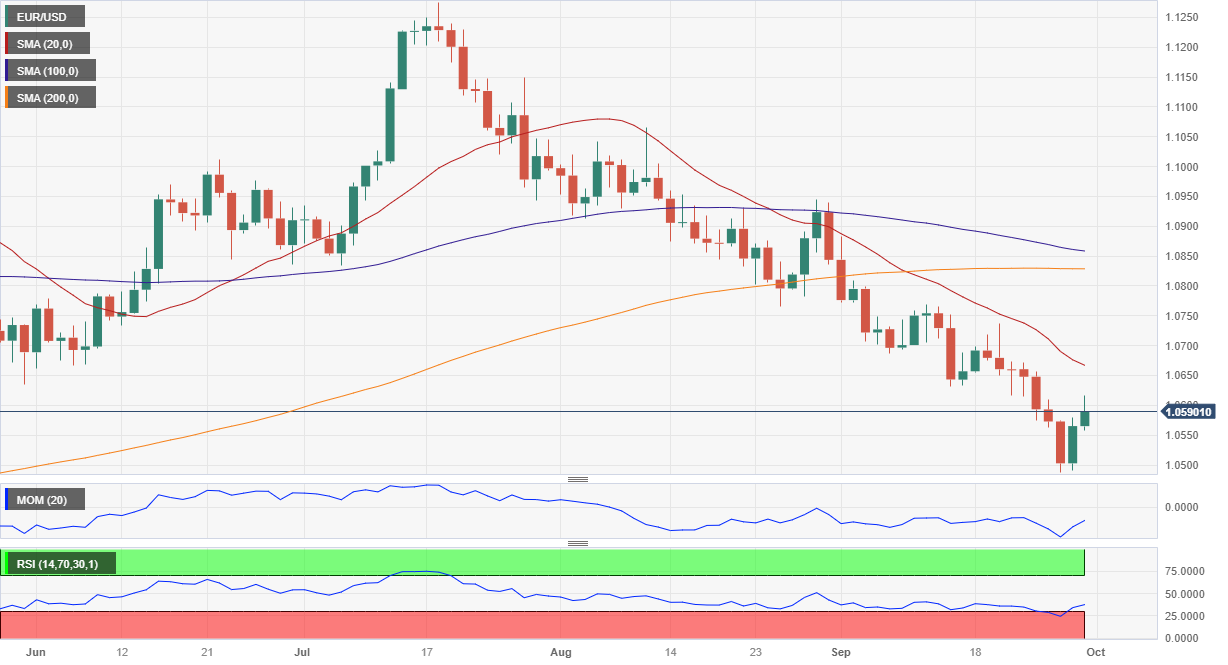
The daily chart shows bears retain control, with the ongoing advance understood as a mere correction. The 20 SMA offers a sharply bearish downward slope far below the longer moving averages and provides dynamic resistance at 1.0665. At the same time, the Momentum indicator resumed its decline within negative levels, although it remains stuck within familiar levels. Finally, the RSI corrected extreme oversold conditions but lost upward strength and currently consolidates at around 35.
The 1.0480/90 region provides support ahead of the 1.0400 threshold. Once below the latter, EUR/USD would be en route to test 1.0340, a strong static support area. Sellers, on the other hand, are initially aligned around 1.0620 and 1.0700. Gains beyond the latter seem unlikely, yet a corrective impulse could see the pair trading as high as 1.0840 before it resumes its bearish trend.
EUR/USD sentiment poll
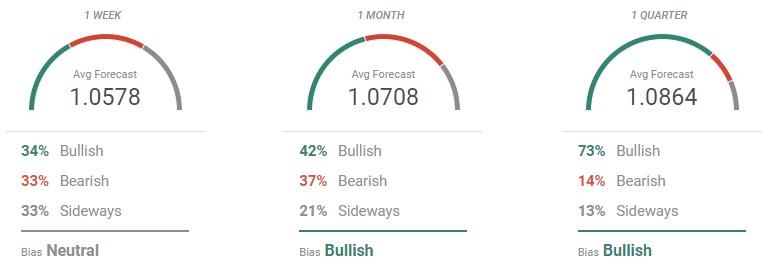
The FXStreet Forecast Poll suggests EUR/USD could soon confirm an interim bottom. The pair is seen neutral in the near term but bullish in the monthly and quarterly perspectives. On average, the pair is seen around 1.0700 in one month, extending the recovery to the 1.0860 region in the three-month view.
The Overview chart, however, indicates bears are likely to retain control. The three moving averages under study head firmly lower, standing at fresh multi-month lows. Furthermore, lower lows are now likely in the monthly and quarterly views, with increased odds for a break below 1.0400. At the same time, the number of those looking for levels at 1.10 or above decreased sharply, with a new ceiling in the 1.0900/1.1000 price zone.
Author

Valeria Bednarik
FXStreet
Valeria Bednarik was born and lives in Buenos Aires, Argentina. Her passion for math and numbers pushed her into studying economics in her younger years.