EUR/USD Weekly Forecast: Losses below the 1.1000 level on the cards amid Eastern European war
- War in Eastern Europe spurred risk aversion to the benefit of the greenback.
- Europe and the US maintain economic progress in the first quarter of 2022.
- EUR/USD is poised to resume its decline towards the critical 1.1000 level.


The EUR/USD pair fell on Thursday to 1.1105, its lowest since June 2020, recovering just modestly ahead of the weekly close. The American dollar soared on the back of risk aversion as Russia invaded Ukraine, launching a massive military attack. Moscow took control of Chernobyl by the end of Thursday and neared Kyiv by Friday. According to US intelligence, the main goal is to depose Ukrainian President Volodymyr Zelenskyy and impose a leader favorable to the Russian regime.
The Occidental world has condemned the act of war and imposed multiple financial sanctions on Russian people and institutions, but so far, those sanctions have had no impact on President Vladimir Putin’s resolve to take over Ukraine.
Why does Ukraine matter?
The Ukrainian territory was part of the Soviet Union until 1991, when the latter was dissolved. In 2014, a revolution against a pro-Russian president ended with Moscow successfully invading and annexing the Crimean Peninsula. Despite being known as an emerging country, Ukraine is the second-largest country by land area in Europe, with extensive fertile farmlands that make it one of the largest grain exporters in the world. But the country also has large reserves of nickel, copper, iron, neon, and other high-ranked commodities.
President Zelenskyy has led the country steadily in a programme of westernization and asked to join NATO – a red line for President Putin, who believes the organization is led by the US with the sole aim of limiting Russian power. Taking over Ukraine is a way of rebalancing the global equilibrium after the disastrous outcome of the cold war for the East, plus recovering multiple resources, including nuclear ones.
At the time of writing, Russian troops are in Kyiv although it may take them a few days to finally take control of the country. With that in mind, financial markets are likely to continue trading alongside sentiment.
Central banks on the background
With all eyes on the conflict, the market seems to have temporarily forgotten that inflation is hitting both Europe and the US and that central banks may need to tighten their monetary policy sooner and at a faster pace than planned.
European Central Bank member of the governing council Klass Knot said he expects the ECB to raise rates in the last quarter of this year, adding that he supports winding down the asset purchasing program as quickly as possible. Across the pond, US Federal Reserve member Raphael Bostic stated that he is open to four or more rate hikes this year if inflation persists. There is one thing policymakers from around the globe converge on: Ukrainian developments could add risk to the economic outlook and hurt growth.
Economic data temporarily ignored
Market players paid little attention to macroeconomic figures released in the last few days, although it is worth noting that, according to February Markit flash PMIs, economic expansion remained firmly in place. Confidence indicators from Germany and the EU posted upbeat readings, in line with the ongoing recovery. The EU confirmed January inflation at 5.1% YoY, while the US core PCE Price Index jumped to 5.2% YoY in January. Finally, US Durable Goods Order surged by 1.6% in the same month, much better than anticipated.
The US reported the second estimate of Q4 Gross Domestic Product, which was upwardly revised to 7% as expected. German GDP in the same period was reported at -0.3%, better than the -0.7% expected.
The next week will bring Retail Sales and inflation updates from Germany, which will publish the preliminary estimate of its February Consumer Price Index. The EU will also publish the preliminary estimate of its February inflation data and January Retail Sales.
The US calendar will offer the official ISM PMIs and February employment figures. The ADP report is expected to show that the private sector recovered 328K positions after losing 301K in the previous month. On Friday, the country will publish the Nonfarm Payrolls report, expected to show the country added 400K new jobs in the month. The Unemployment Rate is expected to have contracted to 3.9%.

EUR/USD technical outlook
The EUR/USD pair is trading around 1.1230 and is poised to resume its long-term slide after completing its corrective advance. The weekly chart shows that sellers appeared around a mildly bearish 200 SMA at the beginning of the week, to later defend the upside around a firmly bearish 20 SMA, which stands below the longer ones. Technical indicators, in the meantime, remain within negative levels, and the RSI resumed its decline, reflecting increased selling interest.
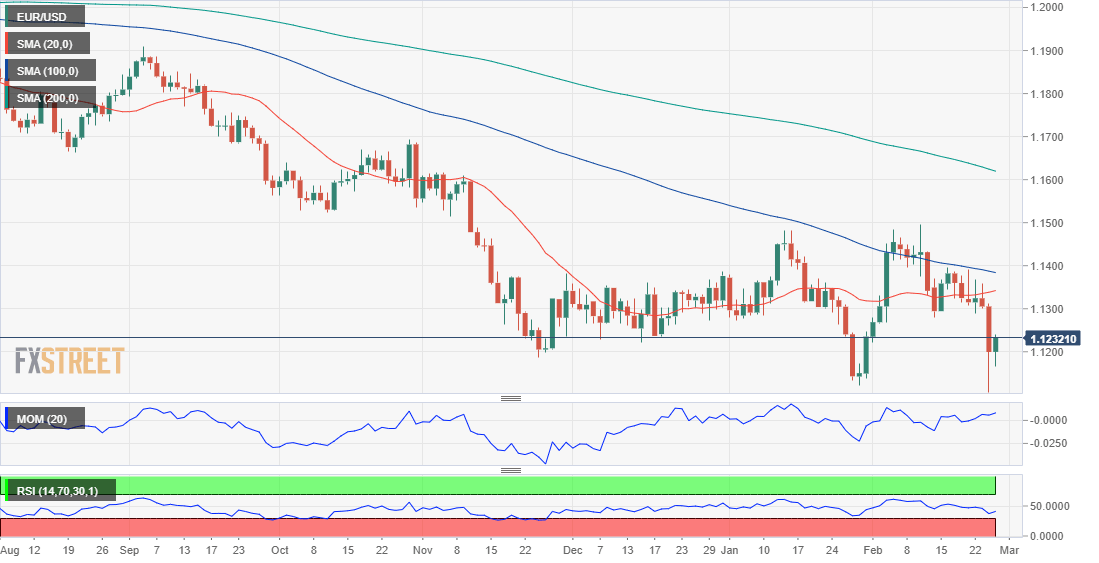
The risk is also skewed to the downside according to technical readings on the daily chart, as the pair is developing well below its moving averages, with the 20 SMA currently at around 1.1350, directionless below firmly bearish longer ones. At the same time, technical indicators hold near oversold readings, lacking directional strength and reflecting the ongoing consolidation.
The immediate support level is the fresh 2022 low of 1.1105, and a break below it exposes the psychological 1.1000 figure. Once below the latter, the pair can extend its slide to 1.0920 in the next few days. A recovery beyond the 1.1300 figure, on the other hand, could take off some of the bearish pressure and favor a corrective advance towards 1.1360 first and the 1.1440 region later.
EUR/USD sentiment poll
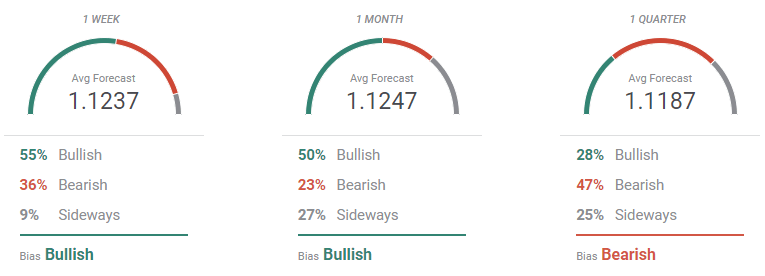
According to the FXStreet Forecast Poll, the EUR/USD pair could hold ground above the 1.1200 level, but it is expected to turn bearish in the quarterly perspective. In the near term, bulls are a majority but fall to 28% in the longer view, with bears in fact at 47%. The pair is then seen on average at 1.1187.
The Overview chart shows that, in the weekly and monthly views, the pair is seen contained between 1.1000 and 1.1400 for the most, but in the quarterly perspective most targets stand between 1.10 and 1.12, with a wider deviation to the upside. Nevertheless, the three moving averages maintain their modest bearish slopes, as lower lows have come to play.
Premium
You have reached your limit of 3 free articles for this month.
Start your subscription and get access to all our original articles.
Author
Valeria Bednarik
FXStreet
Valeria Bednarik was born and lives in Buenos Aires, Argentina. Her passion for math and numbers pushed her into studying economics in her younger years.