EUR/USD Weekly Forecast: Middle East crisis out, Fed’s leadership in
- Easing Middle East tensions overshadowed by Trump’s threat to fire Fed’s Powell.
- US employment and European inflation take centre stage in the upcoming days.
- EUR/USD holds to substantial gains, hinting at higher highs ahead.


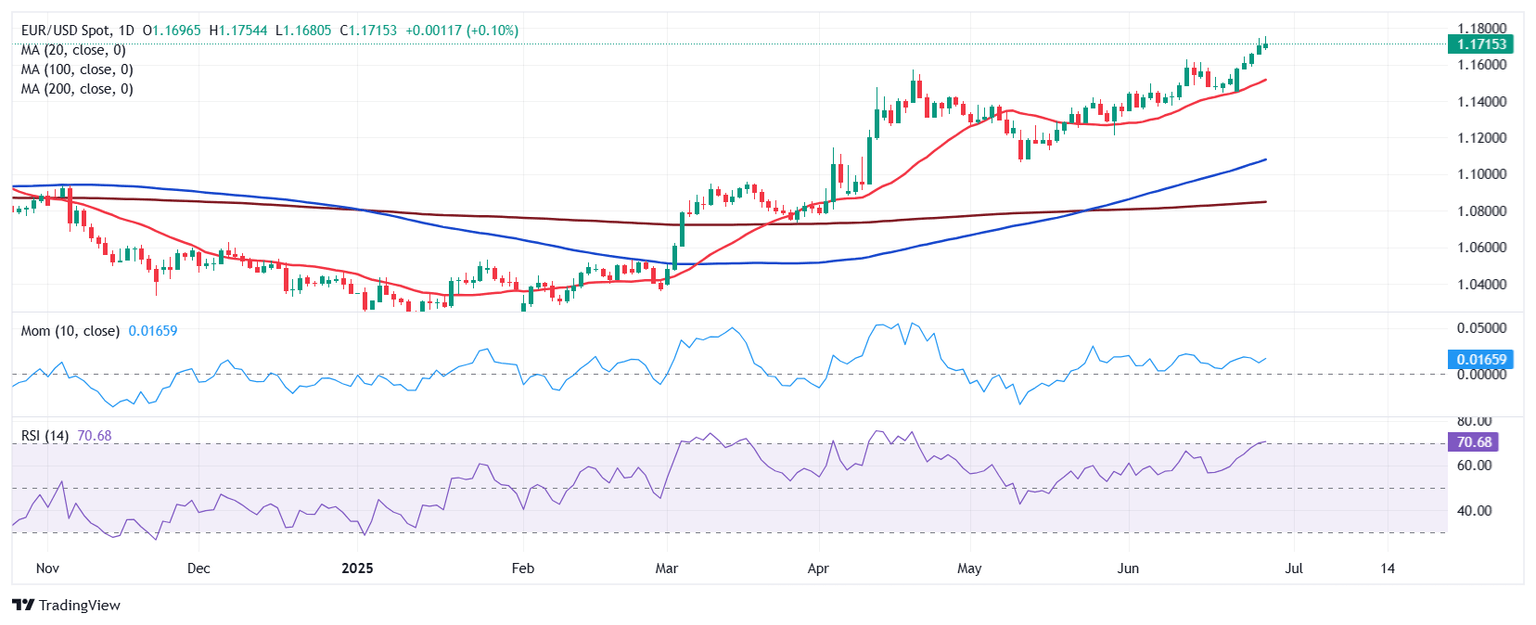
The EUR/USD pair peaked at 1.1754 in the final week of June, its highest since September 2021. It settled around the 1.1720 area, preserving its positive momentum as Friday came to a close.
Middle East ceasefire
The US Dollar (USD) kicked off the week on a strong footing, soaring higher against most major rivals amid the escalation of the Middle East conflict. Over the weekend, the United States (US) launched a massive attack on Iranian uranium sites, with President Donald using social media to report they have “obliterated” the nuclear program. Tehran retaliated by launching missiles at US military bases in Qatar, fueling panic among market participants.
Late on Monday, however, President Trump announced a ceasefire between Iran and Israel, after roughly two weeks of back-and-forth missile attacks. Financial markets quickly turned optimistic despite the initial doubts about a potential truce. Still, as the conflict actually cooled, risk appetite prevailed. As a result, Crude Oil prices plunged, global stocks rallied, and the USD fell.
Federal Reserve’s Powell semi-annual testimony
The Greenback remained under pressure after Federal Reserve (Fed) Chairman Jerome Powell testified on monetary policy before Congress. In his semi-annual appearance, Chief Powell cooled down expectations for a rate cut in July amid uncertainty about the effect of tariffs on inflation. At the same time, Powell reiterated the economy remains solid, adding the US faces no recession. Finally, Powell noted that President Trump's demands for a rate cut have no impact on the Fed’s policy.
That triggered Trump’s rage. Following the NATO Heads of State and Government Summit in the Netherlands, he claimed: "We have no inflation. We have a tremendous economy. Hundreds of billions of dollars of tariff money is pouring in. Factories are being built," immediately announcing he is already looking for Powell’s replacement and adding "I think he is a very stupid person, actually," referring to the Fed’s Chair. Trump's comments further fueled the USD sell-off, resulting in EUR/USD reaching the 1.1740 price zone.
Further pressure on the USD came from the release of the Personal Consumption Expenditures (PCE) Price Index on Friday. Annualized inflation in the US, as measured by the PCE, rose to 2.3% in May from 2.2% in April (revised from 2.1%), while core annual PCE ROSE 2.7% in the same period, surpassing the expected 2.6% increase. The EUR/USD pair reached the aforementioned multi-year high afterwards.
Growth and employment under scrutiny
US data released throughout the week was overall discouraging, as the Q1 Gross Domestic Product (GDP) was confirmed at -0.5%, worse than the preliminary estimate of -0.2%. Additionally, the May Goods Trade Balance posted a larger-than-anticipated deficit of $96.6 billion. Also, the S&P preliminary estimate of the June Purchasing Managers’ Index (PMI) held within expansionary territory, but came in below the final May readings. The Composite PMI printed at 52.8 following the previous 53.
Across the pond, the Hamburg Commercial Bank (HCOB) released the Eurozone PMIs for the same month. The figures brought little surprise, as manufacturing output showed no progress, with the index resulting at 49.4, matching the previous reading, while the Services PMI posted 50.0 following the 49.7 from the previous month. The Composite PMI remained unchanged at 50.2.
In the upcoming days, the macroeconomic calendar will be a bit busier. Germany will release May Retail Sales and the preliminary estimate of the June Harmonized Index of Consumer Prices (HICP) on Monday. The Eurozone will also release the HICP figures for the same period on Tuesday, followed by the US ISM Manufacturing PMI.
Throughout the week, the US will release various employment reports, including the JOLTS Job Openings, the ADP Employment Change, and Challenger job cuts, ahead of the June Nonfarm Payrolls report. The latter will be out on Thursday, as US markets will remain closed on Friday amid the celebration of American Independence Day. Also on Thursday, the country will release the ISM Services PMI.
The macroeconomic calendar includes different speeches from Fed Chair Jerome Powell and European Central Bank (ECB) President Christine Lagarde.

EUR/USD technical outlook
The weekly chart for the EUR/USD pair shows it is overbought, yet also that the risk remains skewed to the upside. Technical indicators maintain their firmly bullish slopes, although the Momentum indicator remains below its weekly peak. The Relative Strength Index (RSI) indicator, however, aims north at around 73. At the same time, the 20 Simple Moving Average (SMA) heads north almost vertically above converging 100 and 200 SMAs, all of them way below the current level.
The daily chart for the EUR/USD pair shows it tested a bullish 20 SMA on Monday, before accelerating north. The pair is up for eight consecutive days, which means higher odds for an upcoming corrective decline, or at least some consolidation before the next directional movement. The same chart shows technical indicators have lost their bullish strength, but retain modest upward slopes well above their midlines, limiting the case for a steep corrective decline.
The former 2025 high in the 1.1630 comes as critical support, with losses below it opening the door for a test of the 1.1500 threshold, where buyers should defend the downside. Resistance comes at the 1.1900 mark, as the pair topped around it between July and September 2021. A clear break above it exposes the 1.2000 psychological threshold.
Economic Indicator
Nonfarm Payrolls
The Nonfarm Payrolls release presents the number of new jobs created in the US during the previous month in all non-agricultural businesses; it is released by the US Bureau of Labor Statistics (BLS). The monthly changes in payrolls can be extremely volatile. The number is also subject to strong reviews, which can also trigger volatility in the Forex board. Generally speaking, a high reading is seen as bullish for the US Dollar (USD), while a low reading is seen as bearish, although previous months' reviews and the Unemployment Rate are as relevant as the headline figure. The market's reaction, therefore, depends on how the market assesses all the data contained in the BLS report as a whole.
Read more.Next release: Thu Jul 03, 2025 12:30
Frequency: Monthly
Consensus: 129K
Previous: 139K
Source: US Bureau of Labor Statistics
America’s monthly jobs report is considered the most important economic indicator for forex traders. Released on the first Friday following the reported month, the change in the number of positions is closely correlated with the overall performance of the economy and is monitored by policymakers. Full employment is one of the Federal Reserve’s mandates and it considers developments in the labor market when setting its policies, thus impacting currencies. Despite several leading indicators shaping estimates, Nonfarm Payrolls tend to surprise markets and trigger substantial volatility. Actual figures beating the consensus tend to be USD bullish.
Premium
You have reached your limit of 3 free articles for this month.
Start your subscription and get access to all our original articles.
Author
Valeria Bednarik
FXStreet
Valeria Bednarik was born and lives in Buenos Aires, Argentina. Her passion for math and numbers pushed her into studying economics in her younger years.