EUR/USD Weekly Forecast: Bulls got a reality check
- The US Federal Reserve smashed hopes for a soon-to-come economic recovery.
- Next week, market players will get some hints of post-lockdown economic activity.
- EUR/USD retains its long-term bullish stance, critical support at 1.1175.

The EUR/USD pair topped 1.1422 this week, its highest since last March, but gave up most of its gains to close it with modest losses below the 1.1300 level.
Optimism ruled throughout the first half of the week, as Europe and the US continue to ease restrictive measures related to the coronavirus pandemic, boosting hopes for a soon-to-come economic recovery. Such hopes were smashed by the US Federal Reserve on Wednesday, as the central bank painted quite a gloomy picture. Policymakers see rates holding at current level at least through 2021 and 2022, and pledged to keep supporting the economy with all the tools available. "We're not thinking about raising rates, we're not even thinking about thinking about raising rates," said chief Powell.
Fed’s long path to recovery
According to the Fed’s projections, the economy will shrink by 6.5% this year, and bounce back to growth in 2021, when GDP is seen up by 5%. For 2022, the forecast is a 3.5% advance. Unemployment will fall to 9.3% by the end of the year and to 6.5% by the end of 2021. Inflation is expected to climb just 1% this year and would average 1.5% in 2021.
Fed’s announcement somehow suggested that the path to an economic comeback will be long and bumpy. Wall Street fell post-Fed, collapsing Thursday to monthly lows after flirting earlier in the week with record highs. The dollar finally got some attention amid its safe-haven condition, advancing against those rivals considered high-yieldings.
Meanwhile, concerns about the second wave of coronavirus contagions in the US added to the dismal mood. Economic reopenings are seeing a significant increase in new cases in states like Florida and Texas. The country has surpassed the 2 million cases, while the death toll is above 113K. These figures only reinforce the idea of a long and painful economic recovery.
Macro data overshadowed by central banks
As expected, macroeconomic data had a limited impact on currencies, as most figures belong to April and May, when strict lockdown measures kept activity paralyzed. Among the most relevant figures, EU Q1 was confirmed at -3.6%, slightly better than the -3.8% previously estimated. Also, US inflation, excluding food and energy prices, was up by 1.2% in the year to May. Initial Jobless Claims for the week ended June 5 came in at 1.54 million, in-line with the market’s forecast, although Continuing Jobless Claims remained well above 20M. Finally, the preliminary estimate of the June Michigan Consumer Sentiment Index, which improved to 78.0 from 72.3, beating the market’s expectation.
The upcoming week will bring some June data, which will catch a bit more of attention, particularly those coming from Europe. As for US data, the Fed’s gloomy outlook will likely overshadow encouraging numbers.
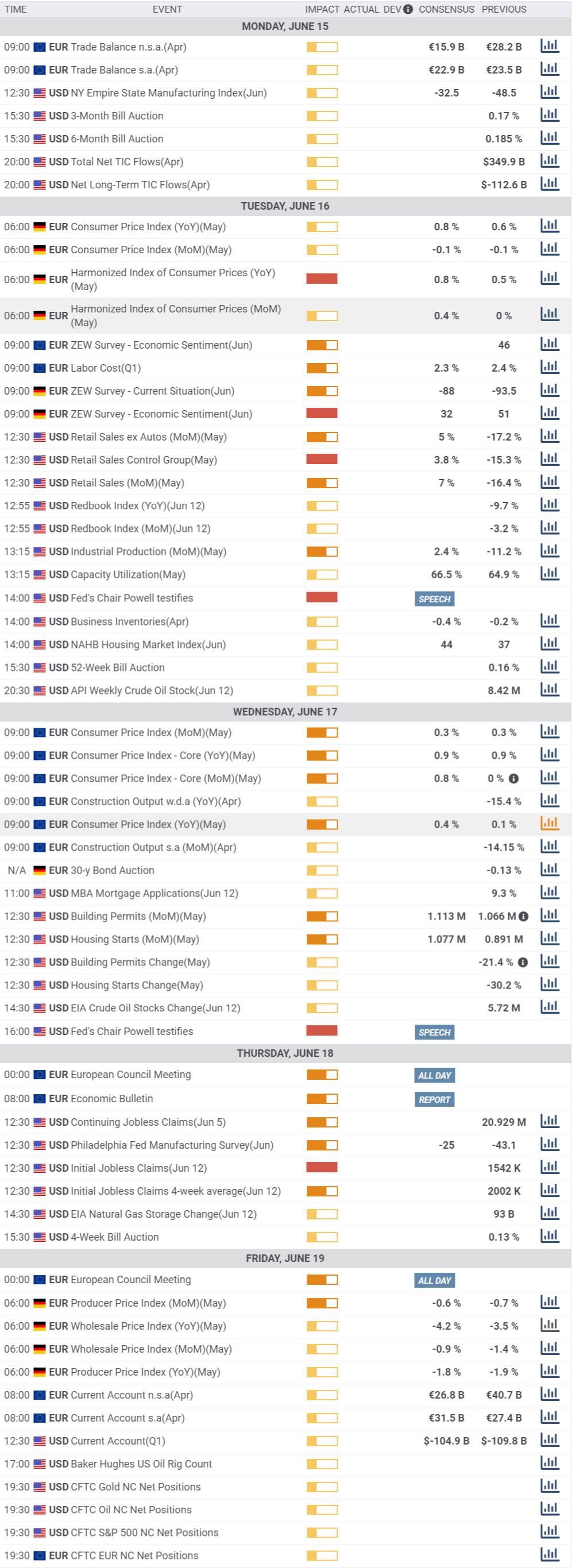
Next Tuesday, the focus will be on the German ZEW survey. Economic Sentiment in the country is seen retreating from 51 to 32 in June, while the assessment of the current situation is seen improving from -93.5 to -88. The US will publish later that day May Retail Sales, which are seen up by 5% after collapsing by 17.2% in the previous month.
US Fed’s Chair Powell will testify before Congress next week, although it seems unlikely that he can surprise investors after his post-meeting speech.
Germany and the EU will unveil May’s inflation data, while the US will publish its usual weekly unemployment figures, although these particular data is meant to have a limited impact on currencies.
EUR/USD technical outlook
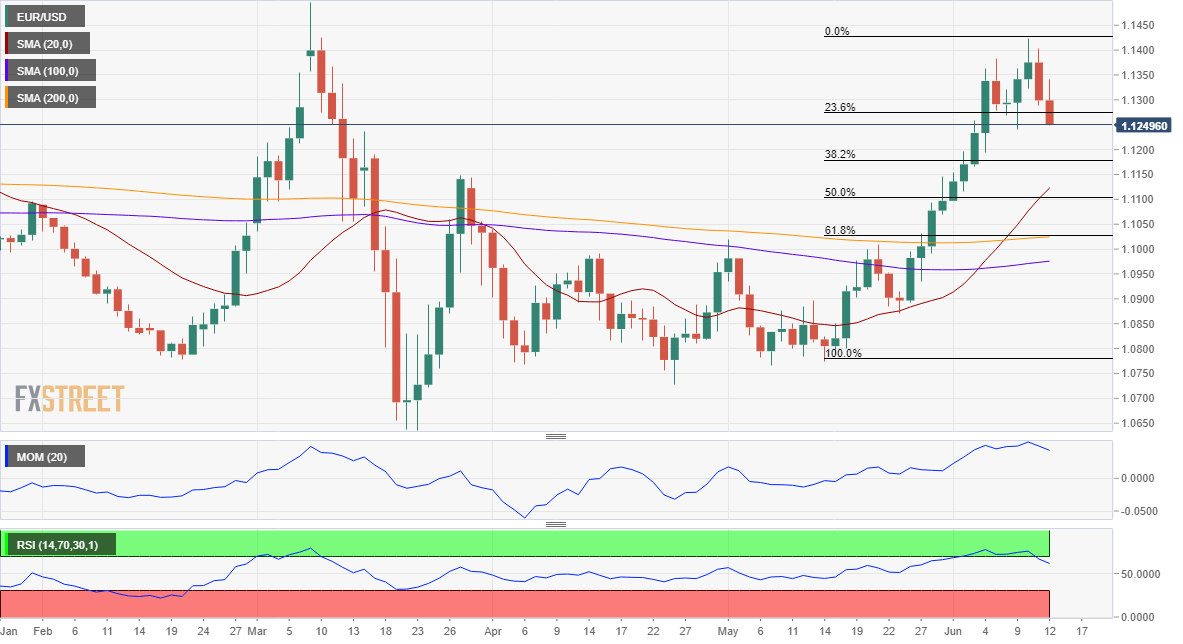
The EUR/USD pair has partially lost its long-term bullish potential, as for a second consecutive week, it was unable to settle above its 200 SMA. Technical indicators in the weekly chart have lost their bullish strength, but are not yet confirming a downturn. The Momentum heads lower within positive levels, rather reflecting the pullback from highs than suggesting an upcoming decline. The RSI, in the meantime, consolidates around 58.
When measuring the latest bullish run, the pair is developing just below the 23.6% retracement at 1.1270, a sign that bears remain sidelined. In the daily chart, technical indicators head lower, correcting extreme overbought conditions, holding far above their midlines. The 20 DMA, in the meantime, maintains its strong bullish slope below the current level and above the larger ones.
The 38.2% retracement of the mentioned rally comes at 1.1175, a level that should provide relevant support next week. Once below it, the slump may continue towards the 1.1080 region. Resistances come at 1.1360 and 1.1425. Beyond this last, 1.1460 is a long-term static resistance level. A break above this last should open the door for a steeper advance.
EUR/USD sentiment poll
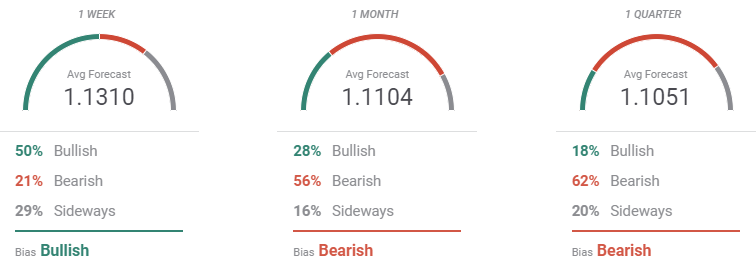
The FXStreet Forecast Poll shows that the pair could advance next week, as most investors are betting for a bullish continuation, although it’s seen on average around 1.1310. The tide turns in the monthly view, where bears soar to 56% and the pair is seen averaging 1.1100. In the quarterly perspective, the number of sellers increases to 62%, with the pair seen closer to the critical 1.1000 figure.
The Overview chart shows that moving averages lack directional strength in the three time-frame under study. A modest bullish slope is present in the monthly view, but not enough to indicate substantial buying interest, as there’s quite an even spread between possible targets. In the longer view, the pair is seen between 1.02 and 1.24 a sign that uncertainty remains high.
Related Forecasts:
AUD/USD Weekly Forecast: Finally turning down under? Australian jobs, US coronavirus data eyed
Author

Valeria Bednarik
FXStreet
Valeria Bednarik was born and lives in Buenos Aires, Argentina. Her passion for math and numbers pushed her into studying economics in her younger years.
















