EUR/USD Weekly Forecast: Boom! NFP upward surprise to put King Dollar in the bullish path
- ECB’s President Christine Lagarde surprised market players with a hawkish stance.
- The US managed to add 467K new jobs in January, largely above the market’s expectations.
- EUR/USD will likely have a hard time extending its latest rally if it loses 1.1400.

The EUR/USD pair posted its largest weekly gain since March 2020, adding roughly 350 pips to reach a fresh 2022 high of 1.1483, to now trade at around 1.1430. The shared currency soared following the European Central Bank monetary policy meeting, after President Christine Lagarde surprised market players with her hawkish tone, following the release of a mildly dovish statement. Lagarde & Co took due notice of record inflation achieved in January. According to Eurostat, consumer prices in the eurozone rose by a record 5.1% YoY against the 4.4% expected and surpassing December’s 5% reading. The preliminary estimate of German inflation in the same period printed at 4.9%, also well above the market’s expectations.
ECB’s hawkishness overshadowed by upbeat US NFP
The February central bank statement echoed the one in December, announcing steady rates and the end of PEPP purchases in March. The ECB reiterated that it would be increasing purchases under the APP program, which will start decreasing next October. It is worth noting that policymakers removed the word “in either direction” in the paragraph related to being open to adjusting monetary policy as needed.
President Lagarde, however, delivered her most hawkish statement ever. Not only did she express logical concerns relating to mounting price pressures, saying that “compared with our expectations in December, risks to the inflation outlook are tilted to the upside, particularly in the near term,” but she also refrained from saying that a rate hike this year would be unlikely. Market players rushed to price in a possible rate hike by the end of 2022.
As a result, government bond yields soared. The German 2-year bund yield added over 30 bps in the week, the biggest rise in over a decade, while the US 2-year Treasury yield surged past 1.20%. Longer-term bond yields also advanced, but it was not enough to spur demand for the American currency.
Ups and downs in macro data
Across the pond, US employment-related data put further pressure on the greenback mid-week. The ADP survey of private job creation posted a 301K loss, much worse than the new 207K positions anticipated. Q4 Unit Labor Cost was up a modest 0.3%, well below the previous 9.3% and the 1.5% expected, although Nonfarm Productivity in the same period beat expectations, up 6.6%.
The dollar came back on Friday after the country published the January Nonfarm Payrolls report. Investors were heading into it, anticipating a tepid outcome, but the US managed to add 467K new job positions, tripling the expected 150K. The Unemployment Rate ticked higher to 4%, while the Participation Rate jumped to 62.2%, signaling quite a healthy recovery in the sector.
The Nonfarm Payrolls report came to remind market players of the aggressive stance of the US Federal Reserve, which by far overshadowed Lagarde’s words.
Other macroeconomic figures released these days showed that major economies are still struggling to return to pre-pandemic growth levels. The preliminary estimate of the EU Q4 Gross Domestic Product came in at 0.3% QoQ as expected, far below the final Q3 reading of 2.3%. Retail Sales in the Union unexpectedly fell by 3.0% MoM, while Markit downwardly revised its January PMIs estimates. German figures suffered the same fate, although Factory Orders in the country improved by 2.8% MoM in December.
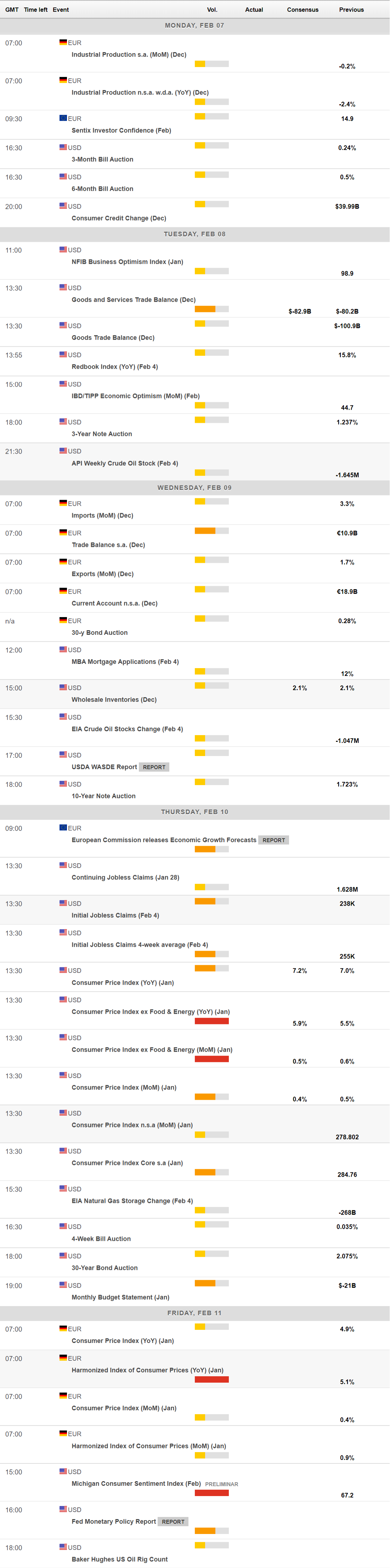
The upcoming week will be lighter in terms of macroeconomic releases, although the US will publish the final estimate of the January Consumer Price Index and the preliminary estimate of the February Michigan Consumer Sentiment Index. Germany will also unveil the final reading of its January CPI.
EUR/USD technical outlook
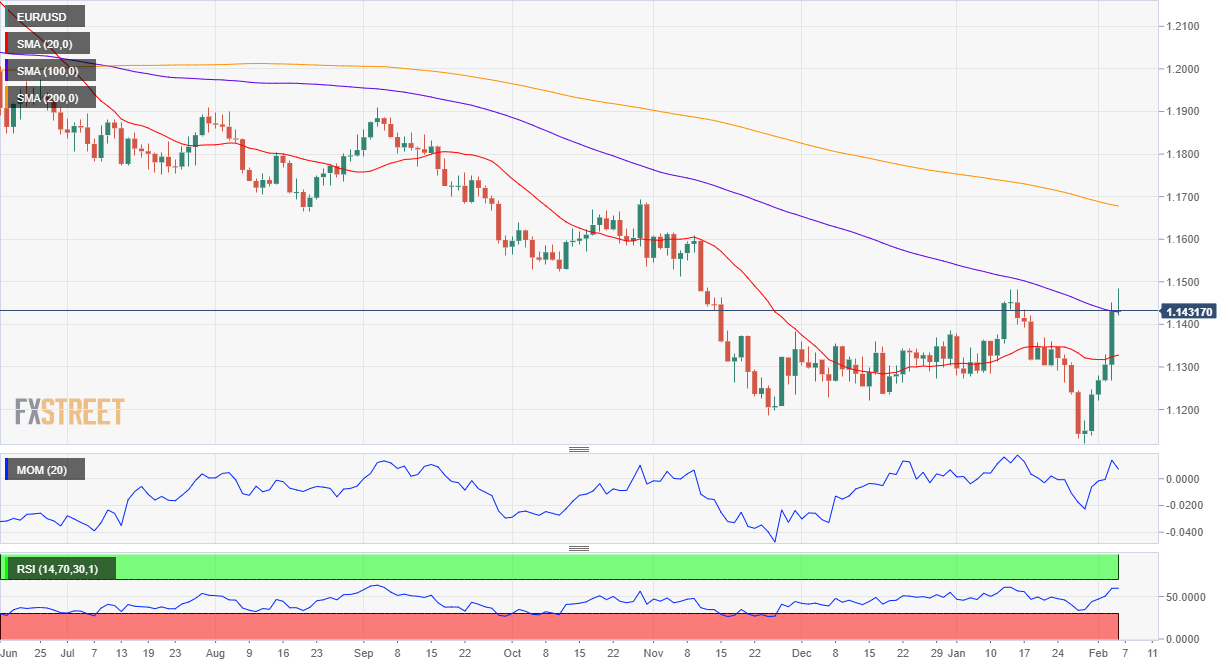
The large advance was insufficient to confirm a long term recovery in EUR/USD. The weekly chart shows that technical indicators have bounced from oversold readings but that they remain within negative levels, although maintaining firmly bullish slopes. At the same time, the pair has managed to surpass a bearish 20 SMA but trades a handful of pips below a bearish 200 SMA, providing dynamic resistance at around 1.1500.
On the daily chart, the pair has advanced five consecutive days before turning south on Friday, rallying beyond its 20 and 100 SMAs – and now battling with the latter. The 200 SMA, in the meantime, maintains its strongly bearish slope in the 1.1670 price zone. Technical indicators have lost their bullishness, and the Momentum turned flat within neutral levels, while the RSI stands at around 59.
Renewed selling pressure driving the pair below 1.1400 should be a warning for bulls, as the pair could quickly ease towards the 1.1300 price zone. Below the latter, the next relevant support level comes in at 1.1260.
On the other hand, the pair needs to advance beyond 1.1500 to return to the bullish path and extend its rally towards the 1.1620 price zone.
EUR/USD sentiment poll
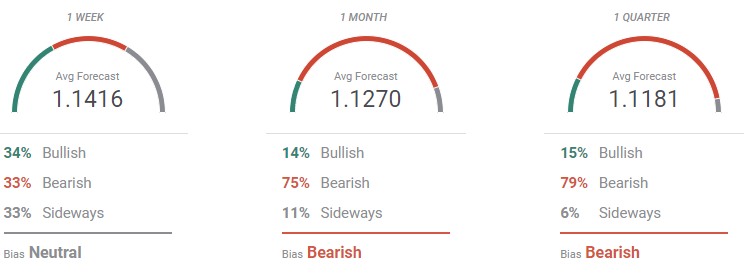
According to the FXStreet Forecast Poll, the EUR/USD pair is neutral in the near term but posed to resume its slide afterwards. The monthly and quarterly perspectives show that over 70% of the polled experts are betting on the downside, while less than 20% are expecting gains above the current level.
The Overview chart hints at an upcoming break below the critical 1.1000 threshold, as the number of those betting for such lows has increased in the wider perspective. On the other hand, the chart shows that the number of experts looking for some gains are hardly seeing the pair moving beyond the 1.1500 price zone.
Related Forecasts:
Gold Weekly Forecast: XAU/USD indecisive as investors assess central banks' rate outlook
GBP/USD Weekly Forecast: Time to sell? Steaming hot US inflation set to reverse BOE-led rally
Author

Valeria Bednarik
FXStreet
Valeria Bednarik was born and lives in Buenos Aires, Argentina. Her passion for math and numbers pushed her into studying economics in her younger years.