EUR/USD Price Forecast: Trump drops the first tariff bomb, markets panic

EUR/USD Current price: 1.0267
- The European core Harmonized Index of Consumer Prices was higher than anticipated in January.
- United States President Donald Trump announced tariffs on Mexico, Canada, and China on Saturday.
- The EUR/USD pair lost roughly 150 pips at the weekly opening, struggles to close the gap.
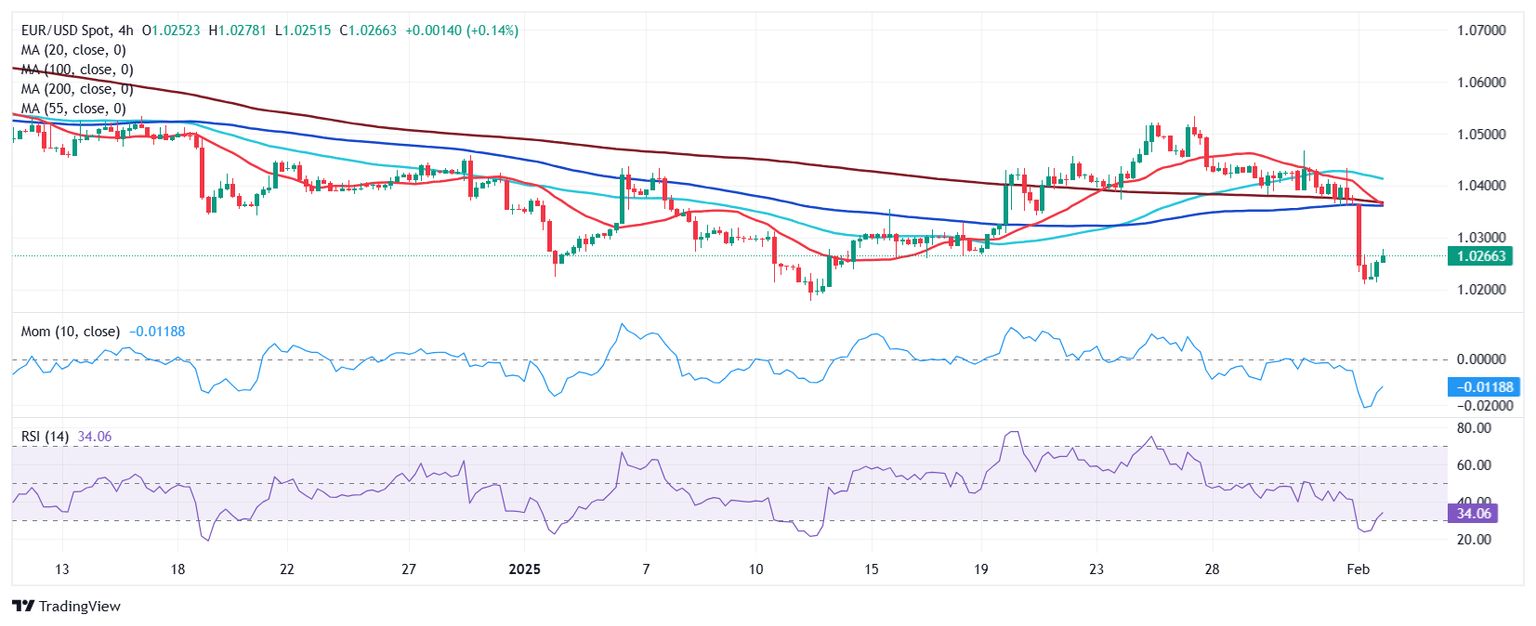
The EUR/USD pair plummeted at the weekly opening, trading near the 1.0200 mark and leaving a huge gap amid weekend news. The US Dollar (USD) soared after United States (US) President Donald Trump announced the first round of tariffs on Saturday. Trump imposed a 25% tariff on Canadian and Mexican imports and 10% on Chinese products, kick-starting a trade war with three of the US major trade partners. Levies will come into effect on Tuesday, February 4.
Even further, Trump added that tariffs will “definitely” hit the European Union (EU) and the United Kingdom (UK), but clarified a deal could still be worked out with UK.
Canada has already announced retaliatory tariffs, and Chinese authorities have announced countermeasures. Finally, Mexican President Claudia Sheinbaum ordered retaliatory tariffs, albeit no further detail has been revealed.
As a result, financial markets entered panic mode. Global stocks plummeted, with all Asian and European indexes trading in the red. Wall Street futures are also down ahead of the opening, with the three major indexes challenging January monthly lows.
Meanwhile, European Central Bank (ECB) member of the Governing Council and French Central Bank Governor Francois Villeroy de Galhau said Trump's tariffs were "very brutal" and would hit the autos sector especially.
Data-wise, the EU published the preliminary estimate of the January Harmonized Index of Consumer Prices (HICP), which rose by 2.5% YoY, as expected. The core annual reading, however, posted 2.7%, matching the December reading, yet it was above the expected 2.6%. Additionally, the Hamburg Commercial Bank (HCOB) released the final estimates of the January Manufacturing Purchasing Managers’ Index (PMI), which suffered modest upward revisions yet remained within contraction levels. The final EU Manufacturing PMI was confirmed at 46.6, following a preliminary estimate of 46.1.
The American session will bring the US S&P Manufacturing PMI and the official ISM index for January. The latter is foreseen at 49.8, improving from the 49.3 posted in December. A couple of Federal Reserve (Fed) speakers will be on the wires during the US afternoon.
EUR/USD short-term technical outlook
From a technical point of view, the daily chart for the EUR/USD pair shows additional losses are likely despite the pair is in recovery mode. It currently trades at around 1.0265 after bottoming at 1.0210. The same chart shows EUR/USD develops below all its moving averages, with a bearish 20 Simple Moving Average (SMA) gaining downward traction at around 1.0355. Technical indicators, in the meantime, crossed their midlines into negative territory, maintaining vertical slopes.
In the near term, and according to the 4-hour chart, EUR/USD is correcting oversold conditions, yet far from turning bullish. The pair IS developing over 100 pips below all its moving averages while a firmly bearish 20 SMA crosses below directionless 100 and 200 SMAs. Finally, technical indicators aim marginally higher but remain near extreme levels, lacking momentum enough to support another leg higher.
Support levels: 1.0210 1.0175 1.0130
Resistance levels: 1.0285 1.0320 1.0355
Tariffs FAQs
Tariffs are customs duties levied on certain merchandise imports or a category of products. Tariffs are designed to help local producers and manufacturers be more competitive in the market by providing a price advantage over similar goods that can be imported. Tariffs are widely used as tools of protectionism, along with trade barriers and import quotas.
Although tariffs and taxes both generate government revenue to fund public goods and services, they have several distinctions. Tariffs are prepaid at the port of entry, while taxes are paid at the time of purchase. Taxes are imposed on individual taxpayers and businesses, while tariffs are paid by importers.
There are two schools of thought among economists regarding the usage of tariffs. While some argue that tariffs are necessary to protect domestic industries and address trade imbalances, others see them as a harmful tool that could potentially drive prices higher over the long term and lead to a damaging trade war by encouraging tit-for-tat tariffs.
During the run-up to the presidential election in November 2024, Donald Trump made it clear that he intends to use tariffs to support the US economy and American producers. In 2024, Mexico, China and Canada accounted for 42% of total US imports. In this period, Mexico stood out as the top exporter with $466.6 billion, according to the US Census Bureau. Hence, Trump wants to focus on these three nations when imposing tariffs. He also plans to use the revenue generated through tariffs to lower personal income taxes.
Premium
You have reached your limit of 3 free articles for this month.
Start your subscription and get access to all our original articles.
Author
Valeria Bednarik
FXStreet
Valeria Bednarik was born and lives in Buenos Aires, Argentina. Her passion for math and numbers pushed her into studying economics in her younger years.