EUR/USD Price Forecast: The upside target remains at 1.1830
- EUR/USD succumbed to the selling pressure and receded to 1.1650.
- The US Dollar picked up pace amid continued trade jitters.
- Investors are now expected to look at upcoming US inflation figures.


The Euro (EUR) dropped to its lowest point against the US Dollar (USD) in three weeks in quite a bearish start to the week, motivating EUR/USD to trade in the red for the fourth day in a row and revisit the area of 1.1650.
Trade jitters reignite
The White House said it would wait until August 1 to look at tariffs again.
However, the recent threats of 30% levies on US imports from the European Union added to last week’s announcements of tariffs on Japan and South Korea by 25% and on copper by 50%, all contributing to the resurgence of a potential trade war.
Central banks diverge
The Minutes from the Federal Reserve's (Fed) June meeting showed that some members wanted to lower interest rates right away, while others wanted to wait and see how tariffs may affect inflation.
Futures markets are still expecting some easing later this year, but only if the price pressures don't last long.
The European Central Bank (ECB) reduced its Deposit Facility Rate to 2.00% in early June. President Christine Lagarde said that any move would be contingent on compelling evidence of weak external demand, implying that there is little interest in decreasing rates in the near future.
Bullish bets on the EUR pile up
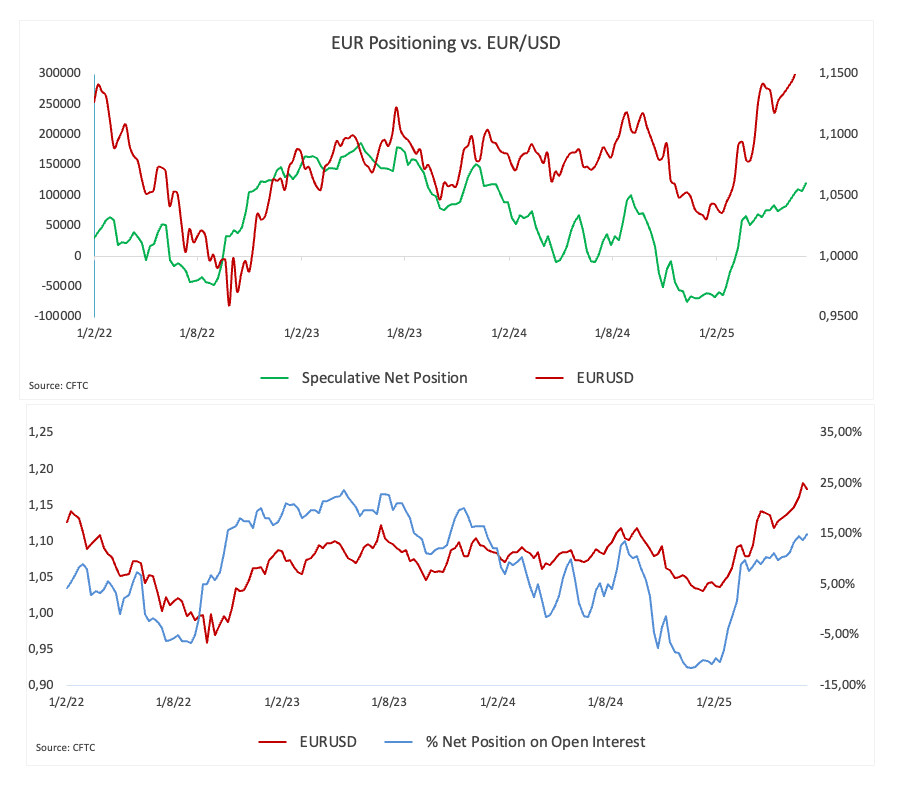
According to CFTC data through July 8, speculative net longs in the single currency have reached over 120.5K contracts, the biggest level since December 2023, while institutional traders have increased their net shorts to over 177K contracts, or multi-month highs. During that period, open interest has also gone up for the third week in a row, this time to around 806K contracts.
Technical landscape
Resistance lines up at the 2025 high of 1.1830 (July 1), ahead of the June peak at 1.1852 (June 2018).
On the flip side, interim contention sits at the 55-day simple moving average (SMA) at 1.1457, prior to the weekly trough at 1.1210 (May 29) and the May base at 1.1064 (May 12), all preceding the key 1.1000 threshold.
Indicators of momentum still point to a strong Euro. The Relative Strength Index (RSI) is close to 55, which means the market is bullish. The Average Directional Index (ADX) hovers around 28, indicating quite a healthy trend.

Medium-term outlook
The view that the Fed might reduce its rates later in the year vs. a potential pause by the ECB could lend some fresh legs to the European currency and propel EUR/USD higher. However, ongoing trade tensions and the uncertainty surrounding President Trump's tariff proposals pose significant risks that could prevent prices from rising further in the near future.
ECB FAQs
The European Central Bank (ECB) in Frankfurt, Germany, is the reserve bank for the Eurozone. The ECB sets interest rates and manages monetary policy for the region. The ECB primary mandate is to maintain price stability, which means keeping inflation at around 2%. Its primary tool for achieving this is by raising or lowering interest rates. Relatively high interest rates will usually result in a stronger Euro and vice versa. The ECB Governing Council makes monetary policy decisions at meetings held eight times a year. Decisions are made by heads of the Eurozone national banks and six permanent members, including the President of the ECB, Christine Lagarde.
In extreme situations, the European Central Bank can enact a policy tool called Quantitative Easing. QE is the process by which the ECB prints Euros and uses them to buy assets – usually government or corporate bonds – from banks and other financial institutions. QE usually results in a weaker Euro. QE is a last resort when simply lowering interest rates is unlikely to achieve the objective of price stability. The ECB used it during the Great Financial Crisis in 2009-11, in 2015 when inflation remained stubbornly low, as well as during the covid pandemic.
Quantitative tightening (QT) is the reverse of QE. It is undertaken after QE when an economic recovery is underway and inflation starts rising. Whilst in QE the European Central Bank (ECB) purchases government and corporate bonds from financial institutions to provide them with liquidity, in QT the ECB stops buying more bonds, and stops reinvesting the principal maturing on the bonds it already holds. It is usually positive (or bullish) for the Euro.
Premium
You have reached your limit of 3 free articles for this month.
Start your subscription and get access to all our original articles.
Author
Pablo Piovano
FXStreet
Born and bred in Argentina, Pablo has been carrying on with his passion for FX markets and trading since his first college years.