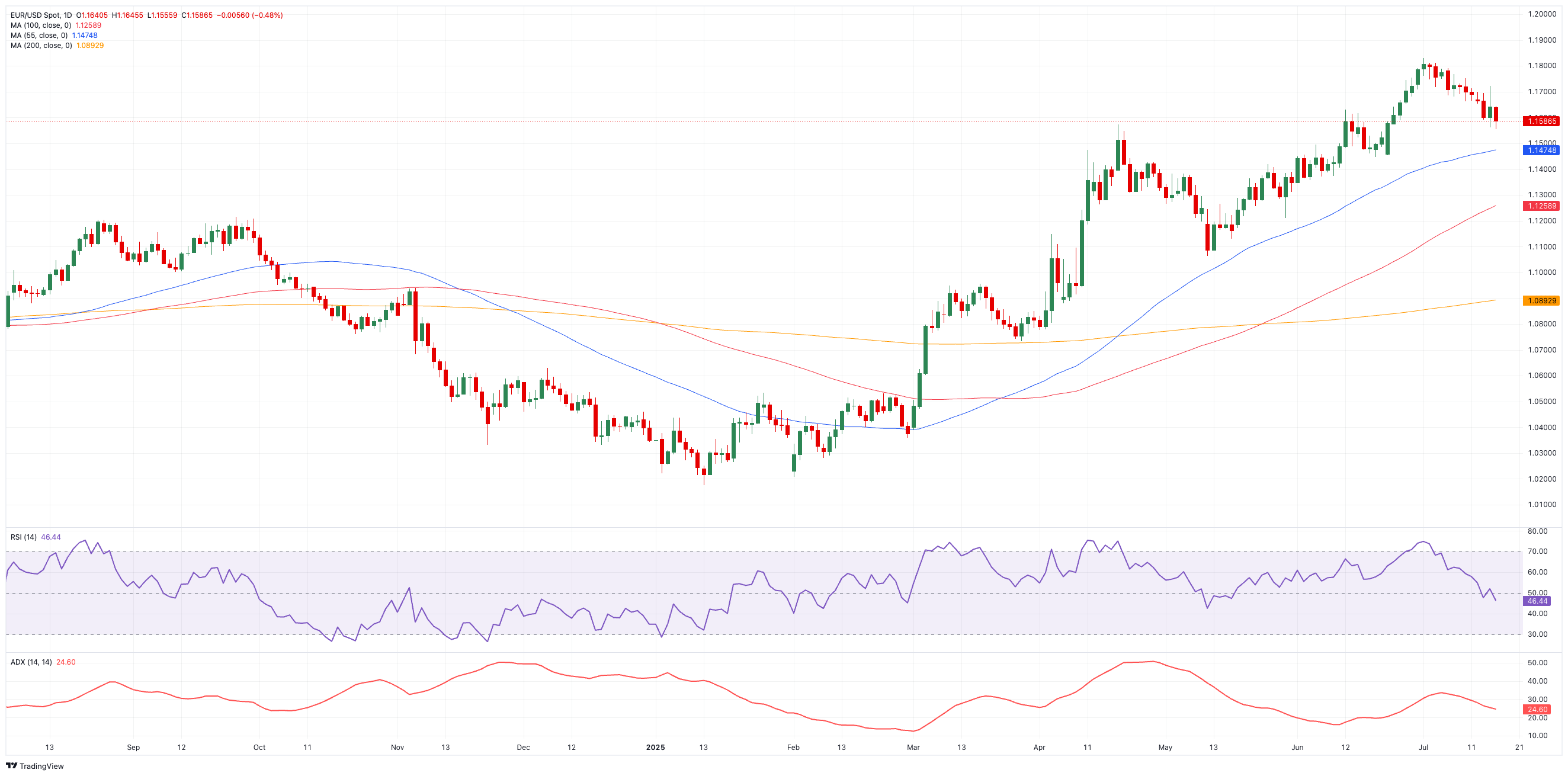
EUR/USD Price Forecast: The 55-day SMA comes next around 1.1470
- EUR/USD resumed its decline, hitting new multi-week lows near 1.1550.
- The US Dollar quickly reversed Wednesday’s drop and refocused on the upside.
- US Retail Sales and weekly Claims add to the notion of a resilient economy.

The Euro (EUR) left behind its recent optimism against the US Dollar (USD), dragging EUR/USD well south of the 1.1600 support to hit fresh multi-week troughs on Thursday.
Trade tensions hem in the Euro
Even though the White House has delayed fresh tariff decisions until August 1, jitters over an escalating trade war have weighed heavily on the European currency.
Threats of 30% levies on EU goods, alongside announced 25% tariffs on Japanese and South Korean imports and a hefty 50% surcharge on copper, have fanned fears of a full‑blown confrontation, lending renewed strength to the dollar in recent sessions.
In a bid to defuse the standoff, EU trade chief Maroš Šefčovič travelled to Washington for talks with Commerce Secretary Howard Lutnick and Trade Representative Jamieson Greer.
Central banks diverge
Minutes from June’s Federal Reserve (Fed) meeting revealed a policymaking body split between those urging immediate rate cuts and others calling for patience until the inflationary fallout from tariffs becomes clearer. The increase in the US Consumer Price Index (CPI) in June only reinforced Fed Chair Jerome Powell’s cautious stance; however, markets still anticipate some easing later this year, assuming that price pressures will prove to be temporary.
In contrast, the European Central Bank (ECB) has kept policy on hold, warning that further easing hinges on clear signs of faltering external demand. Its Deposit Facility Rate remains at 2.00% following an early‑June cut.
Bullish bets clash with rising commercial shorts
Positioning data through July 8 shows speculators piling into Euro longs: net long contracts jumped to their highest level since December 2023 at more than 120.5K, while institutional shorts climbed to multi-month highs around 177K. Overall open interest rose for a third straight week, touching roughly 806K contracts.
Technical outlook
On the upside, EUR/USD must clear its 2025 high of 1.1830 (July 1) before eyeing the June 2018 peak at 1.1852 (June 14).
On the downside, a break below July's base of 1.1556 (July 17) could lead to the transitory 55-day SMA at 1.1472, the weekly low at 1.1210 (May 29), and the May valley at 1.1064 (May 12), ultimately aiming for the psychologically pivotal 1.1000.
Momentum gauges have turned cautiously negative: the Relative Strength Index (RSI) eases below 47, while an Average Directional Index (ADX) near 25 still suggests the current move lacks strong conviction.
Looking ahead
With US tariff policy still in flux and the Fed‑ECB policy divide widening, the EUR may struggle to sustain its advance. Yet any clear signal of Fed moderation or signs of easing trade tensions could swiftly restore momentum to the single currency.
Euro FAQs
The Euro is the currency for the 19 European Union countries that belong to the Eurozone. It is the second most heavily traded currency in the world behind the US Dollar. In 2022, it accounted for 31% of all foreign exchange transactions, with an average daily turnover of over $2.2 trillion a day. EUR/USD is the most heavily traded currency pair in the world, accounting for an estimated 30% off all transactions, followed by EUR/JPY (4%), EUR/GBP (3%) and EUR/AUD (2%).
The European Central Bank (ECB) in Frankfurt, Germany, is the reserve bank for the Eurozone. The ECB sets interest rates and manages monetary policy. The ECB’s primary mandate is to maintain price stability, which means either controlling inflation or stimulating growth. Its primary tool is the raising or lowering of interest rates. Relatively high interest rates – or the expectation of higher rates – will usually benefit the Euro and vice versa. The ECB Governing Council makes monetary policy decisions at meetings held eight times a year. Decisions are made by heads of the Eurozone national banks and six permanent members, including the President of the ECB, Christine Lagarde.
Eurozone inflation data, measured by the Harmonized Index of Consumer Prices (HICP), is an important econometric for the Euro. If inflation rises more than expected, especially if above the ECB’s 2% target, it obliges the ECB to raise interest rates to bring it back under control. Relatively high interest rates compared to its counterparts will usually benefit the Euro, as it makes the region more attractive as a place for global investors to park their money.
Data releases gauge the health of the economy and can impact on the Euro. Indicators such as GDP, Manufacturing and Services PMIs, employment, and consumer sentiment surveys can all influence the direction of the single currency. A strong economy is good for the Euro. Not only does it attract more foreign investment but it may encourage the ECB to put up interest rates, which will directly strengthen the Euro. Otherwise, if economic data is weak, the Euro is likely to fall. Economic data for the four largest economies in the euro area (Germany, France, Italy and Spain) are especially significant, as they account for 75% of the Eurozone’s economy.
Another significant data release for the Euro is the Trade Balance. This indicator measures the difference between what a country earns from its exports and what it spends on imports over a given period. If a country produces highly sought after exports then its currency will gain in value purely from the extra demand created from foreign buyers seeking to purchase these goods. Therefore, a positive net Trade Balance strengthens a currency and vice versa for a negative balance.
Author

Pablo Piovano
FXStreet
Born and bred in Argentina, Pablo has been carrying on with his passion for FX markets and trading since his first college years.