EUR/USD Price Forecast: Rebound targets the 1.1800 barrier
- EUR/USD extends its march north well past the 1.1700 barrier on Tuesday.
- The US Dollar remains on the back foot amid persistent US-EU concerns.
- The ZEW’S Economic Sentiment surprised to the upside in Germany and the EMU.
EUR/USD continues to grind higher, extending its winning streak into a second session and pushing up to fresh yearly highs. With momentum still firmly on its side, the pair looks increasingly comfortable eyeing a potential retest of the December peaks just north of 1.1800 the figure.
The single currency added to Monday’s upbeat tone on turnaround Tuesday, climbing toward the 1.1760 area and putting clear daylight between itself and last week’s dip toward the ever-important 200-day Simple Moving Average (SMA) near 1.1580.
Once again, the move says more about the US Dollar (USD) than the Euro. Renewed selling pressure on the Greenback has followed fresh tariff threats from President Trump, this time aimed at several European Union (EU) countries in connection with the Greenland issue.
That backdrop has dragged the US Dollar Index (DXY) back down, unwinding much of its early-year gains and slipping into the 98.30–98.20 range. US Treasury yields aren’t offering much support either, with mixed moves across the curve doing little to stem the buck’s retreat.
The Fed steps back, but keeps its guard up
The Federal Reserve (Fed) delivered the December rate cut markets were fully priced for, but the real message came through loud and clear in the tone. A split vote and carefully chosen language from Chair Jerome Powell signalled that the easing cycle is far from on autopilot.
Powell reiterated that inflation remains “somewhat elevated” and stressed the need for clearer signs that the labour market is cooling in an orderly way. Updated projections barely moved, still pointing to just one additional 25-basis-point cut in 2026, alongside steady growth and only a modest rise in unemployment.
At the press conference, Powell ruled out rate hikes as the base case, but was equally careful not to suggest that another cut is imminent. He also highlighted tariffs introduced under former President Donald Trump as a factor keeping inflation sticky.
The Minutes later underlined just how finely balanced the debate is inside the Federal Open Market Committee (FOMC). With divisions still evident, confidence in further easing is fading, and a pause looks like the path of least resistance unless inflation cools more convincingly or the labour market weakens more sharply.
The ECB looks in no hurry to move
The European Central Bank (ECB) kept rates unchanged at its December 18 meeting, and the tone struck a noticeably calmer chord. Small upgrades to parts of the growth and inflation outlook have effectively shut the door on near-term rate cuts.
Incoming data have helped steady sentiment. Euro area growth has surprised slightly to the upside, exporters have coped with US tariffs better than expected, and domestic demand has helped cushion the ongoing drag from weak manufacturing.
Inflation trends continue to sit comfortably within the ECB’s framework. Price pressures are hovering close to the 2% target, with services inflation doing most of the heavy lifting, a pattern policymakers expect to persist.
Updated projections still see inflation dipping below target in 2026–27 as energy prices ease, before gradually drifting back toward 2%. At the same time, officials remain alert to the risk that services inflation could stay sticky, given that wage growth is only cooling gradually.
Growth forecasts were nudged higher too, reinforcing the sense that the economy is holding up better than many feared. President Christine Lagarde summed it up neatly, calling exports “sustainable” for now, while stressing that policy decisions will remain data-driven.
Markets appear to have taken the hint, pricing just around 7 basis points of easing this year, hardly a sign of urgency.
Positioning check: still long, but less enthusiastic
Speculative positioning continues to lean in favour of the Euro (EUR), though the bullish impulse is clearly losing some energy.
According to Commodity Futures Trading Commission (CFTC) data for the week ending January 13, non-commercial net long positions slipped to around 132.6K contracts, the lowest level in six weeks. Institutional players also trimmed short exposure, down to roughly 179.8K contracts.
At the same time, open interest has risen for a third straight week, approaching 883.7K contracts, or four-week highs, pointing to broader market participation even as bullish conviction starts to thin.
What’s driving the next move
Near term: The upcoming US Personal Consumption Expenditures (PCE) release is unlikely to move the needle much. Instead, attention will likely turn to preliminary Purchasing Managers’ Index (PMI) readings in both the US and the euro area, which should offer a cleaner snapshot of underlying momentum.
Risk: A renewed climb in US yields or a more hawkish tilt from the Fed could quickly draw sellers back in. A decisive break below the 200-day SMA would raise the risk of a deeper medium-term correction.
Tech corner
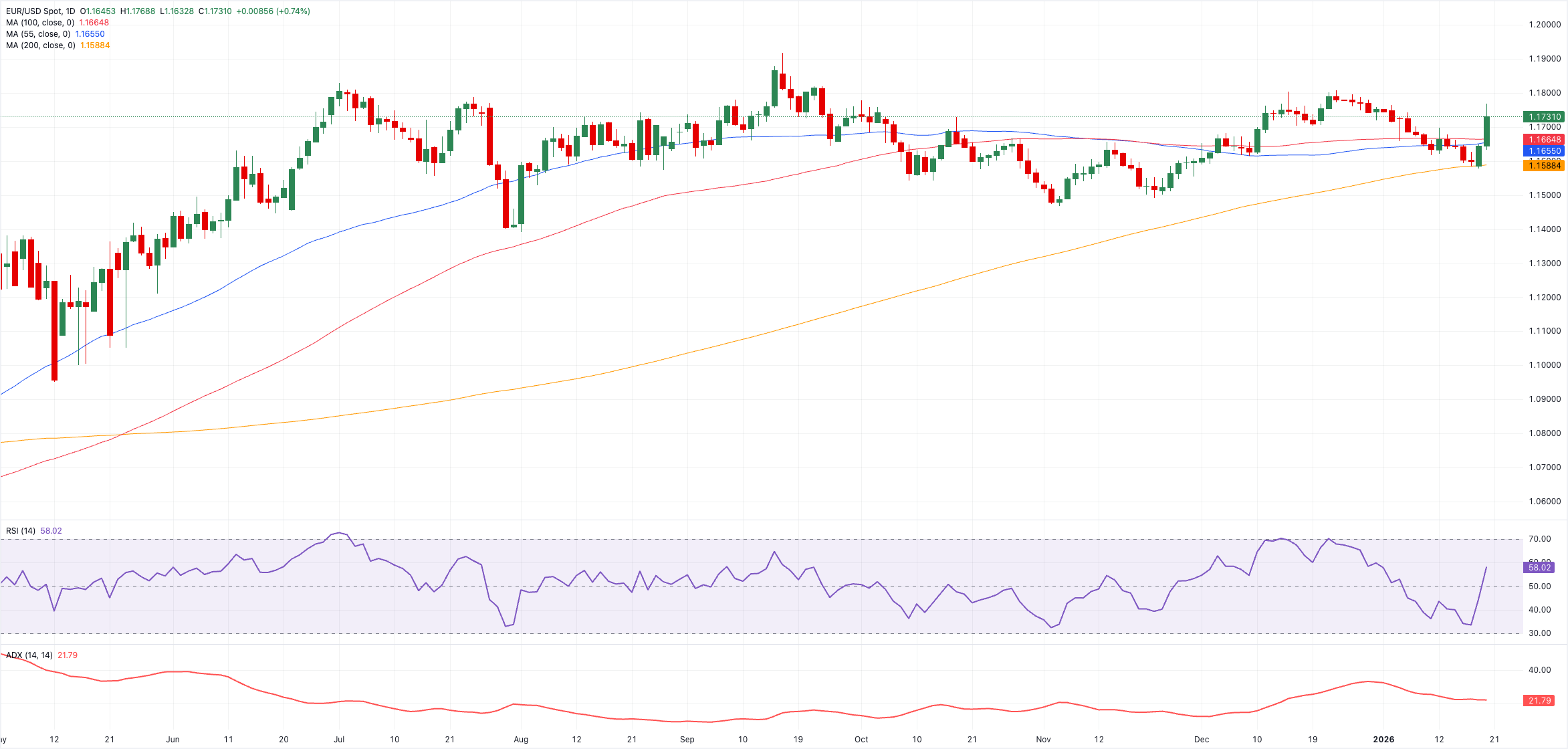
EUR/USD manages to extend its bounce off recent lows and reclaims the 1.1700 hurdle and beyond, opening the door to a potential visit to the December high at 1.1807 (December 24). The break above the latter could prompt a test of the 2025 ceiling at 1.1918 (September 17) to re-emerge on the horizon prior to the 1.2000 milestone.
In the opposite direction, the loss of the key 200-day SMA at 1.1586 could trigger a deeper decline to, initially, the November valley at 1.1468 (November 5) prior to the August base at 1.1391 (August 1).
Additionally, momentum indicators favour extra advances for now: The Relative Strength Index (RSI) rebounds past the 58 level, while the Average Directional Index (ADX) just above 19 mark is indicative of quite a solid trend.
Bottom line
For now, EUR/USD is being driven far more by what’s happening in the US than by developments at home in the euro area.
Until the Fed offers clearer guidance on how far it’s willing to ease, or the eurozone delivers a more convincing cyclical upswing, any further gains are likely to be steady and incremental, rather than the start of a dramatic breakout.
Tariffs FAQs
Tariffs are customs duties levied on certain merchandise imports or a category of products. Tariffs are designed to help local producers and manufacturers be more competitive in the market by providing a price advantage over similar goods that can be imported. Tariffs are widely used as tools of protectionism, along with trade barriers and import quotas.
Although tariffs and taxes both generate government revenue to fund public goods and services, they have several distinctions. Tariffs are prepaid at the port of entry, while taxes are paid at the time of purchase. Taxes are imposed on individual taxpayers and businesses, while tariffs are paid by importers.
There are two schools of thought among economists regarding the usage of tariffs. While some argue that tariffs are necessary to protect domestic industries and address trade imbalances, others see them as a harmful tool that could potentially drive prices higher over the long term and lead to a damaging trade war by encouraging tit-for-tat tariffs.
During the run-up to the presidential election in November 2024, Donald Trump made it clear that he intends to use tariffs to support the US economy and American producers. In 2024, Mexico, China and Canada accounted for 42% of total US imports. In this period, Mexico stood out as the top exporter with $466.6 billion, according to the US Census Bureau. Hence, Trump wants to focus on these three nations when imposing tariffs. He also plans to use the revenue generated through tariffs to lower personal income taxes.
Author

Pablo Piovano
FXStreet
Born and bred in Argentina, Pablo has been carrying on with his passion for FX markets and trading since his first college years.

















