EUR/USD Price Forecast: Outlook remains bearish below the 200-day SMA
- EUR/USD met some resistance just above the 1.0500.
- The US Dollar remained steady in the area of two-month lows.
- Investors will closely follow the FOMC Minutes later in the week.

EUR/USD’s rally seemed to have met some decent hurdle above 1.0500 the figure so far on Monday, coming under some tepid selling pressure along with the irresolute price action in the US Dollar (USD). On the latter, the US Dollar (USD) maintained its trade in the region of multi-week lows near 106.80 amid the inactivity in the US markets due to Washington’s Day holiday.
The pair’s flattish price action was accompanied by scarce volatility and reduced trade conditions, with German 10-year bund yields climbing to fresh monthly highs near 2.50%, persistent unease surrounding trade policies by the White House and prospects of a more cautious Fed going forward.
Tariff tensions keep markets on edge
Uncertainty over global trade policies continues to shake up currency markets. While the US delayed a 25% tariff on Canadian and Mexican imports, it maintained a 10% duty on Chinese goods, keeping investors cautious. The situation took another turn when Trump announced a 25% tariff on all steel and aluminium imports, hinting at more retaliatory moves ahead.
This back and forth from the Trump administration initially led to weaker demand for the US Dollar, but the Greenback could regain strength if protectionist policies push US inflation higher, potentially leading the Federal Reserve (Fed) to hold rates higher for longer.
Central banks take centre stage
The Fed recently held rates steady at 4.25%-4.50%, sticking to its cautious stance amid strong US economic growth, stubborn inflation, and a resilient labour market. Powell emphasised that cutting rates too soon could undermine inflation control efforts, making it clear that future rate decisions will depend on inflation cooling further and continued labour market stability.
Meanwhile, the European Central Bank (ECB) took a different approach, delivering a widely expected 25-basis-point rate cut to combat sluggish growth. ECB President Christine Lagarde dismissed speculation of larger 50-basis-point cuts, instead signalling a gradual approach with future rate decisions guided by incoming economic data. Despite trade tensions, Lagarde remains optimistic about inflation returning to target by 2025, suggesting a measured but steady policy path for the ECB.
Trade war: Who stands to gain—or lose?
If tariffs drive US inflation higher, the Fed may stay hawkish, giving the US Dollar fresh strength. For the Euro, escalating trade disputes and more-likely-than-not US tariffs on imported goods from the European Union (EU) could weigh on sentiment and send EUR/USD closer to parity sooner than expected.
Technical outlook: Key levels to watch
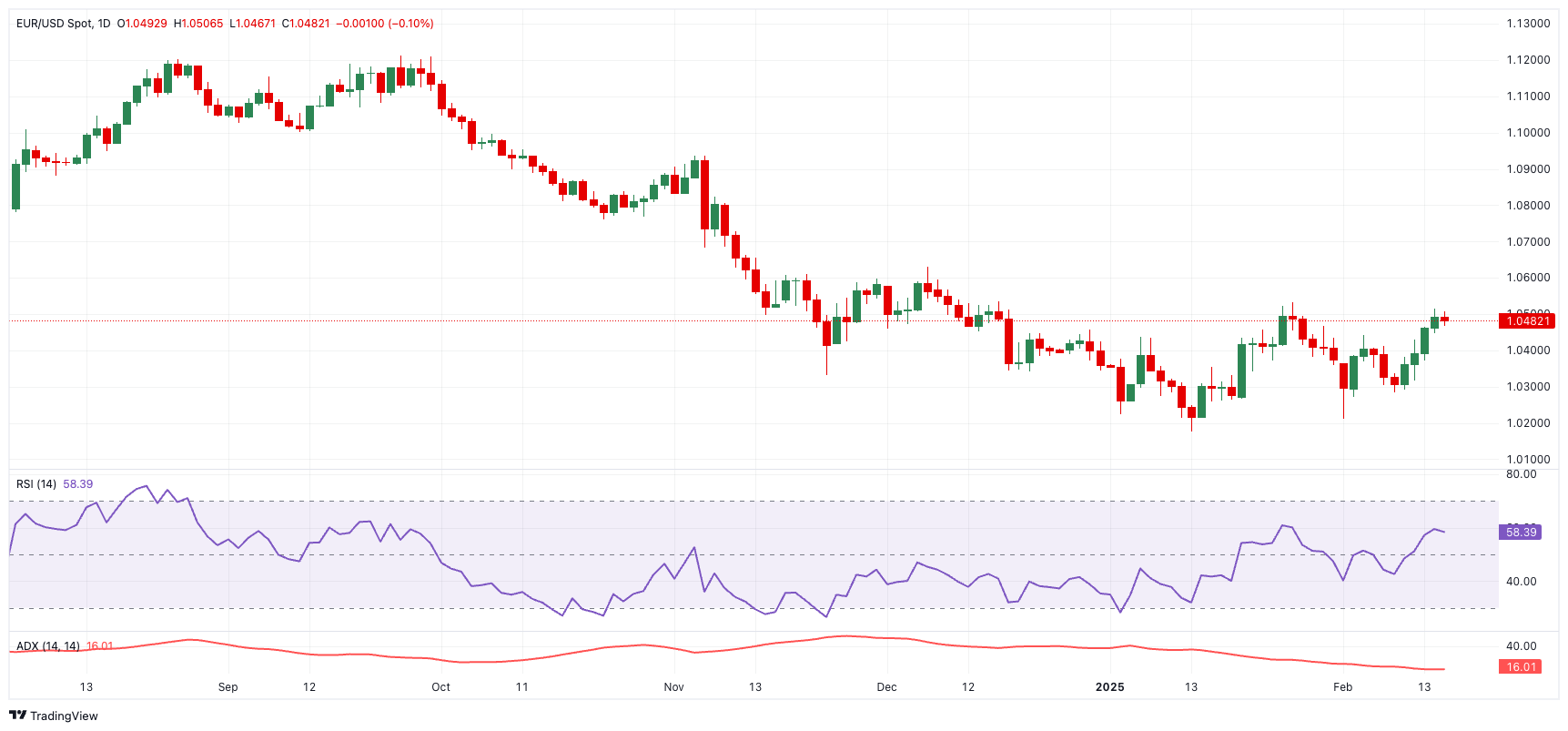
EUR/USD managed to regain composure and surpass the key 1.0500 hurdle in recent days.
In case of extra gains, the immediate barrier emerges at 1.0532, the 2025 high from January 27, followed by 1.0629, the December peak, and 1.0746, the 200-day Simple Moving Average.
On the downside, 1.0209, the February 3 weekly low, acts as initial support. A break below this level could lead to a deeper slide toward 1.0176, marking a new yearly low.
Technical indicators show mixed signals. The Relative Strength Index (RSI) remains around 59, suggesting improving momentum, while the Average Directional Index (ADX) around 15 signals that the current trend may be losing strength.
EUR/USD daily chart
What’s Next for the Euro?
EUR/USD remains caught between multiple forces—trade tensions, Fed-ECB policy divergence, and sluggish eurozone growth in combination with political effervescence, particularly in Germany. While short-term spikes in the pair are possible, the broader outlook remains uncertain for the time being.
Author

Pablo Piovano
FXStreet
Born and bred in Argentina, Pablo has been carrying on with his passion for FX markets and trading since his first college years.