EUR/USD Price Forecast: Next on the downside sits 1.1575
- EUR/USD builds on Wednesday’s pullback and deflates to 1.1650.
- The US Dollar gathered extra pace, backed by firm data and rising yields.
- Final US Q2 GDP, weekly labour market data surprised to the upside.


The Euro (EUR) came under heavy pressure on Thursday, with EUR/USD extending Wednesday’s losses and sliding back into the mid-1.1600s, marking new three-week lows.
The move reflects more than just weakness around the single currency. Indeed, the US Dollar (USD) continues to march higher, fuelled by a strong rebound in US yields across the curve and firmer-than-estimated data. On this, the US Dollar Index (DXY) moves to multi-week highs, comfortably above the 98.00 mark.
The Fed is still searching for balance
The Federal Reserve (Fed) cut interest rates by 25 basis points on September 17. Policymakers pointed to a softer labour market as the trigger but also admitted that inflation is still running “somewhat elevated”.
The updated “dot plot” sketched out another 50 basis points of easing before the end of the year, smaller trims through 2026 and 2027, and a median 2025 policy rate of 3.6%. Growth was revised slightly higher to 1.6%, unemployment left steady at 4.5%, and inflation projections unchanged.
Not everyone was on the same page, though. Incoming governor Stephen Miran argued for a deeper half-point cut, although no one else followed him.
At his press conference, Chair Jerome Powell pointed to slower job creation, weaker consumer spending, and inflation running at 2.7% on the headline PCE and 2.9% on the core measure. He blamed tariffs for some of the pressure on prices but noted that services inflation is easing. Powell framed the risks as “more balanced”, suggesting the Fed is moving closer to neutral and not preparing for aggressive cuts.
When he spoke again on September 23 at the Greater Providence Chamber of Commerce in Rhode Island, Powell admitted the Fed is facing a “challenging situation”: inflation could flare back up even as weak job growth raises concerns about the labour market.
The ECB is comfortable waiting
The European Central Bank (ECB) earlier this month left rates unchanged, keeping its meeting-by-meeting approach in place. Policymakers said inflation is broadly aligned with the 2% medium-term target, with core expected to average 2.4% in 2025, easing to 1.9% in 2026 and 1.8% in 2027.
President Christine Lagarde described the ECB as being in a “good place”, saying the risks look more balanced now. She stressed, however, that any shift in policy will depend entirely on incoming data.
Trade frictions cool, but not gone
Trade tensions have eased a touch. Washington and Beijing agreed to extend their truce by 90 days, though tariffs remain steep: the US still levies a 30% duty on Chinese imports, while China keeps a 10% tariff on US goods.
The US also reached a deal with the EU some weeks ago. Brussels cut tariffs on US industrial goods and opened the door wider to American farm and seafood exports. In return, Washington slapped a 15% tariff on most EU imports. Auto tariffs, however, are still on the table and remain unresolved.
Speculators take a step back
Speculative demand for the Euro has cooled off. Commodity Futures Trading Commission (CFTC) data for the week ending September 16 showed non-commercial (speculators) net longs falling to a five-week low of about 117.8K contracts. Institutional traders (mostly hedge funds) pared net shorts to roughly 167.4K contracts, while open interest dropped to about 855.5K contracts. The numbers suggest conviction is fading on both sides of the market.
Technical picture
EUR/USD has started the week on the front foot, although it has rapidly changed course.
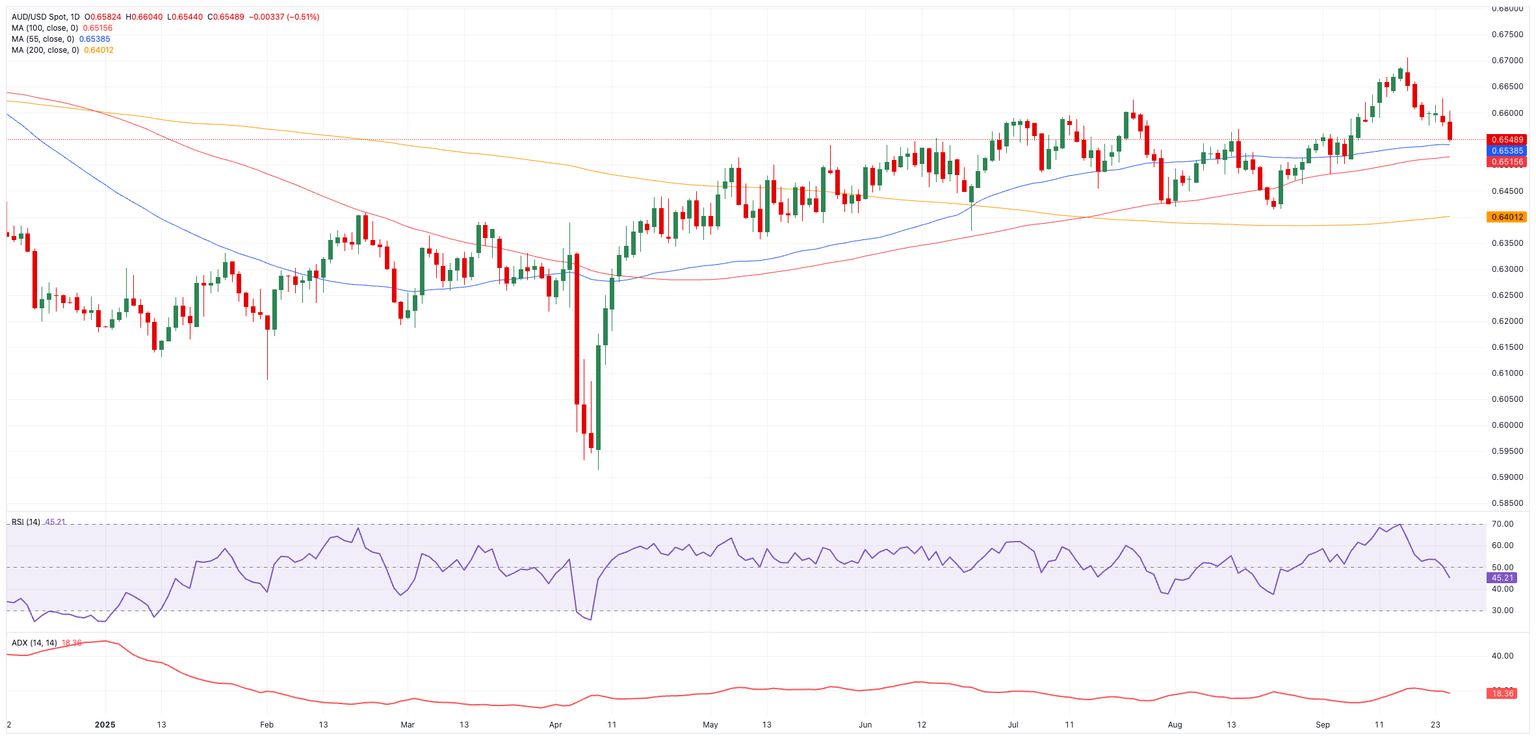
That said, a deeper retracement could expose the provisional 100-day Simple Moving Average (SMA) at 1.1583, which reinforces the weekly low at 1.1574 (August 27) and then the August trough at 1.1391 (August 1).
In case bulls regain the initiative, a move toward yearly peaks above 1.1900 could start re-emerging on the horizon. The key upside marker sits at the 2025 ceiling in 1.1918 (September 17). A clear break would open the way to the psychological 1.2000 level.
Signs from momentum indicators have deteriorated somewhat:The Relative Strength Index (RSI) is close to 44, which means that sellers are now quite comfortable. The Average Directional Index (ADX), on the other hand, is just over 16, which means that the overall trend remains pale.
EUR/USD daily chart
Where next?
So, where does that leave EUR/USD? The pair could certainly bounce in the short term, but it probably needs a bigger spark for a sustained move. That catalyst might come from a dovish turn at the Fed, investors trimming exposure to US assets, a breakthrough in trade talks, or stronger signals that the ECB is comfortable staying on hold for longer.
Euro FAQs
The Euro is the currency for the 19 European Union countries that belong to the Eurozone. It is the second most heavily traded currency in the world behind the US Dollar. In 2022, it accounted for 31% of all foreign exchange transactions, with an average daily turnover of over $2.2 trillion a day. EUR/USD is the most heavily traded currency pair in the world, accounting for an estimated 30% off all transactions, followed by EUR/JPY (4%), EUR/GBP (3%) and EUR/AUD (2%).
The European Central Bank (ECB) in Frankfurt, Germany, is the reserve bank for the Eurozone. The ECB sets interest rates and manages monetary policy. The ECB’s primary mandate is to maintain price stability, which means either controlling inflation or stimulating growth. Its primary tool is the raising or lowering of interest rates. Relatively high interest rates – or the expectation of higher rates – will usually benefit the Euro and vice versa. The ECB Governing Council makes monetary policy decisions at meetings held eight times a year. Decisions are made by heads of the Eurozone national banks and six permanent members, including the President of the ECB, Christine Lagarde.
Eurozone inflation data, measured by the Harmonized Index of Consumer Prices (HICP), is an important econometric for the Euro. If inflation rises more than expected, especially if above the ECB’s 2% target, it obliges the ECB to raise interest rates to bring it back under control. Relatively high interest rates compared to its counterparts will usually benefit the Euro, as it makes the region more attractive as a place for global investors to park their money.
Data releases gauge the health of the economy and can impact on the Euro. Indicators such as GDP, Manufacturing and Services PMIs, employment, and consumer sentiment surveys can all influence the direction of the single currency. A strong economy is good for the Euro. Not only does it attract more foreign investment but it may encourage the ECB to put up interest rates, which will directly strengthen the Euro. Otherwise, if economic data is weak, the Euro is likely to fall. Economic data for the four largest economies in the euro area (Germany, France, Italy and Spain) are especially significant, as they account for 75% of the Eurozone’s economy.
Another significant data release for the Euro is the Trade Balance. This indicator measures the difference between what a country earns from its exports and what it spends on imports over a given period. If a country produces highly sought after exports then its currency will gain in value purely from the extra demand created from foreign buyers seeking to purchase these goods. Therefore, a positive net Trade Balance strengthens a currency and vice versa for a negative balance.
Premium
You have reached your limit of 3 free articles for this month.
Start your subscription and get access to all our original articles.
Author
Pablo Piovano
FXStreet
Born and bred in Argentina, Pablo has been carrying on with his passion for FX markets and trading since his first college years.

















