EUR/USD Price Forecast: It’s all about Trump’s Liberation Day


EUR/USD Current price: 1.0816
- United States President Donald Trump will announce fresh tariffs in the American session.
- The US ADP Employment report came in at 155K much better than anticipated.
- EUR/USD turned flat in the near term, awaits Trump for direction.
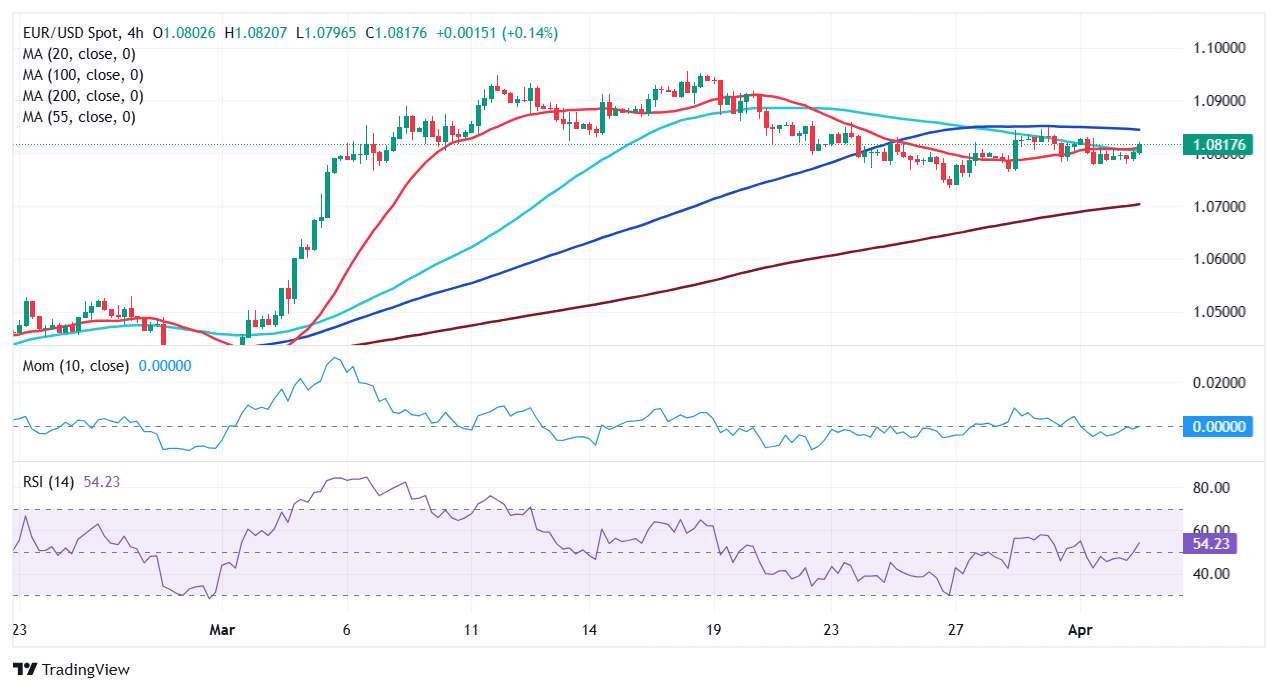
The EUR/USD pair hovers around 1.0810, its highest for the day, yet confined to a tight intraday range for a second day in a row, as investors await fresh announcements from the United States (US) President Donald Trump. The so-called “Liberation Day” is here, and Trump is set to offer a press conference explaining the next round of tariffs rumored to become effective immediately. Uncertainty around the event, however, remains high. As a result, stock markets stand in the red, while the US Dollar (USD) trades mixed across the board.
Data-wise, the US published the March ADP Employment Change report, which showed that the private sector created 155K new jobs in the month, much better than the 105K expected or the previous revised 84K. February Factory Orders will be released later in the session. The upbeat employment-related figures partially lifted the mood and pushed the USD marginally lower across the FX board.
EUR/USD short-term technical outlook
Technically, the daily chart for the EUR/USD pair shows it keeps developing below a now flat 20 Simple Moving Average (SMA), providing dynamic resistance at around 1.0840, while the 100 and 200 SMAs remain directionless far below the current level. Technical indicators, in the meantime, pared their slides and hover directionless around their midlines, failing to provide clear directional clues.
The 4-hour chart for the EUR/USD pair shows it is hovering at around a flat 20 Simple Moving Average (SMA), while a flat 100 SMA provides dynamic resistance at 1.0850. The 200 SMA, in the meantime, aims marginally higher, far below the current level. Finally, technical indicators lack directional strength within neutral levels, reflecting that speculative interest remains sidelined.
Support levels: 1.0765 1.0730 1.0690
Resistance levels: 10850 1.0885 1.0925
Tariffs FAQs
Tariffs are customs duties levied on certain merchandise imports or a category of products. Tariffs are designed to help local producers and manufacturers be more competitive in the market by providing a price advantage over similar goods that can be imported. Tariffs are widely used as tools of protectionism, along with trade barriers and import quotas.
Although tariffs and taxes both generate government revenue to fund public goods and services, they have several distinctions. Tariffs are prepaid at the port of entry, while taxes are paid at the time of purchase. Taxes are imposed on individual taxpayers and businesses, while tariffs are paid by importers.
There are two schools of thought among economists regarding the usage of tariffs. While some argue that tariffs are necessary to protect domestic industries and address trade imbalances, others see them as a harmful tool that could potentially drive prices higher over the long term and lead to a damaging trade war by encouraging tit-for-tat tariffs.
During the run-up to the presidential election in November 2024, Donald Trump made it clear that he intends to use tariffs to support the US economy and American producers. In 2024, Mexico, China and Canada accounted for 42% of total US imports. In this period, Mexico stood out as the top exporter with $466.6 billion, according to the US Census Bureau. Hence, Trump wants to focus on these three nations when imposing tariffs. He also plans to use the revenue generated through tariffs to lower personal income taxes.
Premium
You have reached your limit of 3 free articles for this month.
Start your subscription and get access to all our original articles.
Author
Valeria Bednarik
FXStreet
Valeria Bednarik was born and lives in Buenos Aires, Argentina. Her passion for math and numbers pushed her into studying economics in her younger years.