EUR/USD Price Forecast: Holding ground as Fed looms

EUR/USD Current price: 1.1508
- Middle East tensions and global trade woes weigh on investors' mood.
- The Federal Reserve will soon announce its decision on monetary policy.
- EUR/USD consolidates at around 1.1500 as investors await the Fed.
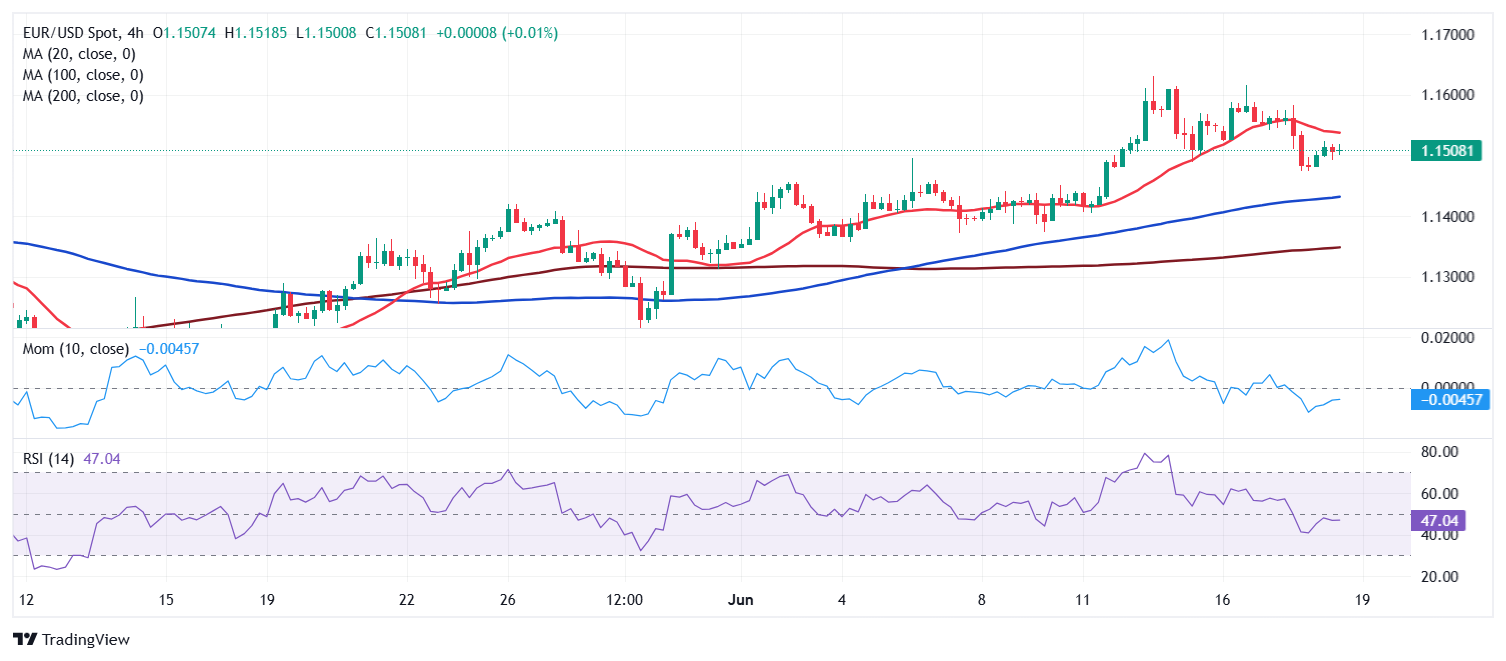
The EUR/USD pair hovers around the 1.1500 level, recovering from a weekly low of 1.1474 posted on Tuesday amid risk aversion fueling demand for the US Dollar (USD). Concerns revolved around the Middle East crisis, as the back-and-forth missile attack between Israel and Iran continues, while United States (US) President Donald Trump adds fuel to the fire.
Trump said on Tuesday that the US's patience was “wearing thin,” and that the US has complete control of the Iranian airspace. Even further, Trump said that he was not in the mood to negotiate, somehow suggesting he would intervene in the conflict.
Other than that, tensions relate to global trade, as tariffs’ negotiations between the US and major rivals show no signs of progress. The latest comments on the matter came from President Trump, who said that Japan was being "tough" in trade talks and that the European Union (EU) had not yet offered a fair deal.
Market participants are now on hold ahead of the Federal Reserve (Fed) monetary policy meeting. The central bank is widely anticipated to keep interest rates on hold, while offering fresh perspectives through the Summary of Economic Projections (SEP). Finally, Chairman Jerome Powell will offer a press conference.
Data-wise, the EU confirmed the Harmonized Index of Consumer Prices (HICP) at 2.3% YoY in May, as previously estimated. The US published Initial Jobless Claims, which rose by 245K in the week ended June 14, matching expectations and better than the revised 250K posted in the previous week.
EUR/USD short-term technical outlook
From a technical point of view, the daily chart for the EUR/USD pair shows that the pair lacks directional momentum, although bulls hold the grip. Technical indicators in the mentioned time frame hold well above their midlines, but with diverging slopes. At the same time, the 20 Simple Moving Average (SMA) partially recovered its upward strength, currently providing dynamic support at around 1.1410.
The 4-hour chart shows that the upward potential remains limited for EUR/USD. The pair seesaws below a mildly bearish 20 SMA, while it also holds above the 100 and 200 SMAs. Finally, technical indicators head nowhere just below their midlines. The upcoming Fed’s decision will set the tone for the EUR/USD, regardless of technical hints.
Support levels: 1.1485 1.1440 1.1410
Resistance levels: 1.1530 1.1580 1.1620
Premium
You have reached your limit of 3 free articles for this month.
Start your subscription and get access to all our original articles.
Author

Valeria Bednarik
FXStreet
Valeria Bednarik was born and lives in Buenos Aires, Argentina. Her passion for math and numbers pushed her into studying economics in her younger years.