EUR/USD Price Forecast: Further weakness likely below the 200-day SMA
- EUR/USD rebounded sharply past the 1.0400 barrier on Monday.
- The US Dollar came under strong selling pressure on Inauguration Day.
- Investors should closely follow Trump’s initial announcements this week.

The Euro (EUR) extended its recovery against the US Dollar (USD) on Monday, briefly climbing above the 1.0400 mark as the Greenback remained under heavy pressure.
In fact, the US Dollar Index (DXY) struggled in response to widespread risk-on sentiment as investors were assessing President Trump’s message on Inauguration Day.
It is worth noting that the Greenback lost some momentum last week on disappointing US data, while dovish remarks from FOMC Governor Christopher Waller further weighed on the USD as he hinted at the possibility of additional rate cuts if economic conditions warranted them. This back-and-forth in the Greenback highlights growing investor uncertainty as markets reassess the likelihood of Federal Reserve (Fed) policy changes at its upcoming January 28-29 meeting.
Central banks in focus
Monetary policy continues to drive market dynamics. December’s strong Nonfarm Payrolls report (+256K) has prompted traders to recalibrate their expectations for the Fed’s actions in 2025. Currently, most anticipate either a modest 25-basis-point rate cut or no change at all.
In December, the Fed lowered interest rates by 25 basis points to a range of 4.25%–4.50%. However, it signalled a more cautious approach for 2025 due to concerns about persistent inflation. Fed Chair Jerome Powell reaffirmed the central bank’s commitment to its 2% inflation target, acknowledging that inflation in 2024 exceeded expectations. Powell stressed the importance of vigilance, pointing out that while the labor market is gradually softening, the Fed must maintain a delicate balance between price stability and full employment.
Meanwhile, the European Central Bank (ECB) is expected to continue its rate-cutting strategy, even as inflation in the eurozone ticked higher in December. The ECB remains focused on supporting growth, particularly in Germany, while navigating risks from political instability. ECB Vice President Luis de Guindos recently emphasized that further rate cuts would depend on inflation easing as projected, though he also warned of uncertainties stemming from global trade tensions, fiscal policy shifts and geopolitical risks.
Trade policy and its impact
Uncertainty around President-elect Trump’s proposed trade tariffs also looms large. If implemented, these tariffs could stoke inflation in the US, potentially forcing the Fed to maintain a more aggressive monetary stance. This scenario could strengthen the USD further, adding pressure to the EUR/USD pair.
Key events to watch
Looking ahead, market participants will focus on sentiment gauges in Germany and the euro bloc, as well as advanced Manufacturing and Services PMIs.
Technical outlook for EUR/USD
EUR/USD remains under pressure, with key support levels at 1.0176 (year-to-date low on January 13) and the parity level at 1.0000. On the upside, resistance is located at 1.0436 (2025 high on January 6), 1.0486 (55-day SMA) and 1.0629 (December peak).
The broader bearish trend will likely persist as long as the pair stays below the 200-day SMA at 1.0775. In shorter timeframes, interim resistance lies at 1.0434 and 1.0534, while support can be found at 1.0176, 0.9935, and 0.9730. Momentum indicators are mixed, with the RSI bouncing to nearly 51, suggesting some pick-up in momentum, while the ADX diminishing to around 31 points to a shrinking strength in the current trend.
EUR/USD daily chart
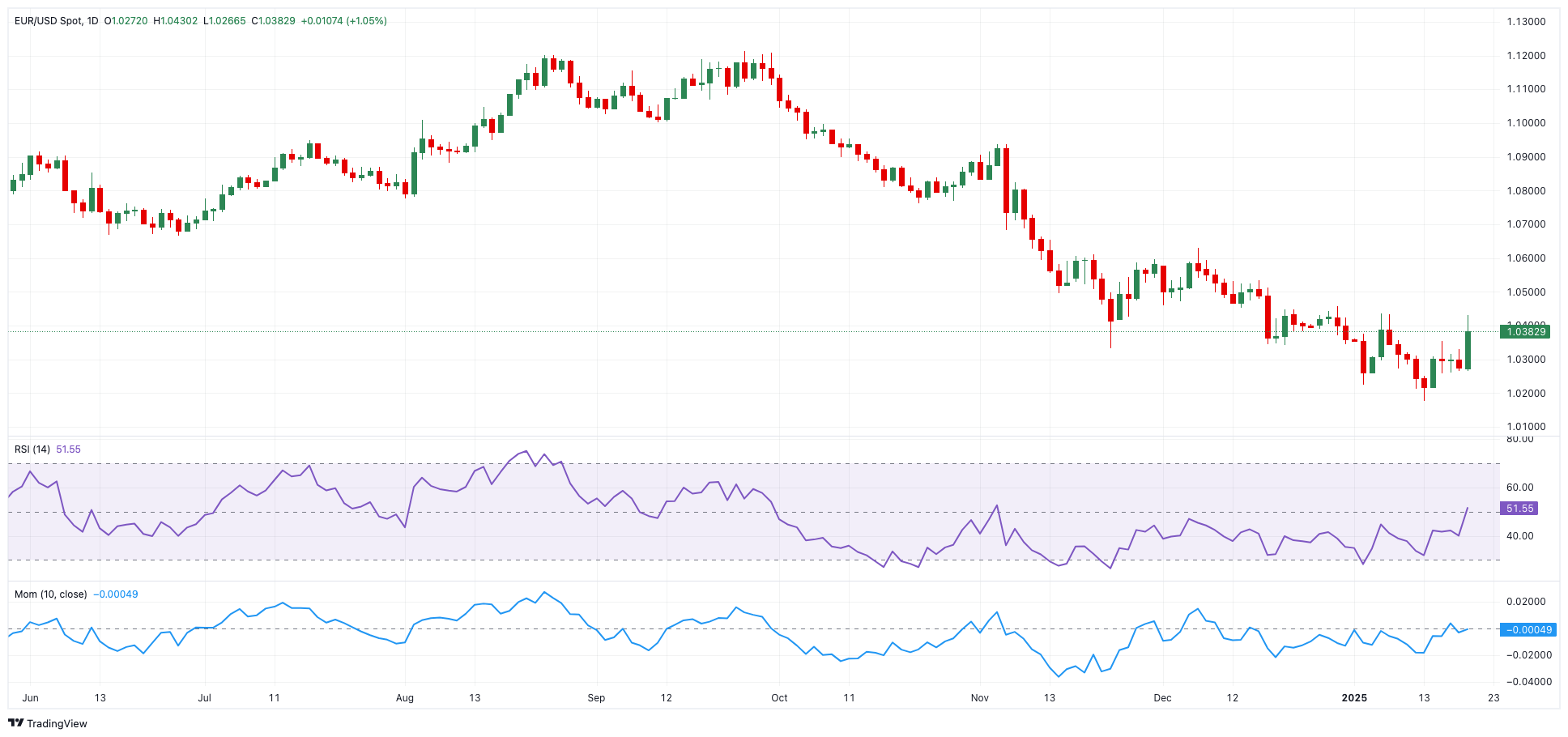
Outlook: EUR/USD faces an uphill battle
The EUR/USD pair continues to grapple with headwinds from a strong US Dollar, divergent monetary policies between the Fed and ECB, and persistent economic and political uncertainties. With eurozone growth—especially in Germany—facing challenges, the euro remains under pressure. While a short-term recovery is possible, the pair is likely to struggle for sustained gains in the current challenging environment.
Author

Pablo Piovano
FXStreet
Born and bred in Argentina, Pablo has been carrying on with his passion for FX markets and trading since his first college years.