|

EUR/USD preserves upleg above SMAs

  • EUR/USD finds familiar support after pullback from 4-year high.

  • A break above 1.1800 could trigger the next bullish cycle.

Chart

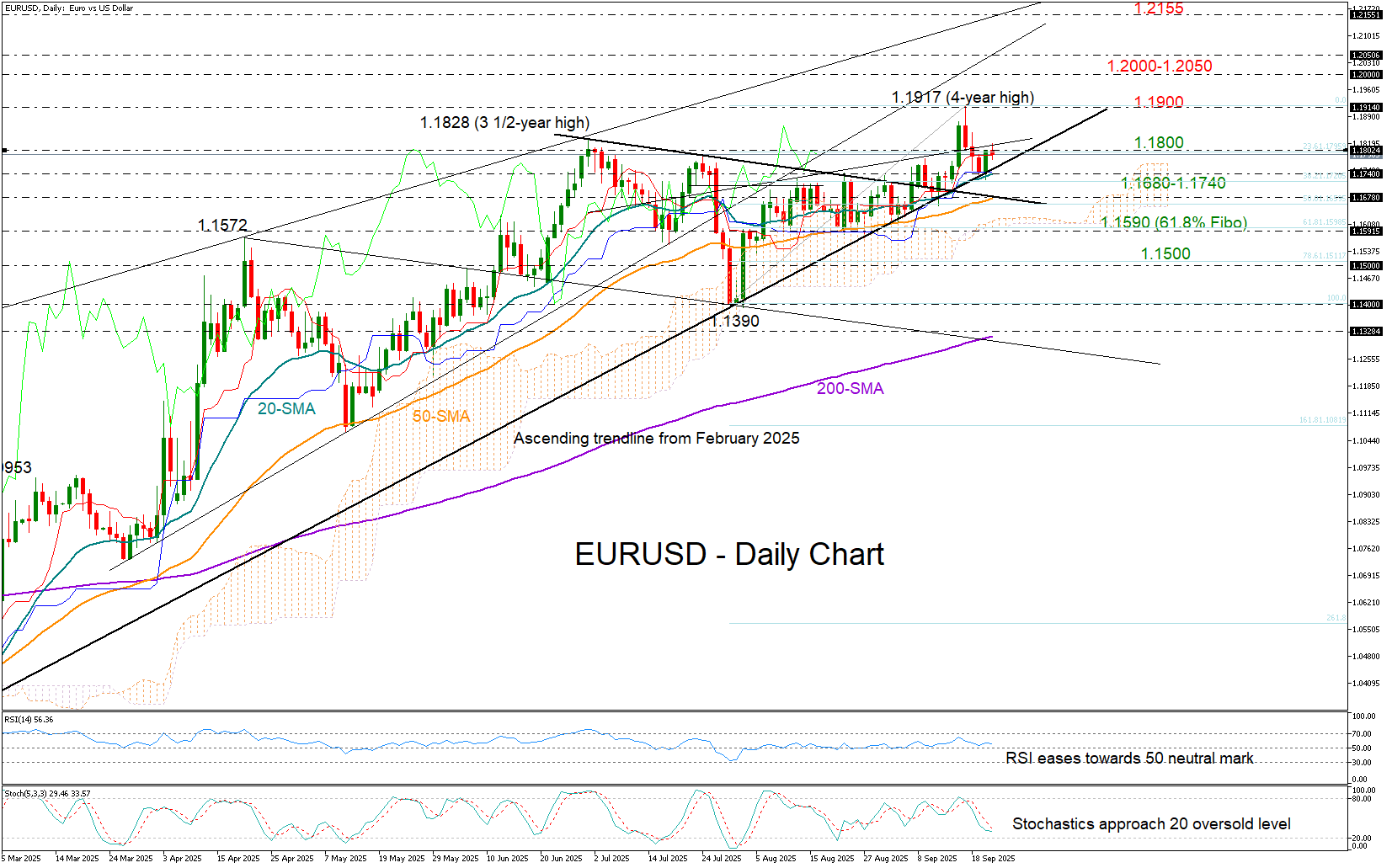
EUR/USD continues to defend its July–September upleg. Despite its pullback from a four-year high of 1.1917, the bulls managed to secure strong foothold around the 20-day simple moving average (SMA) at 1.1735 on Monday. Recall that the pair has been fluctuating above its short-term SMAs for nearly two months. Therefore, yesterday’s pivot boosted optimism that the bulls are still in town. 

With the Fed preparing a more accommodative monetary policy and the ECB pausing its rate-cut cycle, the euro still carries an advantage, although upcoming data releases could alter policy guidance. German flash business PMI figures for September were mixed earlier today: the services sector showed further expansion to 52.5, while the manufacturing PMI slipped back into contraction below 50. 

From a technical perspective, traders may prefer to remain on the sidelines unless the price reclaims the 1.1800 level. If that happens, the 1.1900 area could act as immediate resistance, and a decisive break above it could open the way toward the 1.2000–1.2050 region. Beyond that, the next barrier may emerge around 1.2150.

On the downside, if the pair falls below its short-term SMAs and the 2025 support trendline, currently located in the 1.1680–1.1740 zone, the bears could push the price toward the 1.1590 region. The 61.8% Fibonacci retracement level of the latest upleg may reinforce that floor. Otherwise, a deeper sell-off could extend toward the 1.1500 area.

In summary, EURUSD appears neutral in the short-term outlook. After its pullback from a four-year high, the bulls need to reclaim the 1.1800 area to revive momentum for a continuation higher.

Author

Christina Parthenidou

Christina joined the XM investment research department in May 2017. She holds a master degree in Economics and Business from the Erasmus University Rotterdam with a specialization in International economics.


More from Christina Parthenidou
Share:

Markets move fast. We move first.

Orange Juice Newsletter brings you expert driven insights - not headlines. Every day on your inbox.

By subscribing you agree to our Terms and conditions.

Editor's Picks

EUR/USD holds steady below 1.1800

EUR/USD moves sideways in a narrow channel below 1.1800 as the market volatility remains low ahead of the New Year holiday. On Tuesday, investors will pay close attention to the minutes of the Federal Reserve's December policy meeting.

GBP/USD retreats below 1.3500 as trading conditions remain thin

GBP/USD corrects lower after posting strong gains in the previous week and trades below 1.3500 on Monday. With the action in financial markets turning subdued following the Christmas holiday, however, the pair's losses remain limited.

Gold holds above $4,300 after profit taking kicked in

Gold retreats sharply from the record-peak it set at $4,550 and trades below $4,400, losing more than 3% on the day. Growing optimism about a Ukraine-Russia peace agreement and profit-taking ahead of the New Year holiday seem to be causing XAU/USD to stay under heavy bearish pressure.

Bitcoin, Ethereum, and XRP bulls regain strength

Bitcoin, Ethereum, and Ripple record roughly 3% gains on Monday, regaining strength mid-holiday season. Despite thin liquidity in the holiday season, BTC and major altcoins are regaining strength as US President Donald Trump pushes peace talks between Russia and Ukraine. The technical outlook for Bitcoin, Ethereum, and Ripple gradually shifts bullish as selling pressure wanes.

Economic outlook 2026-2027 in advanced countries: Solidity test

After a year marked by global economic resilience and ending on a note of optimism, 2026 looks promising and could be a year of solid economic performance. In our baseline scenario, we expect most of the supportive factors at work in 2025 to continue to play a role in 2026.

Crypto market outlook for 2026

Year 2025 was volatile, as crypto often is.  Among positive catalysts were favourable regulatory changes in the U.S., rise of Digital Asset Treasuries (DAT), adoption of AI and tokenization of Real-World-Assets (RWA).