|

EUR/USD path of least resistance is up ahead of Draghi – Confluence Detector

EUR/USD consolidates its recovery around 1.1400 after ECB President Mario Draghi was one of the protagonists of the recent volatility. Draghi will speak again later today amid a technically favorable environment for the euro.

The Technical Confluences Indicator shows that that the world's most popular currency pair has significant support around 1.1390 which is the convergence of the Simple Moving Average 10-one-day, the Fibonacci 23.6% one-week, and the Fibonacci 23.6% one-day.

Further support is close by. At 1.1375 we see a juncture including the Bollinger Band four-hour Middle, the Fibonacci 38.2% one-week, the Fibonacci 38.2% one-day, the SMA 100-1h, the SMA 5-1d, and the SMA 10-4h. 

Looking up, the clusters of resistance are not as massive. At 1.1439 we see the meeting point of the Fibonacci 23.6% one-month and the Bollinger Band 4h-Upper. 

The next meaningful cap is only at 1.1533 which is the confluence of the BB one-day Upper and the Pivot Point one-month Resistance 1.

All in all, the upside is more appealing. 

Here is how it looks on the tool:
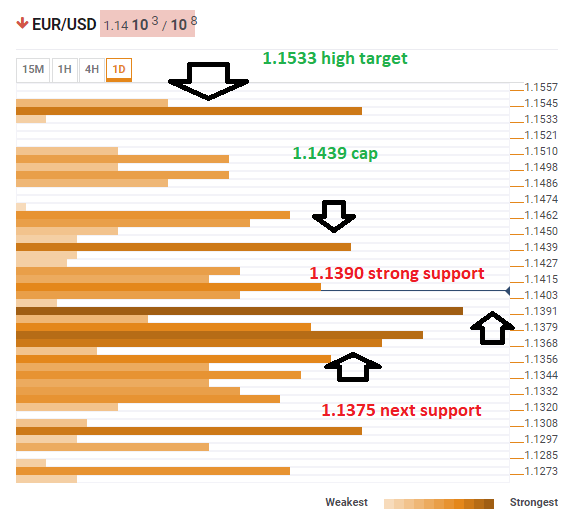
EURUSD technical confluence analysis January 28 2019

Confluence Detector

The Confluence Detector finds exciting opportunities using Technical Confluences. The TC is a tool to locate and point out those price levels where there is a congestion of indicators, moving averages, Fibonacci levels, Pivot Points, etc. Knowing where these congestion points are located is very useful for the trader, and can be used as a basis for different strategies.

This tool assigns a certain amount of “weight” to each indicator, and this “weight” can influence adjacents price levels. These weightings mean that one price level without any indicator or moving average but under the influence of two “strongly weighted” levels accumulate more resistance than their neighbors. In these cases, the tool signals resistance in apparently empty areas.

Learn more about Technical Confluence

Author

Yohay Elam

Yohay Elam

FXStreet

Yohay is in Forex since 2008 when he founded Forex Crunch, a blog crafted in his free time that turned into a fully-fledged currency website later sold to Finixio.


More from Yohay Elam
Share:

Editor's Picks

USD/JPY stays below 160.50 as markets assess BoJ decision

USD/JPY fluctuates in a relatively narrow range above 160.00 on Tuesday as markets assess the Bank of Japan's (BoJ) decision to raise the policy rate by 25 at the June meeting. Meanwhile, investors keep a close eye on news coming out of the Middle East, while preparing for the critical Fed meeting.

AUD/USD trades in tight channel near 0.7050 despite hawkish RBA message

AUD/USD trades modestly lower on the day at around 0.7050 on Tuesday as markets adopt a cautious stance amid a lack of details surrounding the US-Iran peace agreement. The Reserve Bank of Australia (RBA) left the door open for possible policy tightening after leaving the interest rate unchanged, as expected, at the June meeting but failed to boost the Australian Dollar.

Gold trims gains, approaches $4,300

Gold now surrenders part of its initial advance and recedes to the vicinity of the $4,350 mark per troy ounce on Tuesday. The early enthusiasm sparked by the US-Iran peace deal has faded somewhat, prompting investors to adopt a more prudent stance as they await further details of the agreement and key guidance from the Fed.

Why a hawkish RBA is no longer enough to lift the Australian Dollar

The Reserve Bank of Australia delivered more than what markets expected: a hawkish hold that should have supported the Aussie. But markets widely ignored it.

BoJ just hiked and US-Iran deal is on the table: Why Japanese Yen is still around 160.00

The Bank of Japan lifted interest rates from 0.75% to 1.00%, its highest level in more than three decades. The landmark move aims to stabilize a sharply weakening Japanese Yen, but by looking at the immediate market reaction, it doesn’t look like it’s going to work.

Why a hawkish RBA is no longer enough to lift the Australian Dollar

The Reserve Bank of Australia delivered more than what markets expected: a hawkish hold that should have supported the Aussie. But markets widely ignored it, focusing instead on slowing economic growth and proving that central bank messaging alone isn’t always enough to drive currencies.















