EUR/USD Forecast: Why Non-Farm Payrolls may disappoint, triggering a bullish breakout
- EUR/USD has been recovering after the safe-haven dollar failed to capitalize on the stock sell-off.
- All eyes are on US Non-Farm Payrolls, which have room to disappoint.
- Friday's four-hour chart is showing a narrowing range that is set to make way for a substantial move.

Only a temporary calm before the next turbulence – EUR/USD is at a rare moment of stability in a turbulent week that saw a range of well over 200 pips. The brewing storm is the upcoming US Non-Farm Payrolls report for August.
Economists expect an increase of 1.4 million jobs last month, a remarkable surge in normal times but a slower restoration of jobs in coronavirus times. It would be below July's 1.763 million gain. The unemployment rate is projected to drop from 10.2% to 9.8% – entering single-digit territory which would cheer politicians.
However, lower joblessness is accompanied by a plunge in the participation rate, which is forecast to remain at the depressed level of 61.4%. Indicators leading to the publication have been mixed. While headline purchasing managers' indexes showed impressive expansion, their employment components continued contracting in August.
ADP's private-sector labor figure disappointed with an increase of only 428,000 positions. Investors shrugged it off – as the payrolls firm has been off the mark in recent months, unable to keep up with the rapid changes in employment.
One of the reasons for July's upbeat statistics came due to a seasonal quirk – the education sector normally sees firing in that month. However, these layoffs occurred earlier this year, due to the pandemic. The seasonally adjusted July figure was therefore skewed to the upside, a phenomenon that is unlikely to be repeated in August.
Overall, there are reasons to believe the NFP will fall short of estimates, weighing on the dollar and allowing EUR/USD to extend its recovery.
More:
- Nonfarm Payrolls Preview: Fed’s policy shift to introduce vital noise
- Non-Farm Payrolls August Preview: US dollar is waiting for good news
Euro/dollar's strength was evident in response to the much-awaited sell-off in stocks. The S&P 500 fell by around 3.5% after a 60% run from March's bottom. Profit-taking, concerns about deadlocked fiscal stimulus talks, and uncertainty about the elections – which still point to a small lead for Biden – were cited as reasons for the fall. The safe-haven dollar tends to gain when stocks fall – and that did not happen now.
Not all is well in the old continent – Germany's factory orders disappointed with a meager rise of 2.8% in July. The miss on expectations joins Thursday's report of a 1.3% drop in the eurozone's retail sales.
Coronavirus cases continue rising in Spain and France, with both major countries considering extending the furlough scheme that kept workers attached to their jobs.
The European Central Bank has been weighing on the common currency earlier this week. Philip Lane, the ECB's Chief Economists, said he is watching the exchange rate. Later, an article in the Financial Times cited unnamed officials expressing concern about the appreciation of the euro.
The ECB announces its decision next week and investors may refocus on these reports at some point – but probably only after the dust settles from the NFP.
Overall, the war between bulls and bears continues, and bulls may have the upper hand on Friday due to weak Non-Farm Payrolls.
EUR/USD Technical Analysis
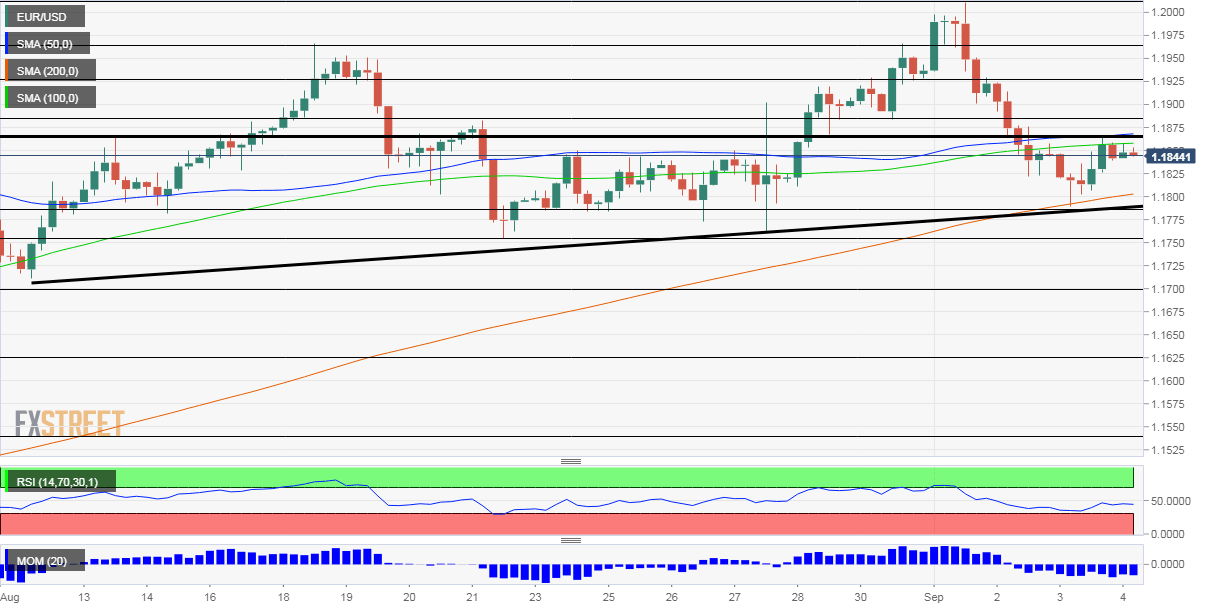
Euro/dollar is squeezed between two strong lines. Robust resistance awaits at 1.1865, which is the convergence of the 50 Simple Moving Average on the four-hour chart and the daily high. The SMA 100 is also close by.
Looking down, uptrend support awaits at 1.1785. It nearly converges with the 200 SMA. The range is narrowing and points to an explosion in one direction or another. Momentum is to the downside.
Below 1.1785, the next levels to watch are 1.1750 and 1.17.
Further resistance beyond 1.1865 is at 1.1885, 1.1925 and 1.1960.
More What is behind the greenback comeback? Not only the NFP buildup
Author

Yohay Elam
FXStreet
Yohay is in Forex since 2008 when he founded Forex Crunch, a blog crafted in his free time that turned into a fully-fledged currency website later sold to Finixio.
















