EUR/USD Forecast: US data not supporting Fed’s dovishness

EUR/USD Current Price: 1.0586
- The US Consumer Price Index rose in September by more than anticipated.
- US government bond yields surged, boosting the American currency.
- EUR/USD gains bearish traction and could test 1.0500 in the near term.
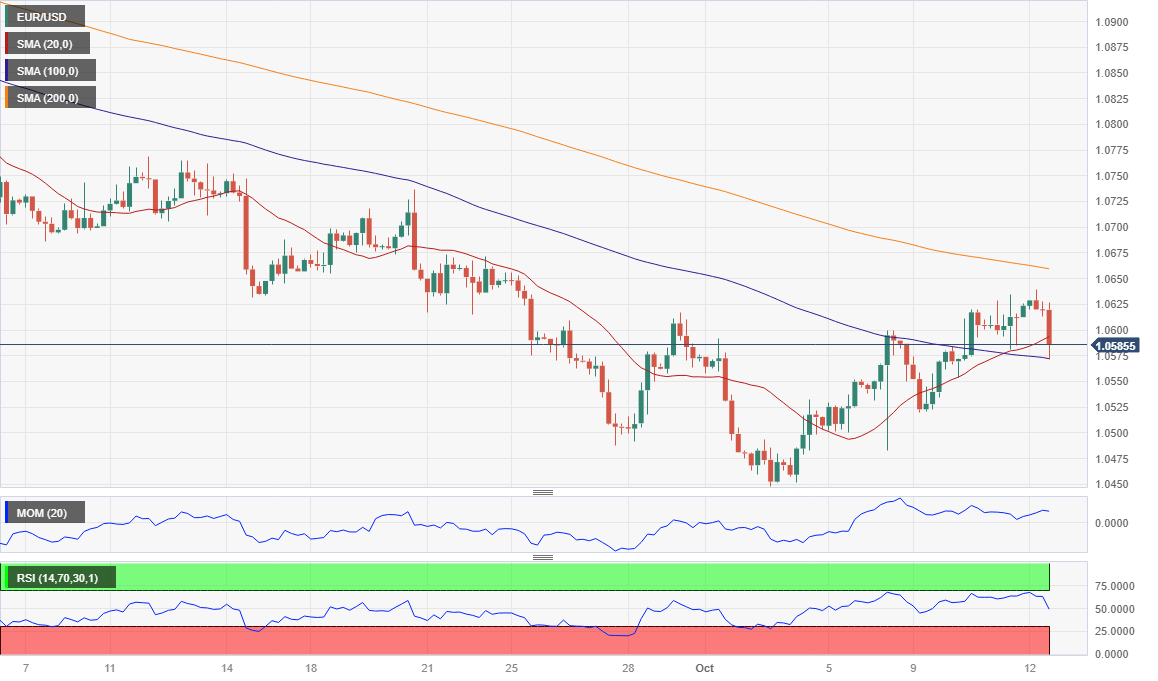
The EUR/USD pair peaked at 1.0639 during London trading hours but stabilized in the 1.0610 price zone ahead of the release of the United States (US) Consumer Price Index (CPI). The market sentiment was generally positive, with stock markets posting substantial gains and government bond yields extending their weekly slides before the announcement.
Finally, the US reported that the inflation was up by 0.4% MoM in September and rose by 3.7% from a year earlier, higher than anticipated. The annual core CPI printed at 4.1%, meeting expectations while easing from the previous 4.3%. At the same time, the country published Initial Jobless Claims for the week ended October 6, which resulted in 209K, slightly better than the 210K expected. The US Dollar gained upward traction with the news, as higher inflation and a tight labor market are not helping the case of an on-hold Federal Reserve (Fed).
Following data releases, US government bond yields ticked north, reflecting investors’ concerns, while Wall Street futures shed some ground. As a result, the EUR/USD pair fell to the 1.0570 price zone, losing its positive stance.
EUR/USD short-term technical outlook
The daily chart for the EUR/USD pair suggests the decline will continue, as the pair is sliding through a bearish 20 Simple Moving Average (SMA). Technical indicators, in the meantime, turned south within negative levels, suggesting the bullish corrective advance is done.
In the near term, the 4-hour chart paints a similar picture. EUR/USD is about to break below a mildly bearish 100 SMA while already below the 20 SMA. At the same time, technical indicators accelerated lower, heading south almost vertically and currently within neutral levels. The pair has an immediate support level at 1.0560, with a steeper slide expected once below it.
Support levels: 1.0560 1.0520 1.0475
Resistance levels: 1.0600 1.0640 1.0690
Author

Valeria Bednarik
FXStreet
Valeria Bednarik was born and lives in Buenos Aires, Argentina. Her passion for math and numbers pushed her into studying economics in her younger years.
















