The Fed's rate cycle will not end in December
The Federal Reserve governors staked their economic opinion two weeks ago in a unanimous vote to hike the fed funds rate 25 basis points. It was the first adjustment in three years.
For markets, the September year end rate projection, which added 0.3% to 4.1% implying one more hike this year, just confirmed a long standing view.
Yet even though the Fed’s own analysis shows the 4.1% fed funds rate stationary through the end of next year, that is not the final word. Continuing price pressures, US economic strength and the Fed’s own institutional inertia will make that rate assumption moot by the next set of projections in early December.
The unanimous 12-0 Federal Reserve Open Market Committee (FOMC) vote came despite the presence of Kevin Warsh, the newly appointed Chairman, whose understanding of policy should agree with that of President Trump, that lower interest rates are better for the economy.
It’s clear that there was a majority, perhaps even 11 votes, for a rate hike. Chairman Warsh’s negative vote would have served no purpose but to undermine his authority. In the past four decades only one Fed Chairman, Paul Volker in 1984, lost a policy vote, and that was quickly patched up and reversed to prevent his resignation.
After having delayed raising interest rates in 2022 until March, when CPI was already 8.5% and the ostensible price guideline core PCE was 5.2%, the FOMC is not going to repeat the same mistake.
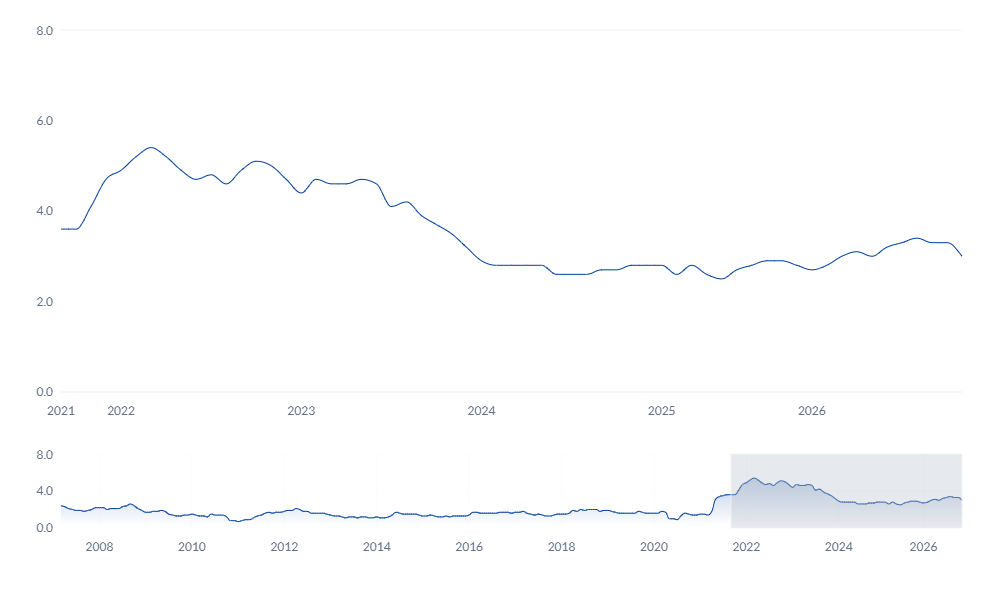
The September Fed statement, in Mr. Warsh’s new abbreviated style, noted that although the economy is expanding and “productivity”, “investment”, and “domestic spending” are “strong”, “robust” and “resilient”, "uncertainty remains elevated”, due “in part to geopolitical developments”.
Put more plainly, the impact of the Iran war on global energy prices, the basic commodity of industrial civilization, makes inflation very difficult to predict, and the board wary.
Consider the Fed rate action an insurance policy.
If oil prices continue at their current level or rise, the FOMC can keep rate hikes coming next year and will have gained a march on inflation. If energy prices and inflation fall, the governors, after a discrete interval, can cite statistics for the halt. Economically the insurance will cost little to the robust US economy.
Politically and bureaucratically at the FOMC, Warsh’s vote for a rate hike this time, should give him greater leverage next year to halt a rate cycle when and if inflation cools.
History is also on the side of further increases in 2027.
In the nine upward rate cycles since 1980, the FOMC has limited itself to two or a single 0.25% increase just twice. In March of 1997 the Fed hiked 25 basis points. The next move was a 25 basis point cut 18 months later in September 1998, (the first of three). In December 2015 the Fed also boosted the fed funds rate 25 basis points but then did not move again until December 2016 with another 0.25% increase, the beginning of a two year series of increases.
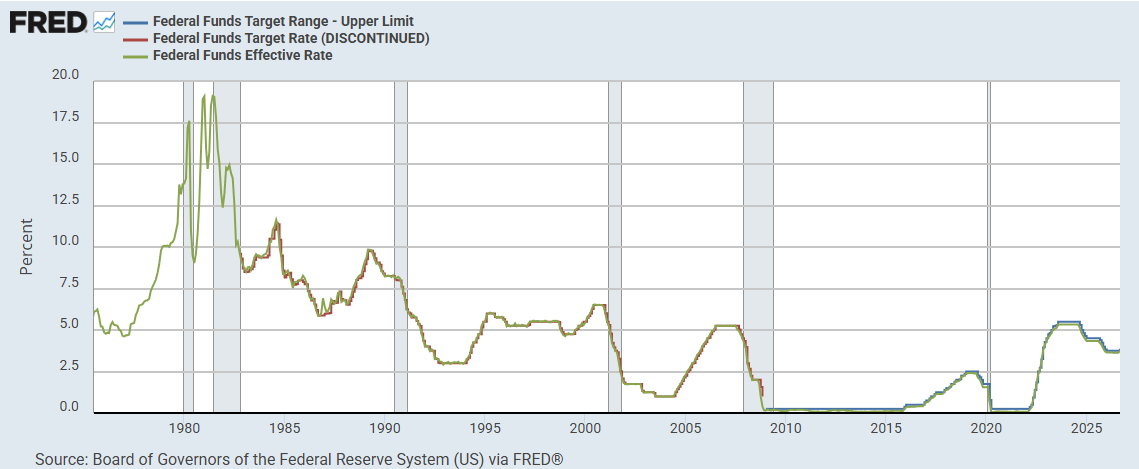
Even if the largest reason for the current inflation is the oil supply shock, which is swiftly reversible, and the core rates in August were only 3.0% and 2.4% for the PCE and CPI measures, the institutional momentum inherent in a unanimous vote should keep the governors on the rate pedal into the first half next year unless there is a drastic change in the inflation outlook.
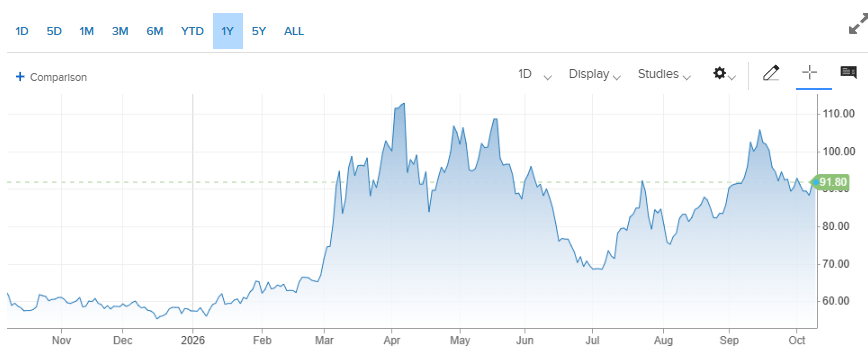
The average price for West Texas Intermediate (WTI) was 16% higher in September ($97.4) over August ($83.9), which guarantees continuing upward pressure on last month's prices. Regular gasoline averaged $4.06 in August and $4.33 in September according to the American Automobile Association (AAA), a 6.7% increase. September’s CPI will be reported on October 14th and PCE on the 30th.
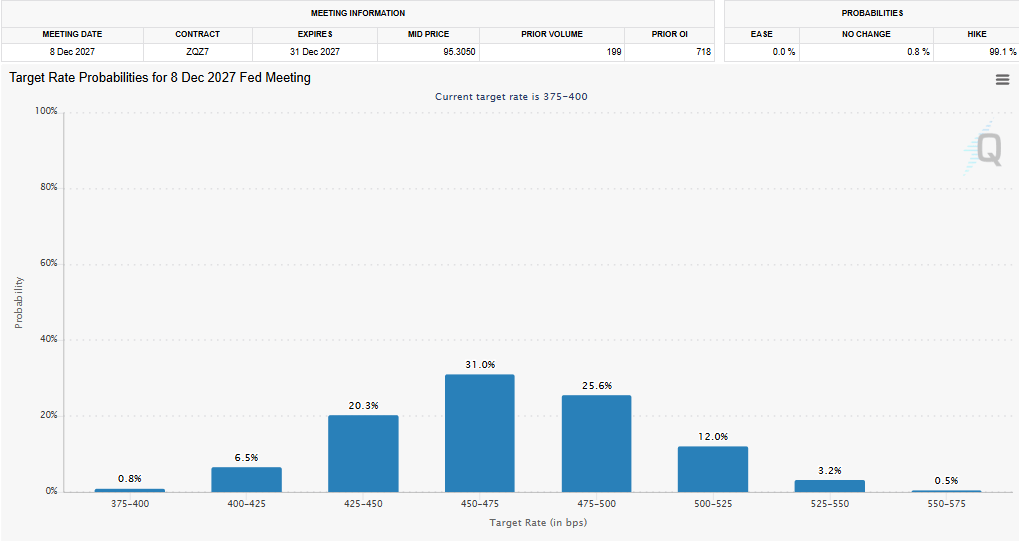
Futures markets also believe that more hikes are on the way in 2027. The CME FedWatch currently has 76.9% odds for between two and four more 0.25% increases to the end of 2027. The Economic Projections due at the December 9th FOMC meeting should second this market assessment.
In their September analysis the Fed governors depicted a modest US economy. The 2.3% GDP growth predicted for 2026 is already looking decidedly out of date.
Recent American statistics indicate economic growth has accelerated from the second to the third quarter.
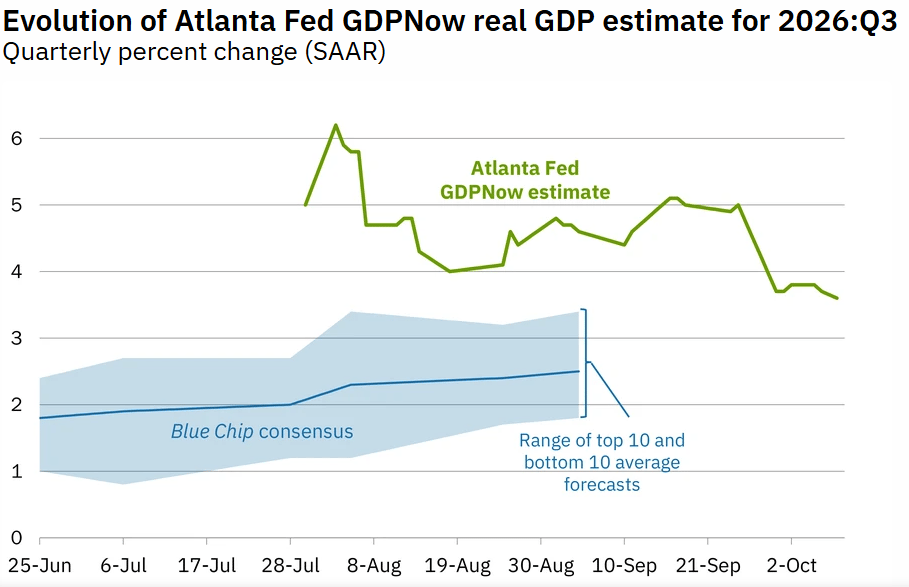
Annualized Gross Domestic Product (GDP) in the first quarter was 2.5%, and 2.2% in the second quarter, revised from 1.5% initially. The Atlanta Fed GDPNow estimate for the third quarter is currently 3.6%. Over the past five years the final GDPNow figure has been remarkably accurate, underestimating the final GDP number by an average of 0.44%.
Non-Farm Payrolls have averaged 66,000 for the six months from April to September. That is almost four times the 17,000 average of the prior six months from October 2025 to March.
Private sector jobs were 1,500 higher as federal, state and local governments have shed a total of 9,000 jobs in the past half year.
The Institute for Supply Management (ISM) Purchasing Managers’ Index (PMI), one of the most reliable leading economic indicators, has also improved in the past six months.
Services PMI, which represents the largest part of the US economy, has averaged 54.4 since April, a modest gain over 53.7 in the previous six months.
Manufacturing PMI has improved markedly, posting an average of 54 in the six months to September against 50.4 for the same statistic in March. However, the real improvement has been this year's 53.6 average against the contractionary 48.1 average of the previous 38 months.
Consumer spending, as the Fed notes, is ‘resilient’. Annual retail sales were up 6% in August, with the fourth month average of 5.9% well above the prior 12 month average of 3.6% and doubling the three year average to April of this year of 2.9%.
Core Durable Goods orders (Nondefense Capital Goods Orders Excluding Aircraft), a well regarded and responsive proxy for business investment, is also ‘robust’ as per the Fed. The six month average increase to August was 1.73%, the strongest in over six years.
This economic, investment and consumer activity has shrugged off the steep rise in US Treasury interest rates since the start of the Iran war on February 28.
The 2 year Treasury has gained 140 basis points overall to 4.77% as of this writing, with 63 of those points coming since August 13. The 10 year Treasury is likewise up 132 points to 5.28% with 90 of that addition arriving after June 29. The rates on 30-year fixed mortgages, the most popular in the US, have jumped from around 6% to 7.5%, the steepest rise in four years.
Until the Iran War and its continuing pressure and uncertainty on energy costs ends, and markets are convinced it is over, inflation, or at least the Fed’s concern, will not abate sufficiently for the governors to call a halt to their rate increases.
The Fed has begun an inflation cycle even though the governors know that the price problem is an energy supply shock that cannot be tamed by interest rates. No known rate level will insure free tanker passage in Middle Eastern waters.
If the war does not end and oil prices stay or rise, then the Fed has addressed the inflation problem with the only weapon it has, interest rates.
If, or as one hopes, when, the war ends and oil and energy prices resume their pre-conflict levels and trajectory, the Fed’s main consideration may be, how quickly–and with what degree of policy seemliness–it can end a cycle fomented by politics and not economics.
Author

Joseph Trevisani
FXStreet
Joseph Trevisani began his thirty-year career in the financial markets at Credit Suisse in New York and Singapore where he worked for 12 years as an interbank currency trader and trading desk manager.
















