EUR/USD Forecast: US CPI to trigger next directional movement
- EUR/USD has gone into a consolidation phase above 1.0900 early Wednesday.
- March inflation data from the US could significantly impact the USD's valuation.
- Near-term technical outlook shows that sellers remain on the sidelines.


EUR/USD has lost its recovery momentum and started to move sideways slightly above 1.0900 early Wednesday after having registered daily gains on Tuesday. The market reaction to March inflation data from the US could provide the next directional clue for the pair.
On Tuesday, the US Dollar Index staged a downward correction following the rebound witnessed in the aftermath of the March jobs report. The cautious market mood, however, helped the US Dollar (USD) limit its losses in the second half of the day and capped EUR/USD's upside.
In March, the Consumer Price Index (CPI) is forecast to fall to 5.2% on a yearly basis from 6% in February. The annual Core CPI, which excludes volatile food and energy prices, is expected to edge higher to 5.6% with a monthly increase of 0.3%, compared to 0.4% in February.
Investors are likely to react to the monthly core CPI print. In case this data arrives at 0.5% or higher, markets are likely to continue to price in a 25 basis points (bps) Federal Reserve (Fed) rate hike in May. The CME Group FedWatch Tool's probability for such decision sits at 67%, suggesting that there is room for additional USD strength.
On the other hand, a soft Core CPI with a monthly increase of 0.2% or lower should cause investors to reassess the Fed's rate outlook. In that scenario, the USD is likely to come under renewed selling pressure and allow EUR/USD to gather bullish momentum.
In the late American session, the Fed will also release the minutes of the March policy meeting. Since that meeting took place before the inflation and labor market data for March, however, the publication is unlikely to trigger a significant reaction.
EUR/USD Technical Analysis
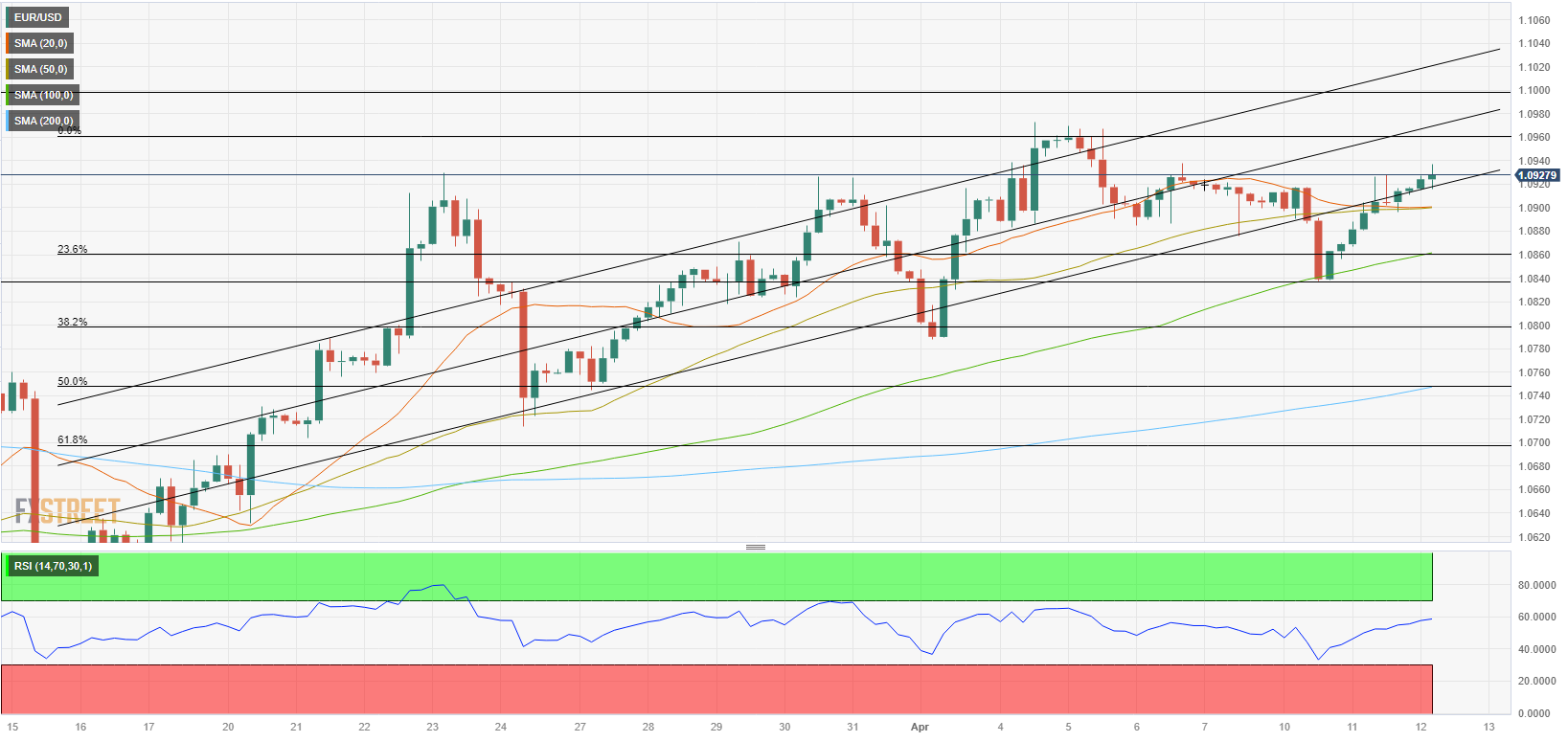
EUR/USD rose above the 20-period and the 50-period Simple Moving Averages (SMA) on the four-hour chart and closed the last four four-hour candles above them. Additionally, the pair has returned within the ascending regression channel and the Relative Strength Index (RSI) indicator climbed above 50, reflecting the lack of sellers interest.
In case the pair falls below 1.0920 (lower limit of the ascending channel), immediate support is located at 1.0900 (20-period SMA, 50-period SMA). With a four-hour close below the latter, additional losses toward 1.0860 (Fibonacci 23.6% retracement of the latest uptrend, 100-period SMA) could be witnessed.
If 1.0920 stays intact, EUR/USD is likely to face resistance at 1.0960 (static level) before targeting 1.1000 (psychological level, static level) and 1.1040 (upper limit of the ascending channel).
Premium
You have reached your limit of 3 free articles for this month.
Start your subscription and get access to all our original articles.
Author
Eren Sengezer
FXStreet
As an economist at heart, Eren Sengezer specializes in the assessment of the short-term and long-term impacts of macroeconomic data, central bank policies and political developments on financial assets.