EUR/USD Forecast: The technical and fundamental case for a bullish breakout of the wedge
- EUR/USD has been trading in a narrow range amid diminishing Mid-East tensions.
- Data from both sides of the Atlantic have significant impact as well.
- Tuesday's four-hour chart is showing potential for a bullish breakout out of the wedge.

"When you have to shoot, shoot, don't talk" – the quote from the movie The Good, the Bad, and the Ugly is relevant to the high tensions – and the softer market reaction which is becoming less impressed with threats.
Iran threatened the US with 13 "nightmare scenarios" and said it is watching American bases around the country. A letter suggesting a potential US retreat from Iraq – where Iranian general Qassem Suleimani was killed – was later shrugged off by officials as erroneous.
The lack of imminent military action has allowed stocks to recover and investors to move away from safe-haven assets such as the US dollar.
Preliminary eurozone inflation figures have met expectations with the headline Consumer Price Index rising to 1.3% yearly and Core CPI holding onto the same level. While the European Central Bank is missing its "2% or close to 2%" inflation target, the situation is improving.
On Monday, Markit's final Services Purchasing Managers' Indexes for December beat expectations, supporting the notion of a recovery in the old continent. The Sentix Investor Confidence also exceeded estimates with 7.6 points.
Later in the day, the US ISM Non-Manufacturing PMI for December is set to rock markets. While economists expect it an improvement over November's statistics, the disappointing manufacturing PMI – the worst since 2009 – may temper expectations.
See ISM Non-Manufacturing PMI Preview: Last call for the concerned?
China confirmed that Vice Premier Liu He will travel to Washington next week for the signing ceremony of Phase One of the trade deal. Investors are still waiting for details of the accord, especially as the scope of Chinese purchases of US agricultural goods remains murky.
Overall, data in Europe is improving while US figures are a cause of concern. Moreover, without Mid-East violence, the safe-haven dollar may extend its retreat. EUR/USD bulls may feel encouraged.
EUR/USD Technical Analysis
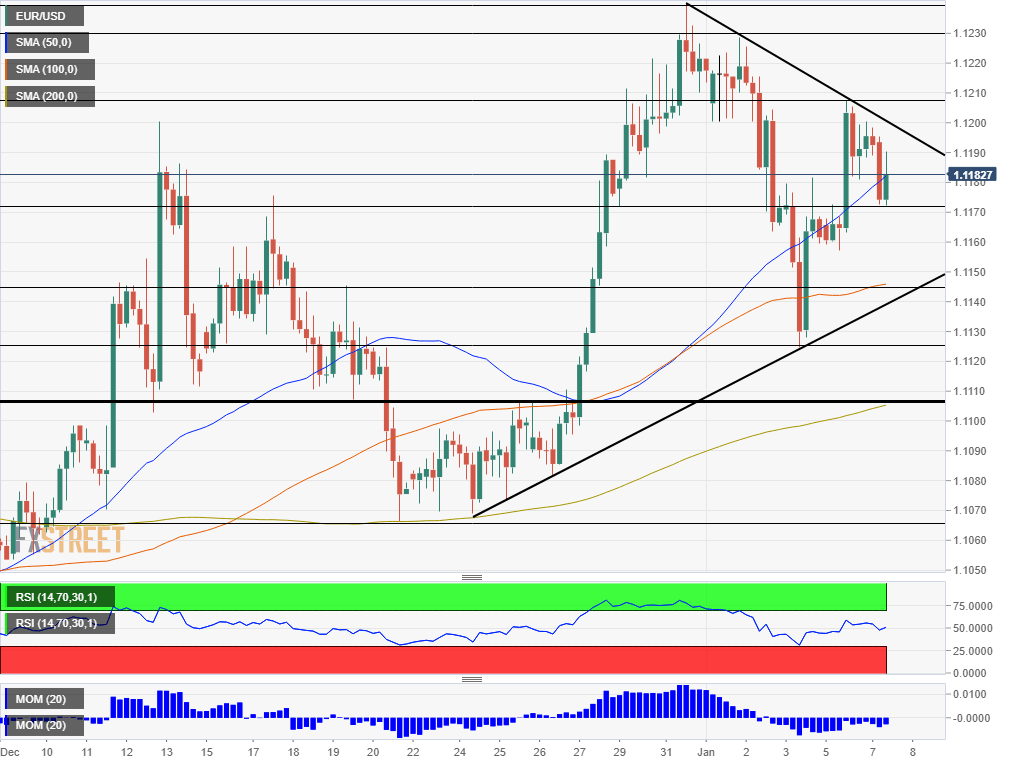
Euro/dollar is squeezed within a wedge or a triangle. This technical pattern implies lower volatility until the currency pair chooses a direction, and at the point, it is set to trend strongly.
But to what direction? EUR/USD is trading above the Simple Moving Average on the four-hour chart and trading closer to downtrend resistance than to uptrend support. While momentum is to the downside, it is near balanced. Overall, the upside seems more appealing.
Support awaits at 1.1170, which is the daily low, followed by 1.1145, a swing high from late December. Next, we find 1.1125m which is 2020 low, followed by 1.1105 that capped the euro around Christmas.
Resistance awaits at 1.1208, the weekly high, followed by 1.1230 and 1.240, which both held EUR/USD down in late December. 1.1325 is the next line to watch.
Author

Yohay Elam
FXStreet
Yohay is in Forex since 2008 when he founded Forex Crunch, a blog crafted in his free time that turned into a fully-fledged currency website later sold to Finixio.

















