EUR/USD Forecast: Sellers move to sidelines while waiting for NFP's impact on rate hike bets
- EUR/USD seems to have steadied around 1.1300 ahead of key data releases.
- Shared currency could find demand on a hot inflation report.
- March Fed rate hike bets retreated toward 60% ahead of US jobs report.


EUR/USD has managed to shake off the bearish pressure and steadied around 1.1300 early Friday as investors stay on the sidelines while awaiting high-tier data releases. Eurostat will release the preliminary December Consumer Price Index (CPI) figures before the US Bureau of Labor Statistics publishes the December Nonfarm Payrolls (NFP) report later in the day.
Several European Central Bank (ECB) policymakers voiced their concerns over inflation staying high for longer than anticipated in the past couple of weeks. The market expectation points to a Core CPI reading of 2.5% on a yearly basis in December, down from 2.6% in November. The annual CPI is forecast to edge lower to 4.7% from 4.9%.
In case the data reveal stronger-than-expected inflation in the euro area, the shared currency could stay resilient against its rivals on the possibility of the ECB acting quicker to pull monetary support in the face of persistent price pressures.
Nonetheless, the market reaction to the US December jobs report is likely to be more significant than the EU inflation data.
After the FOMC's December policy meeting minutes showed that policymakers were planning to start balance sheet reduction after the first rate hike, 10-year US Treasury bond yield jumped to its strongest level since March. More importantly, the odds of a rate hike in March rose above 70%, according to the CME Group's FedWatch Tool. Currently, the March rate increase probability stands at 63%. A bigger-than-forecast increase in December NFP could ramp up rate hike chances and allow the greenback to end the week on a firm footing against its peers.
Nonfarm Payrolls Preview: A strengthening labor market backs a tighter monetary policy.
EUR/USD Technical Analysis
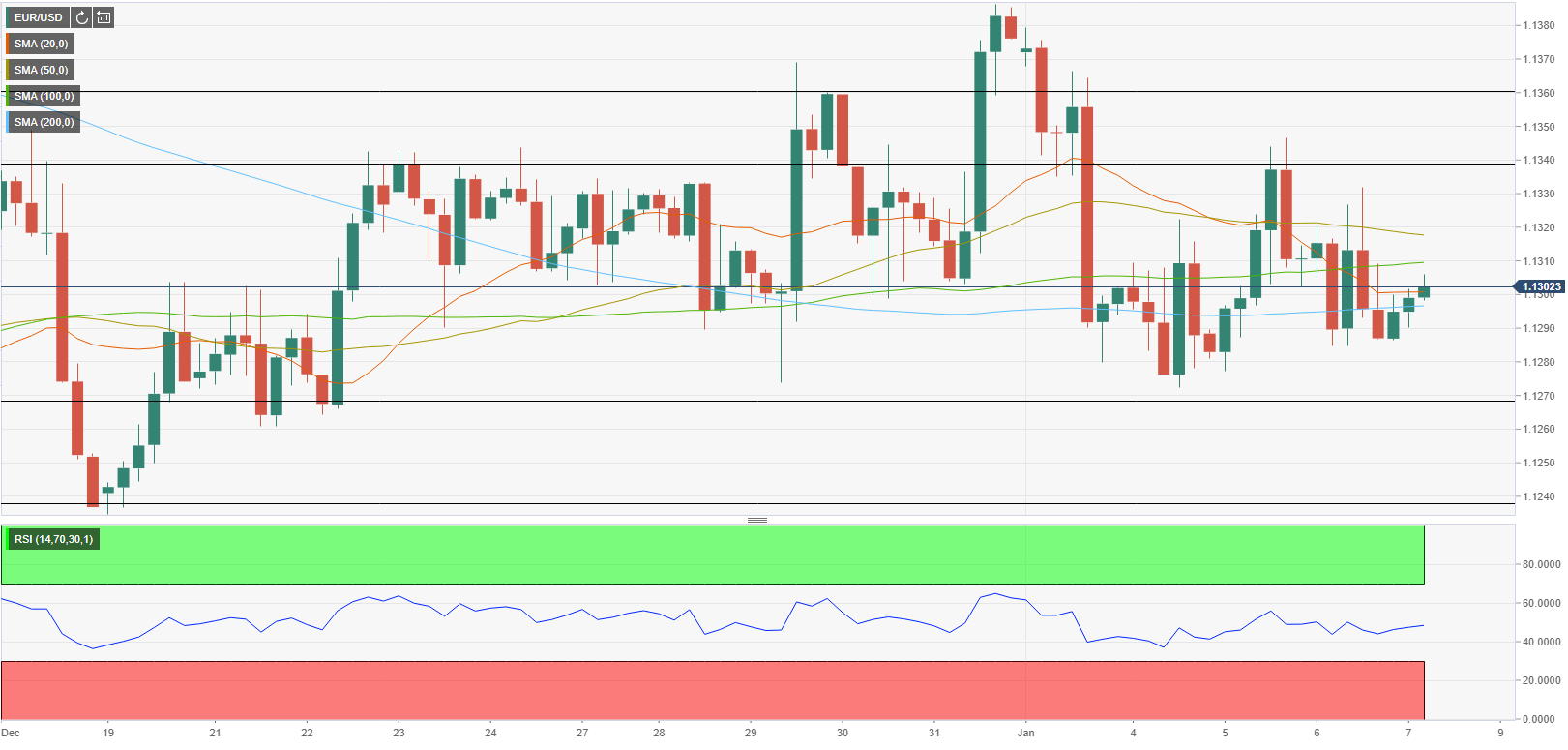
EUR/USD's near-term technical picture shows that the pair is struggling to find direction with the Relative Strength Index (RSI) indicator moving sideways near 50 on the four-hour chart. Moreover, the pair is currently fluctuating in a tight range in between the 100-period and 200-period SMA's on the same chart, reflecting its indecisiveness.
In case US T-bond yields start to push higher after NFP data, the first target on the downside aligns at 1.1270 (static level) ahead of 1.1240 (static level) and 1.1200 (psychological level).
Resistances are located at 1.1320 (50-period SMA), 1.1340 (static level) and 1.1360 (static level, post-ECB high).
Premium
You have reached your limit of 3 free articles for this month.
Start your subscription and get access to all our original articles.
Author
Eren Sengezer
FXStreet
As an economist at heart, Eren Sengezer specializes in the assessment of the short-term and long-term impacts of macroeconomic data, central bank policies and political developments on financial assets.