EUR/USD Forecast: Overbought? So what, fundamentals firmly point higher, correction could be quick
- EUR/USD has been consolidating its gains around 18-month higher amid cautious markets.
- EU recovery fund, cautious optimism on COVID-19, and US fiscal stimulus could push it higher.
- Wednesday's four-hour chart is showing moderate overbought conditions.

Forex trading is never a one-way street – EUR/USD has been experiencing the much-needed correction lower but is holding onto 1.15. Can it continue higher?
After an initial "buy the rumor, sell the fact" response, the common currency surged in response to the EU fund – leaders agreed on a €750 billion recovery fund that includes €390 billion in grants. Despite some analysts pointing to the "devil in the details" and potential hurdles in national parliaments, most agree that debt initialization is a substantial leap forward in the union, and could also encourage private investment.
See EU Deal Analysis: EUR/USD buy opportunity? Why the move is historic and should keep the euro bid
Christine Lagarde, President of the European Central Bank will speak later in the day and will likely praise leaders for their achievement – reached after five exhausting days. Lagarde and the ECB have been urging fiscal stimulus to compound their massive monetary support.
Government help is also high on the agenda across the pond. Speaker of the House Nancy Pelosi and Treasury Secretary Steven Mnuchin have been leading bipartisan talks for another relief package – days ahead of the expiry of federal unemployment benefits.
Both sides have been cautiously optimistic, but talks could go down to the wire. Democrats want more jobless and states while Republicans prefer less generous unemployment benefits and tax cuts.
President Donald Trump has presided over the first coronavirus briefing in around two months and changed his tone markedly. He warned Americans that the situation will worsen before it improves and called for wearing face masks whenever social distancing is impossible.
The White House's U-turn comes as daily COVID-19 deaths passed the 1,000 mark in the latest figures released on Tuesday. While some states have seen stabilizing cases, there are reports of bottlenecks in labs – testing is reaching its limits.
Trump continues trailing rival Joe Biden by around 9% and there is a high correlation between approvals of the president's dealing with the virus and his support ahead of the elections.
The latest projections from RavenPack suggest Biden winning 308 electoral votes and Trump only 230. Hovering over the states provides additional information:
Source: RavenPack
The mood on the medical front is more mixed than earlier in the week. After a slew of coronavirus cure and vaccine announcements, doubts about the efficiency of immunization have surfaced. The New England Journal of Medicine published a study showing that the half-life of antibodies is around 73 days – a short time that would require repeated injections.
The AstraZeneca/ University of Oxford effort promises "double protection" – both developing antibodies and T-cells – but several scientists curb the initial enthusiasm about that project. Further medical headlines may rock currencies. The safe-haven dollar may benefit from downbeat news and fall if progress is reported.
Apart from coronavirus-related figures, US housing prices and existing home sales are of interest. The sector has been holding up despite the broader economic shock.
See US Existing Home Sales June Preview: Old news on jobs and confidence
Overall is benefiting from the EU recovery fund. US coronavirus data and fiscal stimulus are on the agenda.
EUR/USD Technical Analysis
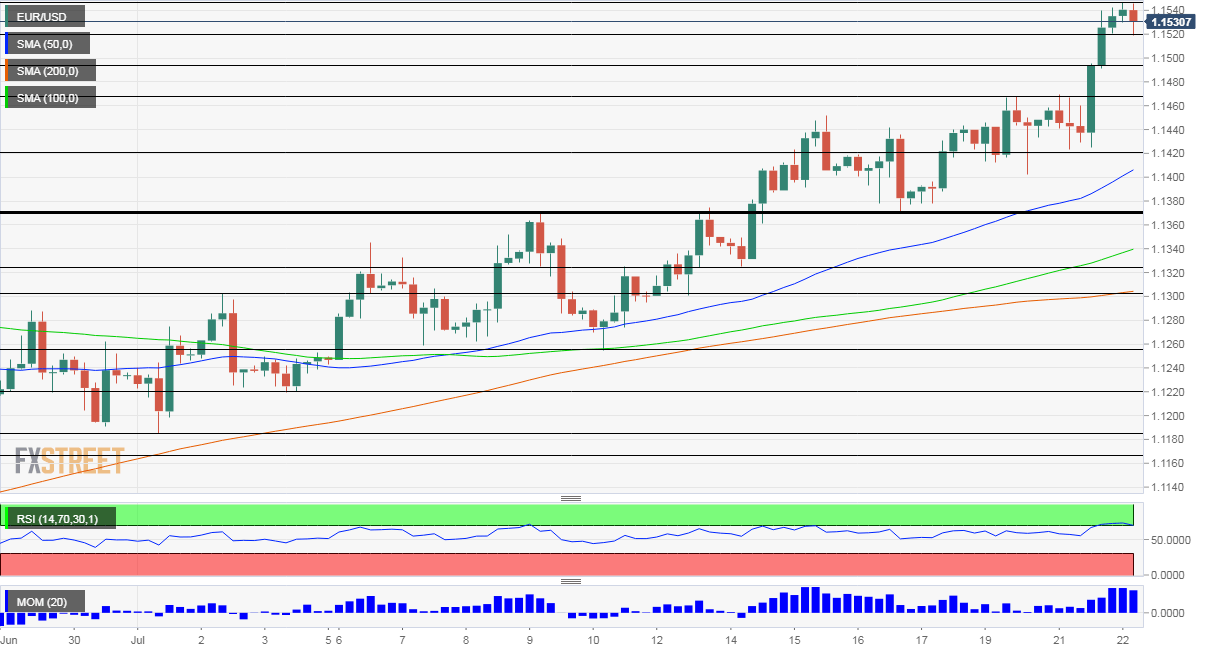
The Relative Strength Index on the four-hour chart is above 70 – pointing to overbought conditions. On the other hand, upside momentum remains robust and the currency pair is trading above the 50, 100, and 200 Simple Moving Averages.
All in all, a small correction could be followed by a further upside for the currency pair.
The fresh high of 1.1547 is the initial resistance line. It is followed by 1.1570 and 1.1620, both capping the pair in late 2018 and early 2019.
Support awaits at the daily low of 1.1520, followed by 1.1495 which was the peak in March. The next lines to watch are 1.1465 and 1.1420.
More 2020 Elections: Trump is losing his economic edge, for three robust reasons
Author

Yohay Elam
FXStreet
Yohay is in Forex since 2008 when he founded Forex Crunch, a blog crafted in his free time that turned into a fully-fledged currency website later sold to Finixio.
















