|

EUR/USD Forecast: nearing 1.1800, but upward potential limited

  • EUR/USD nears 1.1800 on dollar's decreased demand.
  • Pair's upward potential limited as long as below 1.1870.

The greenback is down across the board this Monday, quickly reverting the positive momentum it got at the weekly opening. The EUR/USD pair gapped marginally lower and fell down to 1.1737 but quickly changed course, now trading at its highest for the day not far from the 1.1800 threshold. European currencies are the strongest so far, despite local equities are rallying sharply, while safe-haven assets see little directional strength, consolidating around their Friday's closing levels.

Most of EUR's strength comes from shrinking demand for the greenback, with the DXY sharply down after two days of gains. The macroeconomic calendar will be scarce for today, with the only relevant news being EU inflation for November, expected to tick up from previous figures, but to remain well below the ECB's target of 2.0%. The week will see reduced volumes ahead of year-end holidays.

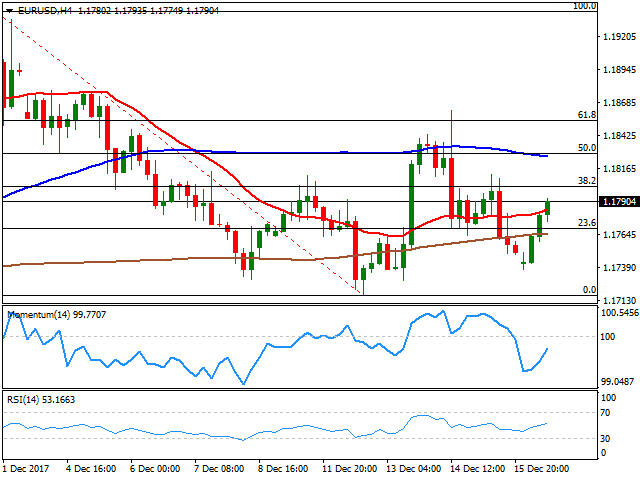
Technically, the EUR/USD pair maintains a neutral stance according to technical readings in the 4 hours chart, as the price keeps hovering around horizontal moving averages, now around the 20 SMA, while technical indicators have extended their bounced from near oversold readings, but the Momentum remains within negative territory while the RSI indicator has entered positive territory, but with limited upward strength and still within neutral territory.

The pair has an immediate resistance at 1.1800, followed by a stronger one around 1.1830, both static levels. Beyond this last, selling interest has been surging around 1.1870, the level to surpass to consider a bullish EUR. Intraday supports are located at 1.1750 and 1.1715, this last being a bearish breakout point.

View Live Chart for the EUR/USD

Author

Valeria Bednarik

Valeria Bednarik was born and lives in Buenos Aires, Argentina. Her passion for math and numbers pushed her into studying economics in her younger years.


More from Valeria Bednarik
Share:

Editor's Picks

AUD/USD hits nine-week lows below 0.7000 on RBA Bullock's remarks

AUD/USD reverses a brief uptick and turns lower to hit nine-week lows below 0.7000 in the European morning on Tuesday, as traders digest cautious remarks from Reserve Bank of Australia (RBA) Governor Michele Bullock during the press conference. Earlier on, the RBA raised the cash rate to 4.60%, as widely expected, leaving the door open to further rate hikes if needed.

USD/JPY consolidates near 157.50 as a bullish USD counters intervention risks

USD/JPY struggles to capitalize on the overnight bounce from a one-week low, consolidating around 157.50 in the Asian session on Tuesday. Trump's concerns about the Japanese Yen's weakness fueled speculation about another US-Japan joint intervention. This, along with the hawkish BoJ, underpins the JPY and caps the currency pair. Meanwhile, rising Fed rate-hike bets and oil-driven inflation fears continue to push US bond yields to multi-year highs, keeping the US Dollar pinned near a two-month high and supporting the pair.

Gold: Bulls seem hesitant as Fed hike bets, higher bond yields, and bullish USD cap upside

Gold clings to modest recovery gains through the first half of the European session, albeit it lacks follow-through and remains below $4,150. Moreover, the bearish fundamental backdrop keeps the precious metal within striking distance of the lowest level since August 4, around the $4,100 neighborhood touched on Monday, and warrants caution before positioning for any meaningful appreciation.

Chainlink trims gains after CCIP 2.0 launch, Swift ledger integration

Chainlink (LINK) edges below $15.00 on Tuesday, trimming its 10% gains from the previous day, driven by the launch of its new Cross-Chain Interoperability Protocol 2.0 and Swift ledger integration for tokenized deposits and 24/7 cross-border payments.

Focus turns to US job openings
In the euro area, focus turns to the September flash inflation print for Spain which will give the first indication of where the euro area data on Friday lands. We expect a modest rise in headline due to higher energy costs and a small increase in core inflation. We also receive the European Commission's business survey for September.
Fed vs BoJ: Both hiked. The market only believes one of them – and the chart shows which

The Fed and the BoJ have just done something remarkably similar. Both central banks raised interest rates by 25 bps last week, both are confronting inflation risks, and both signal that future decisions will depend on incoming economic data.