EUR/USD Forecast: Investors struggle to make up their minds about Euro's direction
- EUR/USD has been struggling to make a decisive move in either direction.
- Hawkish ECB bets help the Euro hold its ground for the time being.
- Investors await the ISM Services PMI report from the US.

Following Wednesday's upsurge, EUR/USD turned south and erased nearly all the previous day's gains on Thursday. The pair, however, managed to stage a rebound early Friday and climbed above 1.0600. The Euro's recent action reflects investors' indecisiveness as focus shifts to the US ISM Services PMI report for February and comments from central bank officials.
Although the Euro struggled to gather strength with the initial reaction to stronger-than-expected inflation figures from the Eurozone, hawkish European Central Bank (ECB) calls have continued to grow louder and supported the currency.
ECB Governing Council member Pierre Wunsch said early Friday that a terminal rate of 4% could not be excluded if core inflation in the eurozone remains persistently high. Meanwhile, Morgan Stanley said in its latest research note that they have updated the ECB terminal rate projection to 4% following "material revisions" to inflation forecasts. Similarly, Danske Bank analysts announced that they now expect the ECB to hike the policy rate to 4% in July, compared to the previous forecast of 3.25%.
Later in the session, European Central Bank (ECB) Vice-President Luis de Guindos will be speaking on the policy outlook. The last time de Guindos spoke, he said that rate increases beyond March will depend on data. In case he opens the door to an additional 50 basis points (bps) rate hike, or hikes, after March due to hot inflation, the Euro is likely to keep its footing against its rivals.
The US economic docket will feature the ISM Services PMI report on Friday. Recession fears could return if the headline PMI comes in below and the US Dollar could come under pressure ahead of the weekend. In case the headline holds comfortably above 50 in line with the market expectations, the Prices Paid Index could trigger a market reaction. In February, the inflation component of the survey is forecast to edge lower to 64.5 from 67.8 in January. A bigger-than-projected decline in that component should weigh on the USD and vice versa.
ISM Services PMI Preview: Strong figure set to catapult US Dollar to new highs.
Meanwhile, market participants will pay close attention to risk perception in the American session. Earlier in the week, upbeat Manufacturing PMI data from China allowed risk flows to return to markets and made it difficult for the USD to gather strength. In the Asian session, Caixin Services PMI from China came in above expectations and showed that the business activity in the service sector continued to expand at an accelerating pace in February.
During the European trading hours, US stock index futures are up between 0.5% and 0.8%. If Wall Street's main indexes rally after the opening bell, EUR/USD could also extend its rebound.
EUR/USD Technical Analysis
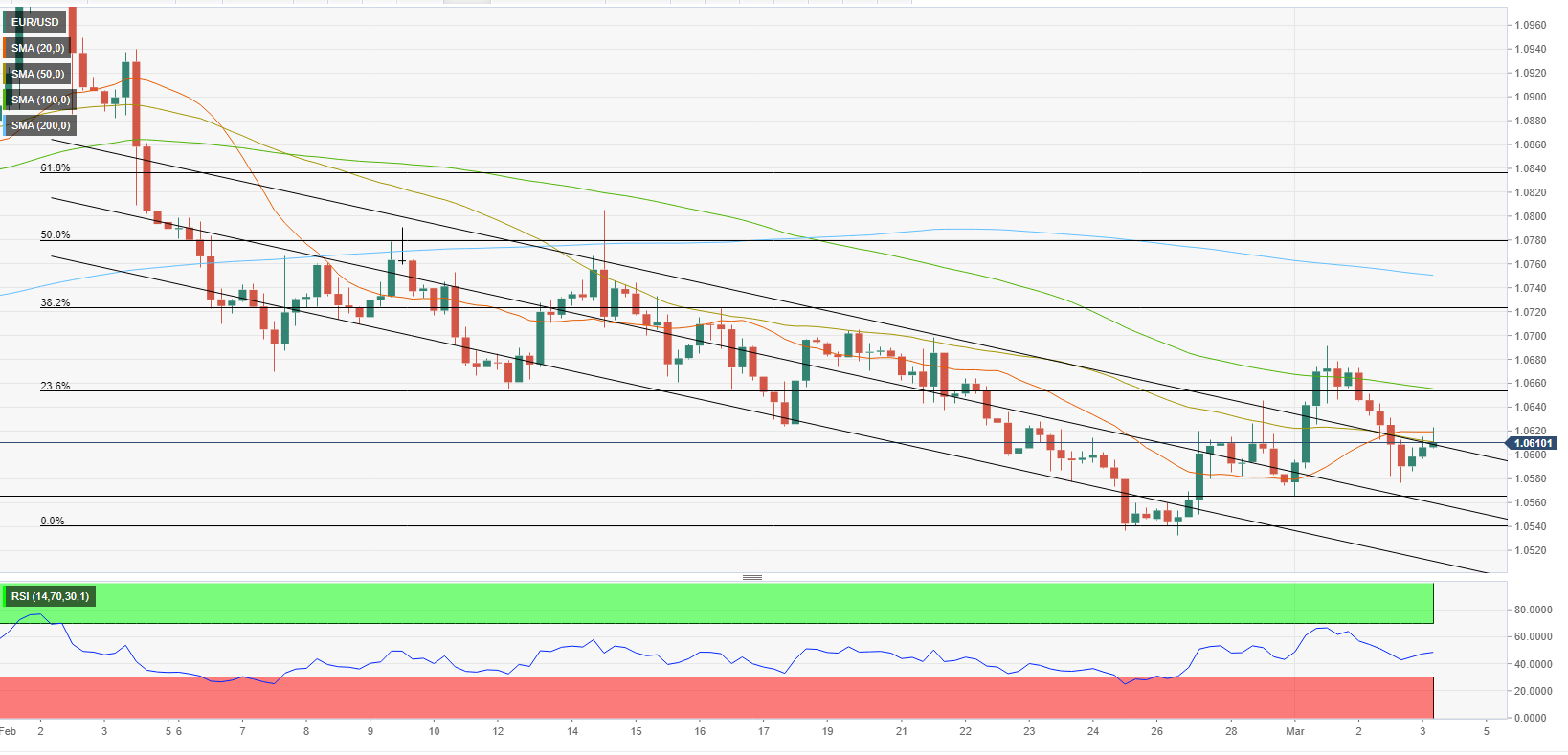
EUR/USD is currently trading slightly above the descending regression channel coming from early February. The 20-period and the 50-period Simple Moving Averages (SMA) reinforce that resistance area that aligns at 1.0610/1.0620. Once the pair stabilizes above that hurdle, it could target 1.0650/60 (Fibonacci 23.6% retracement of the latest downtrend, 100-period SMA), 1.0700 (psychological level) and 1.0720 (Fibonacci 38.2% retracement).
On the other hand, if the pair returns within the descending channel, sellers could take action and cause EUR/USD to slide toward 1.0560 (mid-point of the descending channel), 1.0540 (static level) and 1.0500 (psychological level, lower limit of the descending channel).
Author

Eren Sengezer
FXStreet
As an economist at heart, Eren Sengezer specializes in the assessment of the short-term and long-term impacts of macroeconomic data, central bank policies and political developments on financial assets.