EUR/USD Forecast: Interim bottom not yet confirmed
- Weaker than expected US Markit PMI triggering some profit-taking ahead of the weekend.
- German business confidence tumbled, EU data continues to indicate weak growth.
- EUR/USD extreme oversold conditions point to a bullish corrective advance.

It was another tough week for the shared currency, which fell against its American rival to a fresh multi-year low of 1.0777, practically filling a weekly opening gap from April 2017, when Macron won the French presidential election. Risk-off led the way, amid prevalent concerns about the effects of coronavirus on the global economy.
Speculative interest ran away from high-yielding assets as the outbreak is taking its toll on big names. Apple was the first company to issue a warning, reporting it won’t meet sales targets, amid production disruption and closed stores in China. Several other companies joined the downgrade train in the next couple of days, while the spread continues in Asia. Deaths have been reported in Japan, South Korea and Iran, while multiple international events are being cancelled. Analysts are beginning to estimate the effects on Chinese and global economies, and quickly downgrading growth forecasts for this year.
It’s all about growth
Meanwhile, German Economic Sentiment plummeted in February according to the ZEW Survey, with the index for the country at -15.7 and for the whole Union at 10.4. The preliminary estimates of Markit PMI for February came in mixed. The German manufacturing index rose to 47.8, better than the previous 45.3, although services output contracted to 53.3. The EU indexes were a bit more encouraging, as both beat the market’s forecasts. However, inflation in the Union was confirmed at 1.4% YoY in January. The numbers reflect the fragility of the EU’s economy.
In the US, on the other hand, Producer Prices rose by more than anticipated in January, while regional manufacturing indexes soared. Employment figures failed to impress but remained at healthy levels. On a downward now, the Markit estimates of February preliminary PMI missed the market’s expectations. The manufacturing index came in at 50.8 while services output fell into contraction territory down to 49.4 from 53.4. The numbers were quite disappointing and a good excuse to trigger a dollar’s bearish correction, although not enough to change the fundamental background.
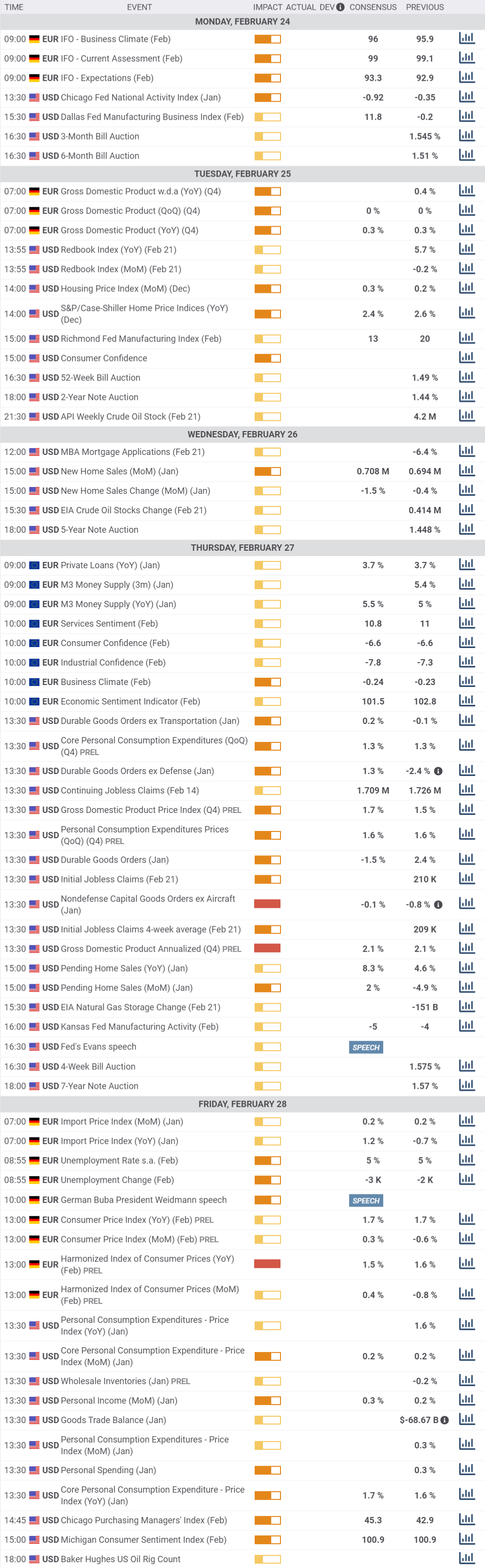
The upcoming week will bring Q4 GDP revisions for Germany and the US, although both are seeing matching their preliminary estimates. On Monday, Germany will release the IFO Business Climate index for February, foreseen at 96 from the previous 95.9. A disappointing outcome should not disappoint at all but for sure, weigh further on the common currency. German will also publish the last version of January inflation while the Union will unveil February Consumer Confidence.
The US macroeconomic calendar will include Durable Goods Orders scheduled for Thursday and seen down by -1.5% and the January Core PCE Price Index, Fed’s favourite inflation measure, previously at 1.6%.
The numbers will be read in relation to growth. So far, the US economy seems the healthiest, and that’s the main reason why the dollar keeps running, whether the market’s mood remains depressed or not. On the contrary, the Union seems unable to lift its head, and while policymakers speak about moderate growth, the figures say something different.
EUR/USD technical outlook
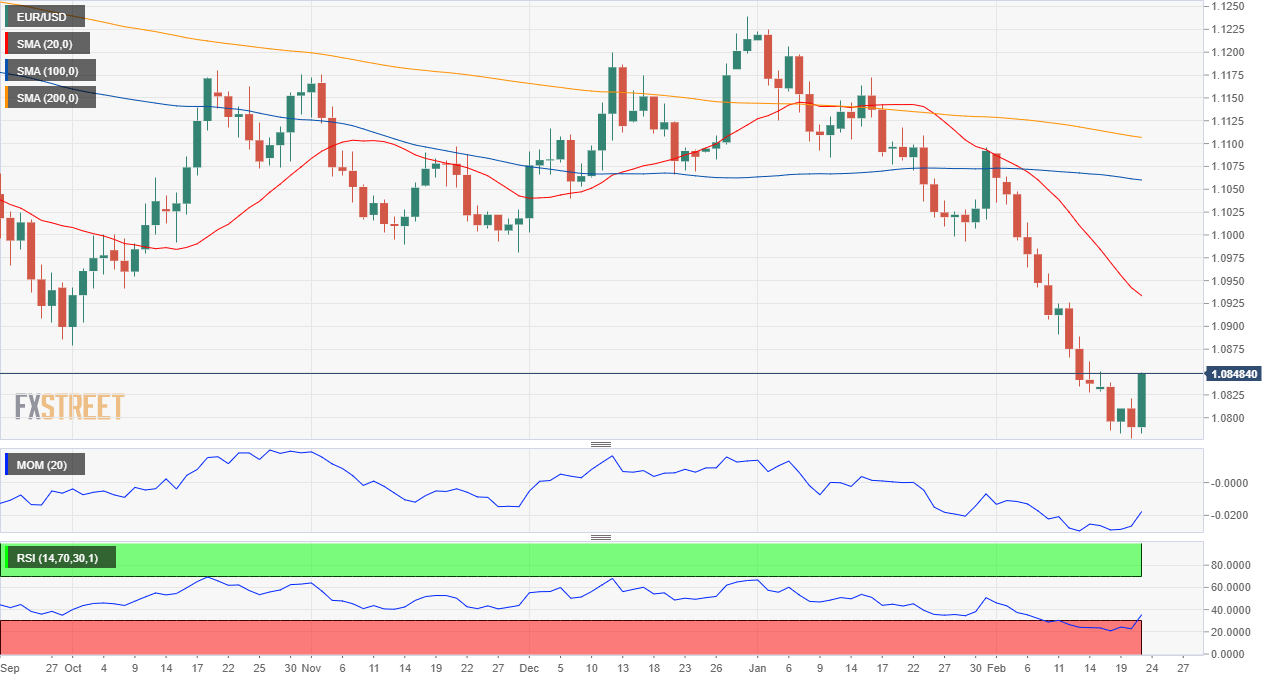
The EUR/USD pair has hovered around the 1.0800 for the last three trading days, although weak US PMI have helped it trim weekly losses, now trading at around 1.0840. Given the extreme oversold conditions, investors are at least considering the possibility of a steeper bullish corrective movement, while taking some profits out of the table.
From a technical point of view, the weekly chart shows that the pair remains far below all of its moving averages, while technical indicators lost strength downward, but remain well into negative territory, suggesting that in the long-term, the risk remains skewed to the downside.
In the daily chart, the pair is barely correcting extreme oversold conditions, as it’s trading roughly 60 pips above its 2020 low after losing 320 pips pretty much straight. Technical indicators have moved out extreme oversold territory for the first time in over a week, but remain well below their midlines. The 20 DMA maintains its bearish slope at around 1.0940 while holding below the larger ones.
For the upcoming days, 1.0900 is the immediate resistance ahead of the mentioned 20 DMA. Once above it, the correction could continue up to the 1.1000 region. 1.0770 is immediate support. Once below it, the 1.0700/20 area is the next relevant area to watch, en route to the 1.0640/60 price zone.
EUR/USD sentiment poll
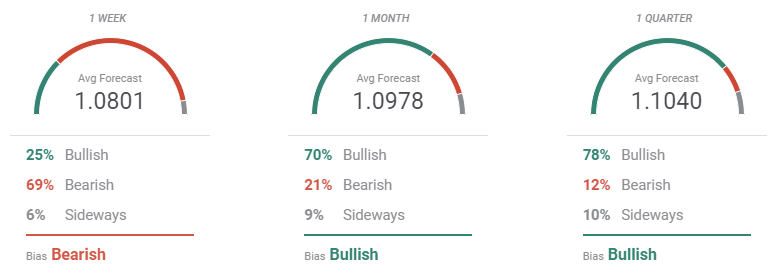
The FXStreet Forecast Poll shows that bulls have not yet given up, at least in the short-term. 69% of the polled experts are seeing the pair falling next week, with the average target at 1.0801. However, bulls take over and jump to 70% in the monthly perspective and to 78% in the quarterly view. In this last time-frame, the average target is 1.1040.
The Overview chart shows a firmly bearish downward trend prevailing in the short-term, although additional gains could be discussed, given a large dispersion of possible targets in the weeks to come. The moving averages in the monthly and quarterly perspectives have bounced, but remain below monthly highs, somehow confirming that speculative interest is willing to take some profits out of the table and add to shorts at higher levels.
Related Forecasts:
AUD/USD Forecast: Oversold conditions may provide (temporary) relief from coronavirus carnage
Author

Valeria Bednarik
FXStreet
Valeria Bednarik was born and lives in Buenos Aires, Argentina. Her passion for math and numbers pushed her into studying economics in her younger years.

















