EUR/USD Forecast: Heat from the Fed set to melt down a growingly vulnerable euro
- EUR/USD has been clinging to 1.19 as tension mounts ahead of the Federal Reserve's decision.
- A touch of optimism from the Fed may be enough to trigger a new sell-off.
- Europe's vaccination issues undermine the common currency.
- Wednesday's four-hour chart is showing bears are in control.

When will things return to normal? The future is murky for Europeans fearing about their summer holidays – and for financial markets as the world's most powerful central bank is set to announce its critical decision.
The Federal Reserve is set to publish new forecasts for inflation, employment, growth – and interest rates, as markets growingly price in a rate hike as early as late 2022. The Fed is set to push back against that, but not entirely. The most recent bank projections show that only a handful of members see higher borrowing costs in 20223, and that number is set to rise. But by how many? That remains an open question.
Jerome Powell, Chair of the Federal Reserve, seemed content with a gradual increase in Treasury yields amid a vaccine and stimulus-led recovery already in the making. He was only worried – like stock markets – by the pace of the move. Ten-year US yields are now hovering around 1.63% while equities and the dollar are stable.
Powell and the Fed have a tight balancing act – acknowledging the recovery and a potential for higher inflation, without stoking fears of a rapid rate increase. The focus will likely remain on the struggles of the labor market, as some 9.5 million Americans remain out of work.
Walking the fine line between worrying about jobs, cheering the expansion, foreseeing a gradual rise in inflation, and putting down fears of an early rate hike is prone to mistakes. That means volatility. As recent figures have been encouraging and the White House is already mulling more spending, it would take only a minor tilt to optimism to push the dollar higher.
Federal Reserve Preview: The Good, the Bad and the Ugly edition, three critical things to watch
Even if Powell presents a perfect balance – the euro is in a weak spot. The debacle around AstraZeneca's COVID-19 vaccines continues as the old continent is struggling to get jabs into its citizens' arms and even if the crisis is resolved shortly, many European would still refuse this specific inoculation – or perhaps others.
The European Medicines Agency is set to announce its verdict on the safety of AZ's immunization on Thursday after cases of blood clots seemed to be correlated with the jabs. Several European leaders hinted that vaccination will likely return. However, a message saying that the benefits of the injections outweigh the risk could do little to alleviate concerns.
After Italy reimposed lockdowns, France is considering shuttering the Paris region, a potential hit to the economy. Germany is also coping sith stubbornly high levels of infections and only Spain is among the large countries still seeing a downtrend.
All in all, unless is the Fed is extremely dovish, EUR/USD is at risk of losing more ground.
EUR/USD Technical Analysis
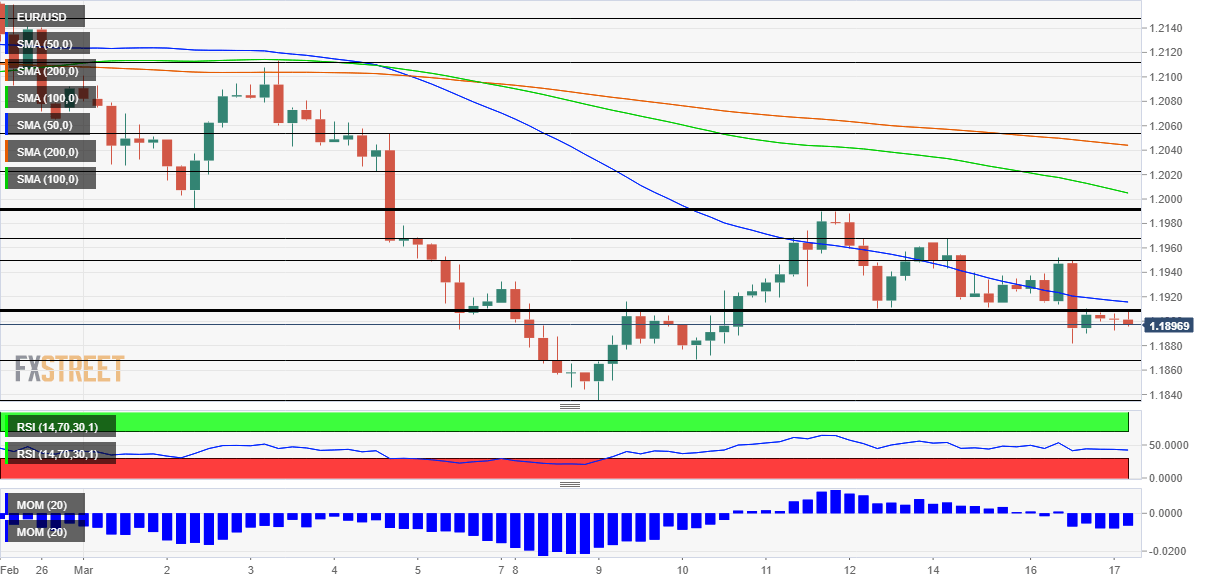
Euro/dollar dropped below 1.1910, a clear separator of ranges. Moreover, it failed to recapture the 50 Simple Moving Average on the four-hour chart and momentum is to the downside. Overall, bears have the upper hand.
Support awaits at 1.1870, which was a stepping stone on the way up last week, and that is followed by the 2021 trough of 1.1836. Further down, the next level to watch is 1.1750.
Above 1.1910, the next cap awaits at 1.1950, which held EUR/USD down on Tuesday. It is followed by 1.1965 and 1.1990, the latter being the high point of the early March recovery.
Author

Yohay Elam
FXStreet
Yohay is in Forex since 2008 when he founded Forex Crunch, a blog crafted in his free time that turned into a fully-fledged currency website later sold to Finixio.