EUR/USD Forecast: Has Euro found the bottom?
- EUR/USD has managed to recover above 1.0700 following Wednesday's slide.
- Improving market mood could help EUR/USD extend its rebound.
- The technical outlook is yet to show a buildup of recovery momentum.

EUR/USD has regained its traction following Wednesday's decline and turned positive on the day slightly above 1.0700 early Thursday. The pair seems to have defined the lower limit of its trading range and the US Dollar's valuation is likely to continue to drive the action in the short term.
After the US Census Bureau reported on Wednesday that Retail Sales rose by 3% in January, compared to the market expectation for an increase of 1.8%, the US Dollar managed to preserve its strength, forcing EUR/USD to stays on the back foot. Later in the American session, Wall Street's main indexes gathered recovery momentum and registered daily gains. In turn, the US Dollar lost its appeal and allowed EUR/USD to retrace its daily slide.
Early Thursday, US stock index futures trade modestly higher on the day. In case risk flows continue to dominate the action in the second half of the day, EUR/USD could continue to stretch higher.
Meanwhile, European Central Bank President Christine Lagarde told European Parliament late Wednesday that they intend to raise key rates by 50 basis points (bps) in March. Lagarde reiterated that the underlying inflation in the Euro area is still high and that price pressures remain strong.
A recently conducted survey by Reuters revealed that a majority of experts see the ECB raising key rates at least by another 25 bps in the second quarter.
Later in the day, ECB Chief Economist Phillip Lane and ECB executive board member Fabio Panetta will be delivering speeches. In case ECB officials leave the door open for additional rate increases after March, the Euro's losses are likely to remain limited in the short term.
On the other hand, market participants will also pay close attention to mid-tier macroeconomic data releases from the US. In January, the Producer Price Index (PPI) is forecast to edge lower to 5.4% on a yearly basis from 6.2% in December. The immediate reaction to the PPI data should be straightforward with a stronger-than-expected annual increase helping the US Dollar hold its ground against its rivals and vice versa.
Nevertheless, the rebound in US stocks witnessed on Wednesday despite the hot inflation and impressive Retail Sales data suggests that the PPI is unlikely to have a long-lasting impact on risk sentiment and the US Dollar's valuation.
EUR/USD Technical Analysis
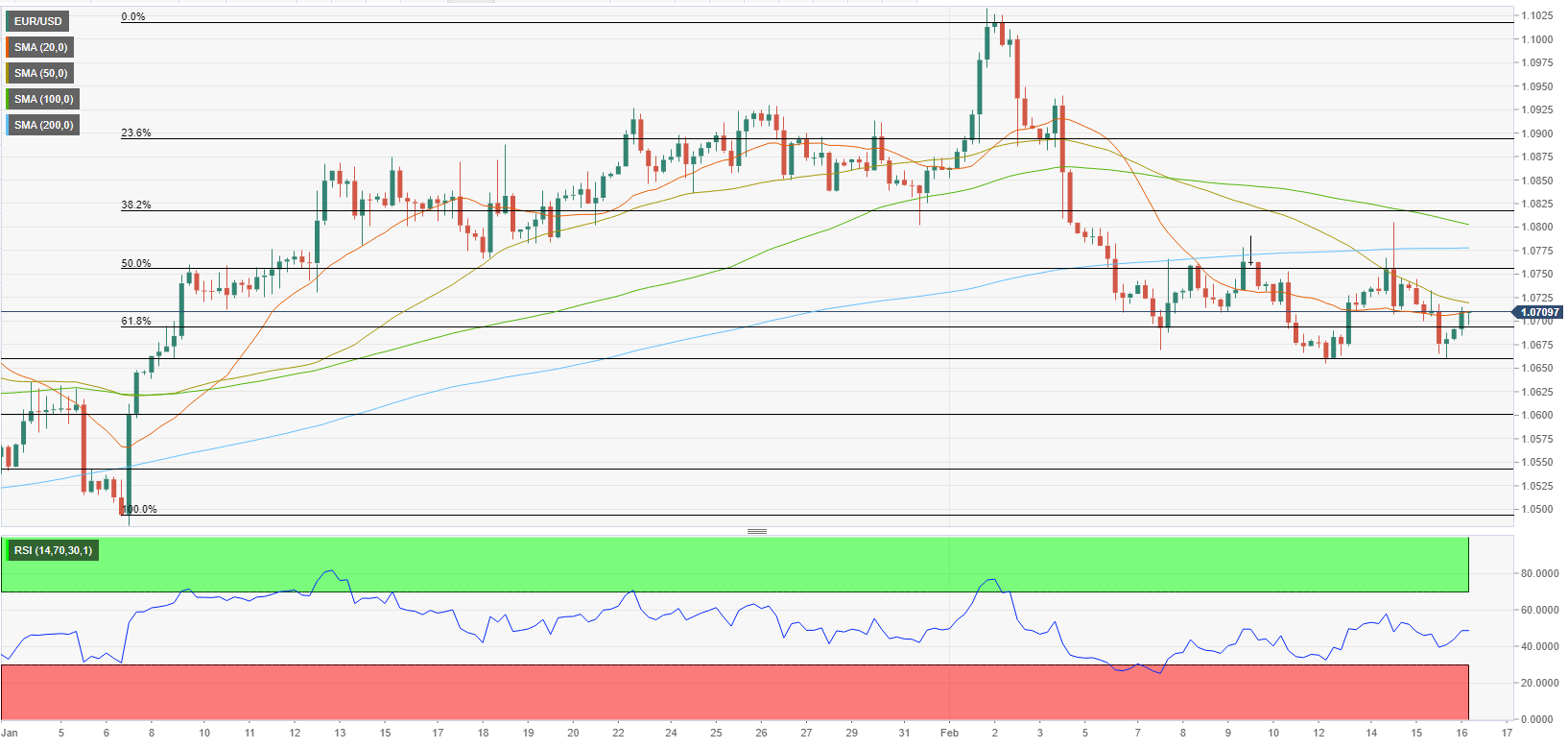
Although EUR/USD is holding above 1.0700, where the Fibonacci 61.8% retracement of the latest uptrend is located, buyers are likely to wait for the pair to clear the 50-period Simple Moving Average (SMA) on the four-hour chart at 1.0720. A four-hour close above that level could open the door for an extended recovery toward 1.0760 (Fibonacci 50% retracement), 1.0775 (200-period SMA) and 1.0800 (100-period SMA).
On the downside, 1.0700 aligns as immediate support before 1.0660 (static level). EUR/USD tested that latter support three time in the last 10 days, highlighting its significant as a technical level. If the pair flips that level into resistance, it could target 1.0600 (psychological level).
Premium
You have reached your limit of 3 free articles for this month.
Start your subscription and get access to all our original articles.
Author
Eren Sengezer
FXStreet
As an economist at heart, Eren Sengezer specializes in the assessment of the short-term and long-term impacts of macroeconomic data, central bank policies and political developments on financial assets.

















