EUR/USD Forecast: Extra gains need to leave behind 1.0830
- EUR/USD resumed its uptrend north of 1.0800.
- ECB’s Stournaras favoured a rate cut in June.
- Markets’ attention will be on US PCE, EMU CPI.

Following Friday’s knee-jerk, EUR/USD managed to resume its multi-session recovery and revisited the 1.0860 region amidst an auspicious kickstart to the new trading week.
In fact, extra losses in the US dollar (USD) prompted the USD Index (DXY) to extend further its so-far two-week decline and flirt once again with the critical 200-day SMA. A convincing breakdown of this region carries the potential to open the gates to a deeper pullback in the short-term horizon at least.
The move higher in spot also came against the backdrop of the resurgence of the upward trend in US and German yields, always amidst ongoing speculation regarding a potential interest rate cut by the Federal Reserve (Fed) later in the year (maybe June).
Meanwhile, expectations for an interest rate cut in May continued to diminish. According to the CME Group's FedWatch Tool, there is approximately a 17% probability of a rate reduction by the Fed at its May 1 meeting, with the likelihood of such action rising to nearly 54% for June.
The possibility of the Federal Reserve (Fed) implementing a series of monetary easing measures in the coming months gained further traction following stronger-than-expected US inflation data in January, as indicated by CPI and PPI readings. This outlook is supported by robust underlying economic fundamentals and a consistently tight labour market.
The interplay between the US dollar dynamics and the potential interest rate cuts by the Fed (possibly starting in June) is expected to continue significantly influencing the price action of EUR/USD in the near term.
Concerning the European Central Bank (ECB), ECB Board member Yannis Stournaras stressed the importance of maintaining prudent monetary policy. He highlighted substantial progress in inflation, suggesting that reaching the 2% inflation target by autumn is highly likely. Stournaras recommended implementing the first rate cut in June, advocating for gradual adjustments of 25 bps at a time.
Later in the session, there was no news from President Christine Lagarde, after she stated that the ongoing disinflationary trend is anticipated to persist, requiring the Governing Council to have assurance that it will effectively guide us toward our 2% target in a sustainable manner. She anticipated inflation to further decelerate as the effects of previous upward pressures diminish, coupled with stringent financing conditions exerting downward pressure on inflation.
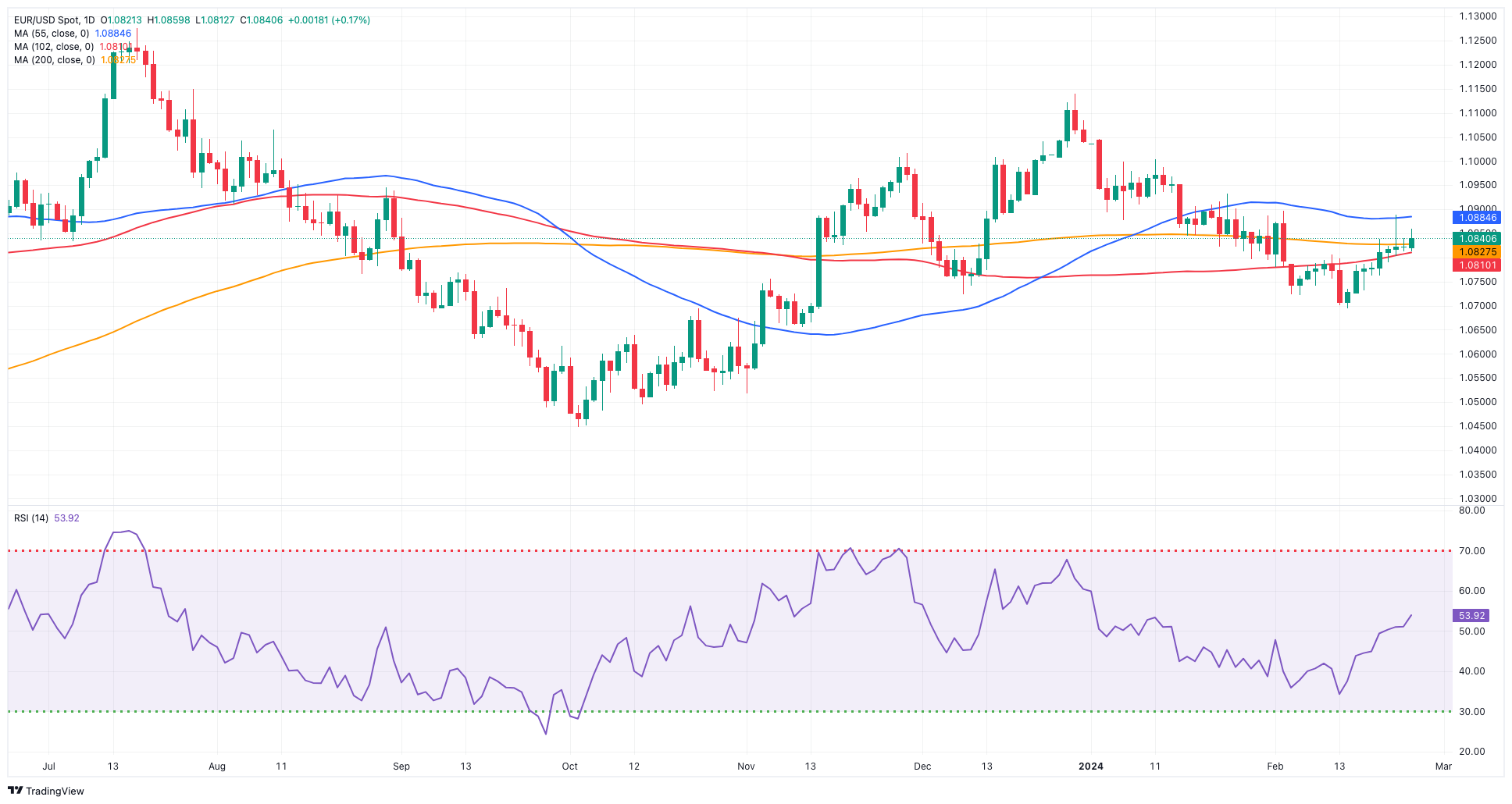
EUR/USD daily chart
EUR/USD short-term technical outlook
The weekly top of 1.0888 (February 22) appears reinforced by the provisional 55-day SMA. The breakout of this region might encourage EUR/USD to hit extra weekly peaks at 1.0932 (January 24) and 1.0998 (January 11), which bolsters the psychological barrier of 1.1000 and comes ahead of the December 2023 high of 1.1139 (December 28).
On the downside, if the pair clears the lowest point of 2024 at 1.0694 (February 14), it might next pursue the November 2023 bottom of 1.0516 (November 1). The loss of the latter might lead to a move to the weekly low of 1.0495 (October 13, 2023), which is below the 2023 bottom of 1.0448 (October 3) and the round level of 1.0400.
As long as the EUR/USD trades above the 200-day Simple Moving Average (SMA) of 1.0826, the pair's outlook is likely to stay constructive.
Looking at the four-hour chart, the slow comeback looks to be in place thus far. The next up-barrier comes at 1.0888, prior to 1.0897 and 1.0932. Conversely, the 55-SMA at 1.0785 provides preliminary support, followed by minor support levels at 1.0761, 10732, and 1.0694. The Moving Average Convergence Divergence (MACD) looked stable in the positive territory, but the Relative Strength Index (RSI) dropped to 62.
Author

Pablo Piovano
FXStreet
Born and bred in Argentina, Pablo has been carrying on with his passion for FX markets and trading since his first college years.

















