EUR/USD Forecast: Euro resilience above 1.0800 is an encouraging sign for bulls
- EUR/USD stabilized above 1.0800 after closing in positive territory on Tuesday.
- The pair could face next resistance at 1.0840.
- Fed will release the minutes of the January policy meeting later in the day.


EUR/USD gained traction and climbed to its highest level since early February at 1.0840 on Tuesday. Although the pair edged lower afterward, it managed to stabilize above 1.0800. The near-term technical outlook points to a bullish tilt.
As trading conditions normalized following a three-day weekend in the US, the US Dollar (USD) came under bearish pressure amid retreating US Treasury bond yields during the American trading hours on Tuesday. Early Wednesday, the cautious market mood, as reflected by falling US stock index futures, helps the USD hold its ground and limits EUR/USD's upside.
Later in the day, the Federal Reserve (Fed) will release the minutes of the January policy meeting.
According to CME FedWatch Tool, markets are currently pricing in a nearly 70% probability that the Fed will leave the policy rate unchanged in the next two policy meetings. Since the January policy meeting took place before the January labor market and inflation data releases, which caused investors to doubt a rate cut in May, the publication is unlikely to offer any fresh clues regarding the timing of the policy pivot.
Meanwhile, investors will pay close attention to comments from Fed policymakers later in the day. In case officials downplay the latest hot inflation readings and leave the door open to a rate reduction in May, the USD could come under renewed selling pressure.
On the other hand, EUR/USD could have a difficult time extending its rebound in case safe-haven flows dominate the financial markets later in the day.
EUR/USD Technical Analysis
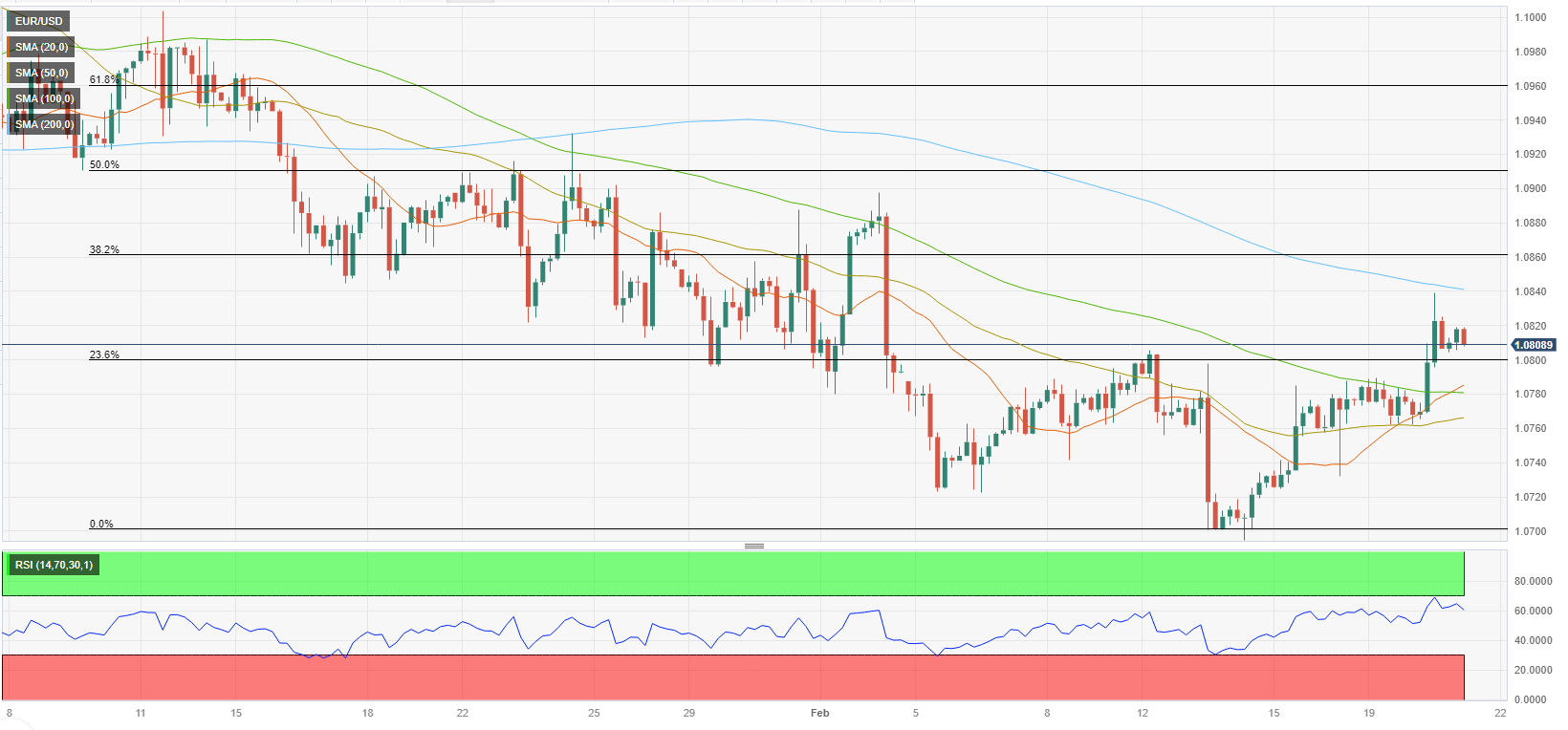
The Relative Strength Index (RSI) indicator climbed above 60 and EUR/USD closed the last 6 4-hour candles above the 100-period Simple Moving Average (SMA), highlighting a bullish tilt in the short-term outlook.
1.0800 (Fibonacci 23.6% retracement of the latest downtrend, psychological level) aligns as immediate support. In case this level holds, buyers could remain interested. On the upside, 1.0840 (200-period SMA) could be seen as first resistance before 1.0860 (Fibonacci 38.2% retracement) and 1.0900 (psychological level, static level).
Below 1.0800, 1.0780 (100-period SMA) could act as next support. A 4-hour close below that level could attract technical sellers and open the door for a leg lower toward 1.0760 (static level, 50-period SMA).
Author
Eren Sengezer
FXStreet
As an economist at heart, Eren Sengezer specializes in the assessment of the short-term and long-term impacts of macroeconomic data, central bank policies and political developments on financial assets.