EUR/USD Forecast: Euro rallies to multi-year high with no recovery in sight for USD

EUR/USD trades at its highest level since February 2022 above 1.1400.
The USD selloff intensifies after China raises tariffs on US goods in retaliation.
The near-term technical outlook points to overbought conditions.
EUR/USD gained more than 2% on Thursday and extended its upsurge on Friday to a new multi-year high above 1.1400. Although the pair's near-term technical outlook points to overbought conditions, investors are like to stay away from the US Dollar (USD) amid a deepening US-China trade conflict.
Euro PRICE This week
The table below shows the percentage change of Euro (EUR) against listed major currencies this week. Euro was the weakest against the Swiss Franc.
| USD | EUR | GBP | JPY | CAD | AUD | NZD | CHF | |
|---|---|---|---|---|---|---|---|---|
| USD | -4.18% | -1.76% | -2.23% | -2.62% | -2.82% | -3.87% | -4.95% | |
| EUR | 4.18% | 2.81% | 2.70% | 2.26% | 1.34% | 0.94% | -0.19% | |
| GBP | 1.76% | -2.81% | -1.42% | -0.54% | -1.43% | -1.82% | -2.92% | |
| JPY | 2.23% | -2.70% | 1.42% | -0.36% | 0.35% | -0.46% | -2.44% | |
| CAD | 2.62% | -2.26% | 0.54% | 0.36% | -0.55% | -1.29% | -2.66% | |
| AUD | 2.82% | -1.34% | 1.43% | -0.35% | 0.55% | -0.40% | -1.52% | |
| NZD | 3.87% | -0.94% | 1.82% | 0.46% | 1.29% | 0.40% | -1.13% | |
| CHF | 4.95% | 0.19% | 2.92% | 2.44% | 2.66% | 1.52% | 1.13% |
The heat map shows percentage changes of major currencies against each other. The base currency is picked from the left column, while the quote currency is picked from the top row. For example, if you pick the Euro from the left column and move along the horizontal line to the US Dollar, the percentage change displayed in the box will represent EUR (base)/USD (quote).
Growing fears over the US economy tipping into recession caused the US Treasury bonds and the USD to remain under heavy selling pressure on Thursday.
On Friday, China's Finance Ministry announced that they will raise additional tariffs on US imports from 84% to 125% from April 12, in retaliation to the US' tariffs on Chinese goods.
This development caused the USD selloff to intensify and triggered another leg higher in EUR/USD in the European session.
The US economic calendar will feature Producer Price Index data for March and the University of Michigan will publish the Consumer Sentiment Index data for April. Investors could ignore these data releases and remain focused on fresh developments surrounding the US -China trade war.
In case US President Donald Trump responds by increasing tariffs on Chinese goods even further, the USD selloff could continue heading into the weekend. On the other hand, the USD could stage a rebound if one of the sides takes a step back to ease tensions.
EUR/USD Technical Analysis
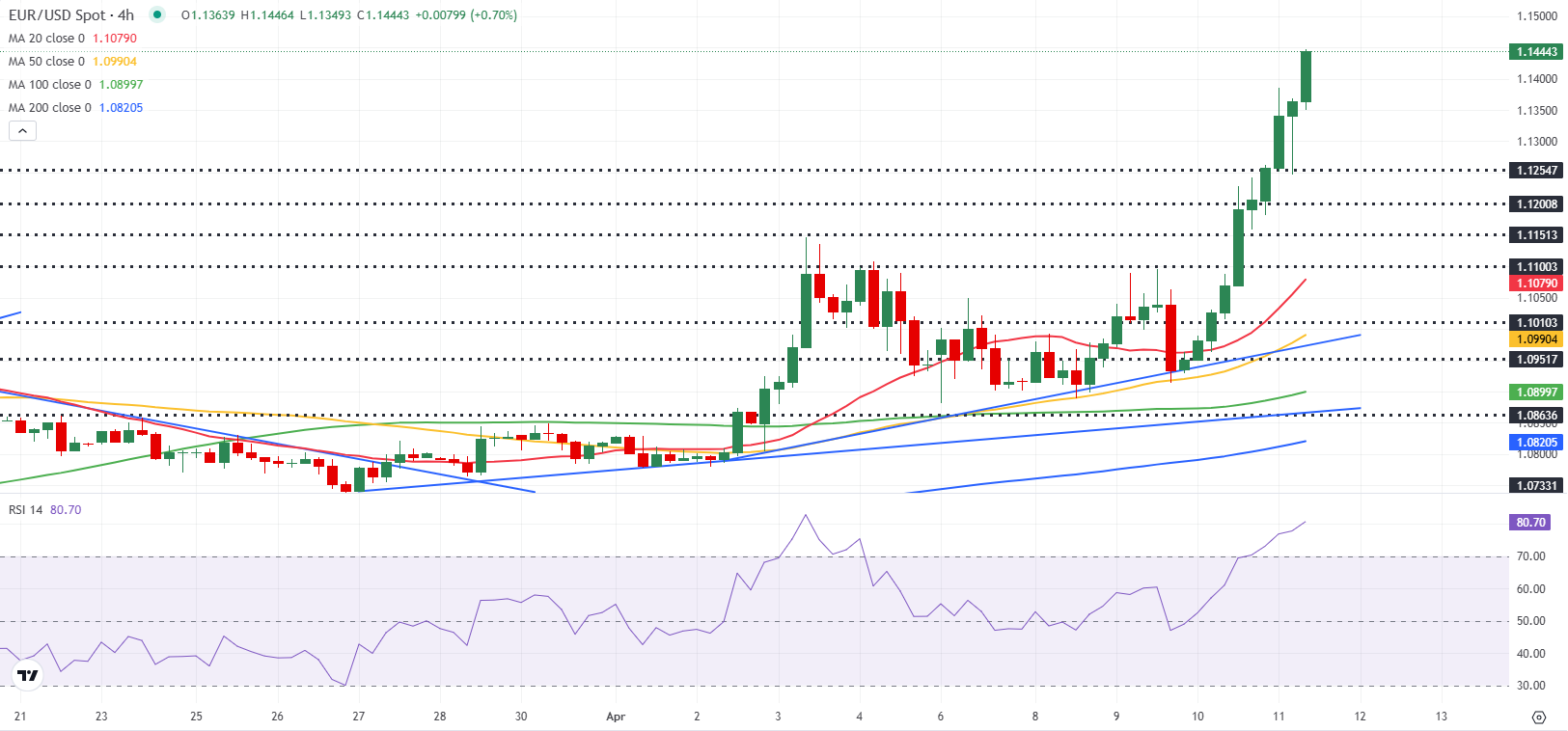
The Relative Strength Index (RSI) indicator on the 4-hour chart climbed above 80, highlighting overbought conditions for the pair.
On the upside, 1.1500 (round level) could be seen as the next resistance level before 1.1535 (static level from November 2021) and 1.1600 (static level, round level). Looking south, supports could be spotted at 1.1300 (static level, round level) and 1.1200 (static level, round level).
US-China Trade War FAQs
Generally speaking, a trade war is an economic conflict between two or more countries due to extreme protectionism on one end. It implies the creation of trade barriers, such as tariffs, which result in counter-barriers, escalating import costs, and hence the cost of living.
An economic conflict between the United States (US) and China began early in 2018, when President Donald Trump set trade barriers on China, claiming unfair commercial practices and intellectual property theft from the Asian giant. China took retaliatory action, imposing tariffs on multiple US goods, such as automobiles and soybeans. Tensions escalated until the two countries signed the US-China Phase One trade deal in January 2020. The agreement required structural reforms and other changes to China’s economic and trade regime and pretended to restore stability and trust between the two nations. However, the Coronavirus pandemic took the focus out of the conflict. Yet, it is worth mentioning that President Joe Biden, who took office after Trump, kept tariffs in place and even added some additional levies.
The return of Donald Trump to the White House as the 47th US President has sparked a fresh wave of tensions between the two countries. During the 2024 election campaign, Trump pledged to impose 60% tariffs on China once he returned to office, which he did on January 20, 2025. With Trump back, the US-China trade war is meant to resume where it was left, with tit-for-tat policies affecting the global economic landscape amid disruptions in global supply chains, resulting in a reduction in spending, particularly investment, and directly feeding into the Consumer Price Index inflation.
Author

Eren Sengezer
FXStreet
As an economist at heart, Eren Sengezer specializes in the assessment of the short-term and long-term impacts of macroeconomic data, central bank policies and political developments on financial assets.