EUR/USD Forecast: Euro not out of the woods yet, eyes on US data
- EUR/USD stabilized above 1.0950 following Tuesday's sharp decline.
- Near-term technical outlook suggests that the pair remains bearish.
- US economic docket will feature key data releases on Wednesday.

EUR/USD declined sharply on Tuesday and touched its lowest level in nearly two weeks at 1.0938 as the US Dollar (USD) staged a decisive correction following the poor performance seen in the last couple of weeks of 2023. Early Wednesday, the pair holds steady at around 1.0950.
In the absence of high-tier data releases, the USD benefited from souring market mood and the steady recovery seen in the US Treasury bond yields on Tuesday. The US Dollar Index, which lost about 2% in December, gained nearly 1% on the first trading day of 2024.
In the second half of the day, the US economic docket will feature the ISM Manufacturing PMI data for December and JOLTS Job Openings report for November.
Investors expect the ISM Manufacturing PMI to edge higher to 47.1 from 46.7 in November. A reading above 50 could provide a boost to the USD with the immediate reaction. On the other hand, a noticeable decline in the number of job openings could hurt the USD.
Later in the American session, the Federal Reserve (Fed) will release the minutes of the December policy meeting. In the post-meeting press conference, Fed Chairman Jerome Powell said that policymakers were thinking and talking about when it will be appropriate to cut rates. In case the publication confirms that officials discussed the timing of a policy pivot, the USD could find it difficult to stay resilient against its rivals. According to the CME Group FedWatch Tool, markets are currently pricing in a 25% probability that the Fed will leave the policy rate unchanged in March.
EUR/USD Technical Analysis
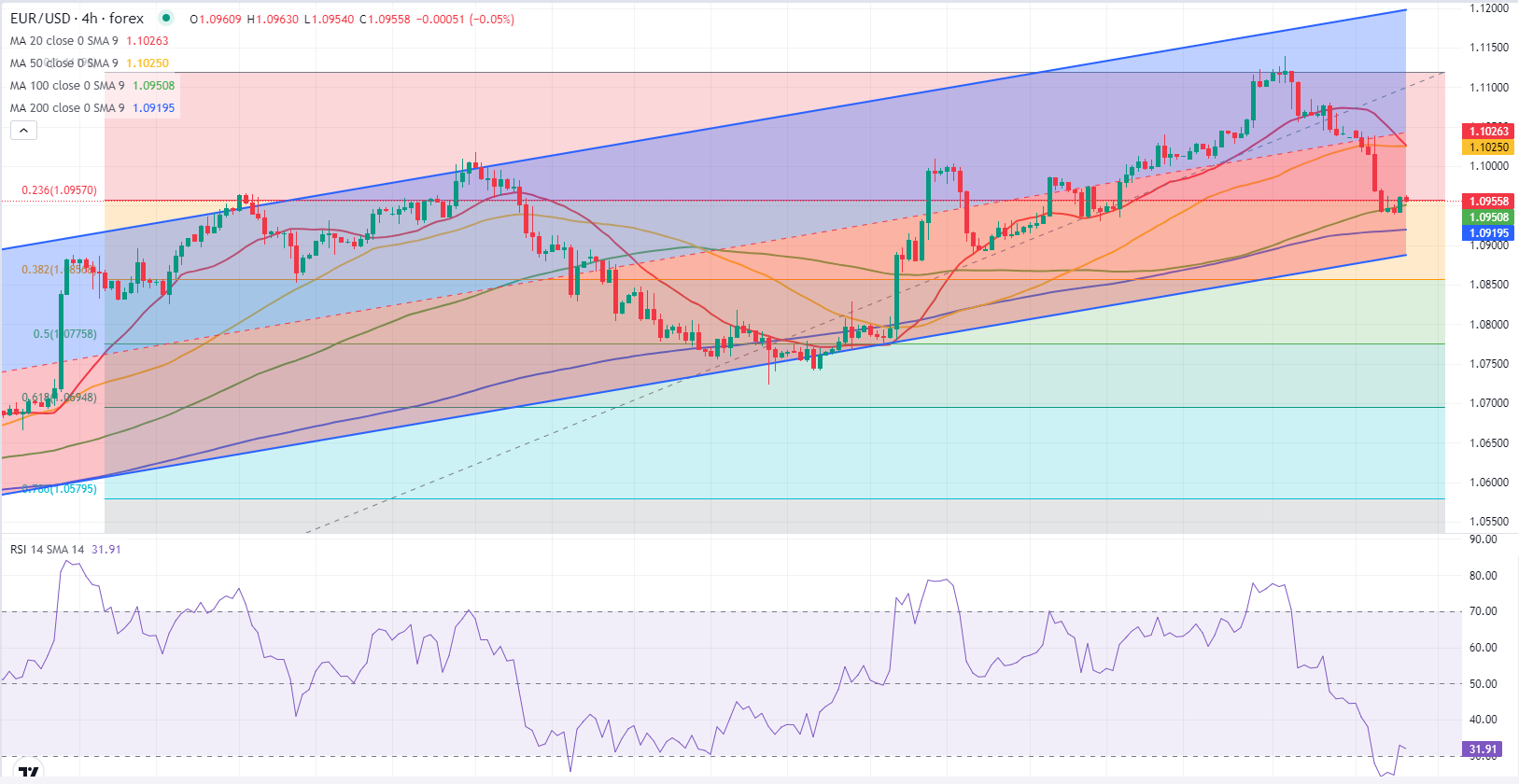
The Relative Strength Index on the 4-hour chart rose slightly above 30 after falling below that level on Tuesday, suggesting that the bearish bias remains intact following a technical correction. Additionally, the 20-period Simple Moving Average (SMA) is about to make a bearish cross with the 50-period SMA on the same chart, highlighting a buildup of bearish pressure.
On the downside, 1.0950 (Fibonacci 23.6% retracement of the latest uptrend) aligns as immediate support. The 100-period SMA reinforces this level as well. If EUR/USD falls below 1.0950 and starts using that level as resistance, sellers could remain interested. In this scenario, 1.0920 (200-period SMA), 1.0900 (psychological level, static level, lower limit of the ascending regression trend channel) and 1.0850 (Fibonacci 38.2% retracement) could be seen as next supports.
On the upside, resistances are located at 1.1000 (psychological level, static level), 1.1025 (20-period SMA, 50-period SMA, mid-point of the ascending channel) and 1.1100 (psychological level, static level).
Author

Eren Sengezer
FXStreet
As an economist at heart, Eren Sengezer specializes in the assessment of the short-term and long-term impacts of macroeconomic data, central bank policies and political developments on financial assets.