EUR/USD Forecast: Euro needs to stabilize above 1.0760 for sellers to take a break
- EUR/USD has recovered modestly from two-year lows set at the beginning of the week.
- The pair needs to flip 1.0760 into support to extend its rebound.
- The risk-averse market mood is likely to continue to weigh on the euro.

EUR/USD has slumped to its weakest level in more than two years at 1.0706 early Monday despite having opened with a bullish gap. Although the pair managed to erase a small portion of its daily losses, it continues to trade deep in negative territory amid the risk-averse market environment. 1.0760 aligns as a key resistance in the near term and sellers may move to the sidelines if the pair stabilizes above that level.
The shared currency started the new week on a firm footing as investors reacted to Emmanuel Macron's convincing victory in the second round of the French presidential election. The intense flight to safety, however, caused the euro to come under heavy bearish pressure during the Asian trading hours.
Investors continue to seek refuge amid heightened fears over a global economic slowdown. Major central banks remain on track to tighten their policies despite the worsening growth outlook amid the coronavirus-related lockdowns in China and the ongoing Russia-Ukraine conflict. The Euro Stoxx 600 Index is down 1.7% early Monday and US stock index futures are losing between 0.6% and 0.7%.
On a positive note, the IFO survey from Germany showed that the business sentiment improved modestly in April. The Business Climate Index edged higher to 91.8 from 90.8 in March and the Expectations Index rose to 86.7 from 84.9. Nevertheless, EUR/USD is likely to find it difficult to gain traction unless risk flows start to dominate the markets.
Meanwhile, Reuters reported on Monday that the European Central Bank (ECB) policymakers were willing to conclude asset purchases as soon as possible so that they can hike the policy rate as early as July if needed. Despite this headline, it's obvious that the US Federal Reserve will stay on a much more aggressive tightening path than the ECB and the policy divergence is likely to favour the dollar over the common currency.
EUR/USD Technical Analysis
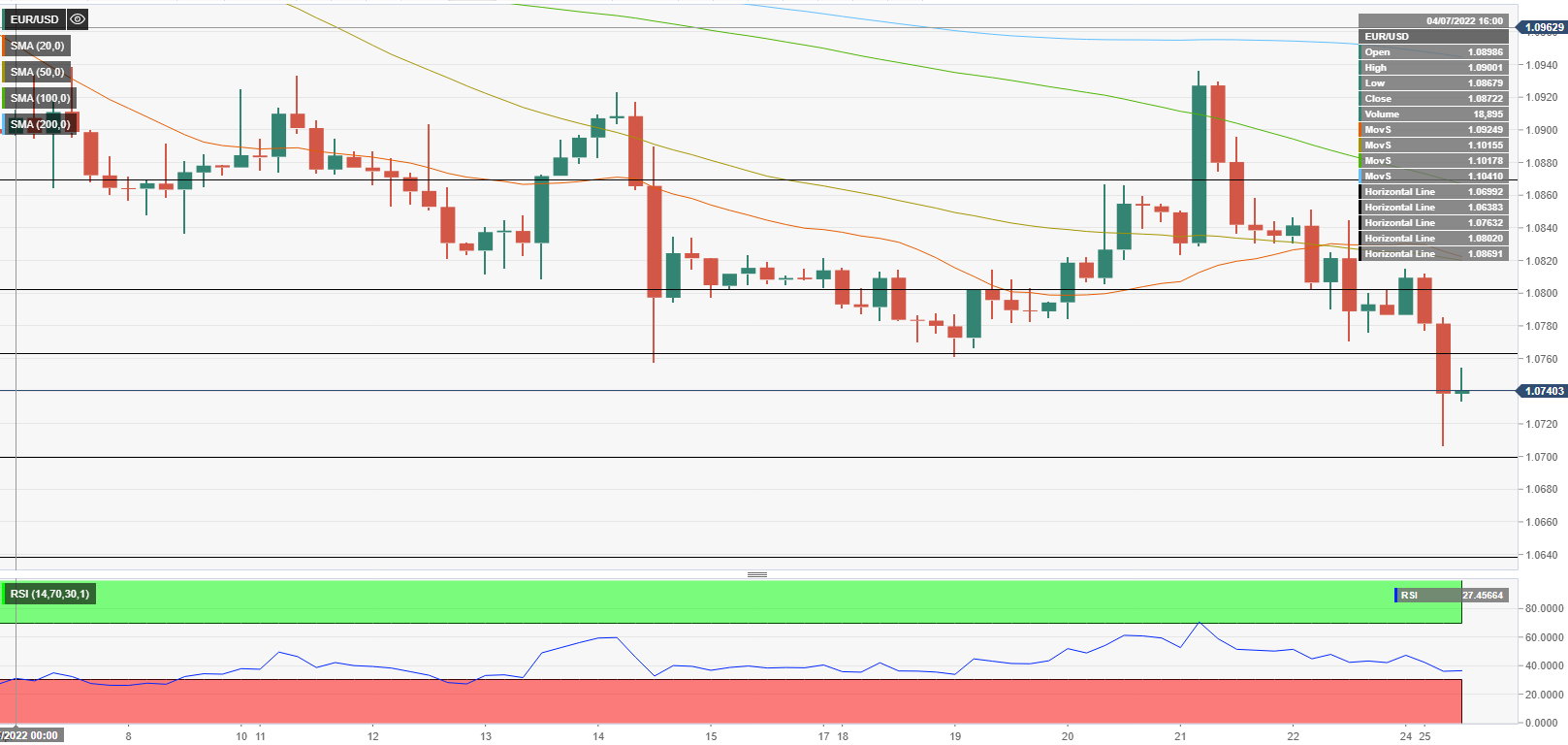
The Relative Strength Index (RSI) indicator on the four-hour chart stays below 50 following the latest recovery attempt, suggesting that sellers are not willing to lose control of EUR/USD's action.
1.0750 (former support, static level) aligns as the first hurdle. In case the pair rises above that level and starts using it as support, it could extend its correction toward 1.0800 (psychological level) and 1.0820 (20-period SMA, 50-period SMA).
On the downside, significant near-term support seems to have formed at 1.0700 (psychological level) following the sharp decline witnessed in the early Asian session. With a four-hour close below that level, additional losses toward 1.0640 (March 2020 low) could be witnessed.
Author

Eren Sengezer
FXStreet
As an economist at heart, Eren Sengezer specializes in the assessment of the short-term and long-term impacts of macroeconomic data, central bank policies and political developments on financial assets.