EUR/USD Forecast: Euro looks fragile as key resistance holds
- EUR/USD trades in the red near 1.1350 after posting gains on Thursday.
- Technical sellers could remain interested unless the pair stabilizes above 1.1380.
- The economic calendar will not offer any high-impact data releases on Friday.


EUR/USD snapped a two-day losing streak on Thursday but failed to preserve its bullish momentum. The pair struggles to hold its ground and trades in negative territory at around 1.1350 on Friday.
Euro PRICE This week
The table below shows the percentage change of Euro (EUR) against listed major currencies this week. Euro was the weakest against the New Zealand Dollar.
| USD | EUR | GBP | JPY | CAD | AUD | NZD | CHF | |
|---|---|---|---|---|---|---|---|---|
| USD | 0.36% | -0.02% | 0.85% | 0.26% | -0.15% | -0.66% | 1.75% | |
| EUR | -0.36% | -0.52% | 0.50% | -0.14% | -0.70% | -1.04% | 1.37% | |
| GBP | 0.02% | 0.52% | 1.18% | 0.40% | -0.18% | -0.52% | 1.91% | |
| JPY | -0.85% | -0.50% | -1.18% | -0.58% | -1.12% | -1.38% | 0.93% | |
| CAD | -0.26% | 0.14% | -0.40% | 0.58% | -0.54% | -0.92% | 1.51% | |
| AUD | 0.15% | 0.70% | 0.18% | 1.12% | 0.54% | -0.33% | 2.08% | |
| NZD | 0.66% | 1.04% | 0.52% | 1.38% | 0.92% | 0.33% | 2.46% | |
| CHF | -1.75% | -1.37% | -1.91% | -0.93% | -1.51% | -2.08% | -2.46% |
The heat map shows percentage changes of major currencies against each other. The base currency is picked from the left column, while the quote currency is picked from the top row. For example, if you pick the Euro from the left column and move along the horizontal line to the US Dollar, the percentage change displayed in the box will represent EUR (base)/USD (quote).
Growing optimism about a de-escalation in the US-China trade conflict helped the US Dollar (USD) stay resilient against its rivals and made it difficult for EUR/USD to gain traction.
United States (US) President Donald Trump told reporters late Thursday that a meeting between Chinese and US officials was held earlier in the day. Additionally, Bloomberg reported that China was considering suspending its 125% tariff on some US goods, including medical equipment and ethane, while mulling waiving the tariff for plane leases.
Early Friday, however, China's Foreign Ministry noted that they are not having any consultations or negotiations on tariffs with the US. This development caused the USD to lose some strength and allowed EUR/USD to find support.
In the absence of high-impact data releases, investors will continue to pay close attention to headlines surrounding the US-China trade conflict. A re-escalation of tensions could hurt the USD and open the door for a rebound in EUR/USD heading into the weekend.
EUR/USD Technical Analysis
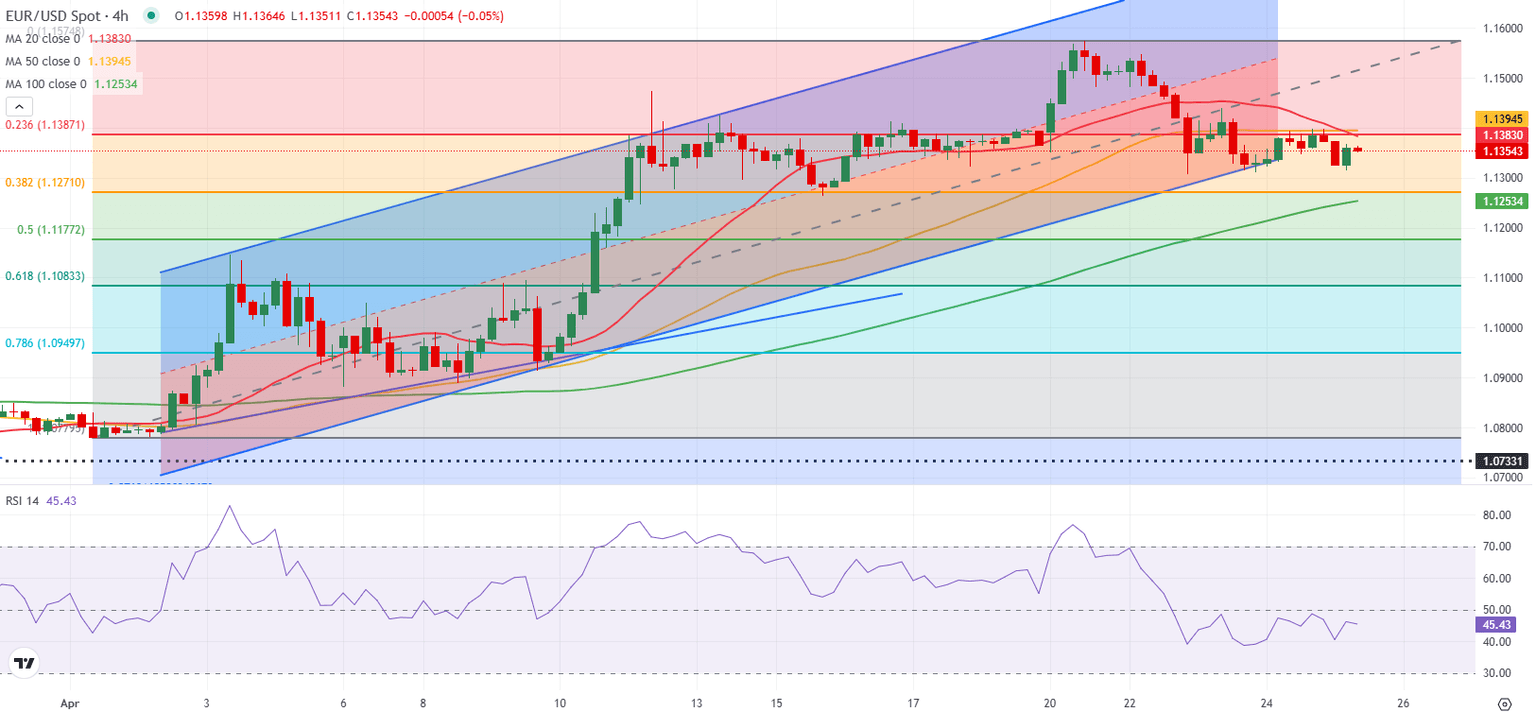
The Relative Strength Index (RSI) indicator on the 4-hour chart stays below 50 and EUR/USD failed to make a 4-hour close above the 20-period and 50-period Simple Moving Averages (SMA), reflecting a lack of buyer interest.
On the downside, 1.1300 (static level) aligns as interim support before 1.1270-1.1260 (Fibonacci 238.2% retracement of the latest uptrend, 100-period SMA) and 1.1180 (Fibonacci 50% retracement).
EUR/USD could face strong resistance at 1.1380, where the Fibonacci 23.6% retracement level converge with the 20-period and 50-period SMAs. In case EUR/USD manages to stabilize above this resistance, 1.1450 (static level) and 1.1500 (static level, round level) could be seen as next hurdles.
Euro FAQs
The Euro is the currency for the 19 European Union countries that belong to the Eurozone. It is the second most heavily traded currency in the world behind the US Dollar. In 2022, it accounted for 31% of all foreign exchange transactions, with an average daily turnover of over $2.2 trillion a day. EUR/USD is the most heavily traded currency pair in the world, accounting for an estimated 30% off all transactions, followed by EUR/JPY (4%), EUR/GBP (3%) and EUR/AUD (2%).
The European Central Bank (ECB) in Frankfurt, Germany, is the reserve bank for the Eurozone. The ECB sets interest rates and manages monetary policy. The ECB’s primary mandate is to maintain price stability, which means either controlling inflation or stimulating growth. Its primary tool is the raising or lowering of interest rates. Relatively high interest rates – or the expectation of higher rates – will usually benefit the Euro and vice versa. The ECB Governing Council makes monetary policy decisions at meetings held eight times a year. Decisions are made by heads of the Eurozone national banks and six permanent members, including the President of the ECB, Christine Lagarde.
Eurozone inflation data, measured by the Harmonized Index of Consumer Prices (HICP), is an important econometric for the Euro. If inflation rises more than expected, especially if above the ECB’s 2% target, it obliges the ECB to raise interest rates to bring it back under control. Relatively high interest rates compared to its counterparts will usually benefit the Euro, as it makes the region more attractive as a place for global investors to park their money.
Data releases gauge the health of the economy and can impact on the Euro. Indicators such as GDP, Manufacturing and Services PMIs, employment, and consumer sentiment surveys can all influence the direction of the single currency. A strong economy is good for the Euro. Not only does it attract more foreign investment but it may encourage the ECB to put up interest rates, which will directly strengthen the Euro. Otherwise, if economic data is weak, the Euro is likely to fall. Economic data for the four largest economies in the euro area (Germany, France, Italy and Spain) are especially significant, as they account for 75% of the Eurozone’s economy.
Another significant data release for the Euro is the Trade Balance. This indicator measures the difference between what a country earns from its exports and what it spends on imports over a given period. If a country produces highly sought after exports then its currency will gain in value purely from the extra demand created from foreign buyers seeking to purchase these goods. Therefore, a positive net Trade Balance strengthens a currency and vice versa for a negative balance.
Premium
You have reached your limit of 3 free articles for this month.
Start your subscription and get access to all our original articles.
Author
Eren Sengezer
FXStreet
As an economist at heart, Eren Sengezer specializes in the assessment of the short-term and long-term impacts of macroeconomic data, central bank policies and political developments on financial assets.