EUR/USD Forecast: Pair lacks direction despite hawkish ECB comments, weak US data
- EUR/USD struggles to make a decisive move on Tuesday.
- Euro needs to break out of 1.0680-1.0750 range to find direction.
- Comments from ECB officials help the Euro hold its ground.


EUR/USD has extended its sideways grind early Tuesday after having closed the first trading day of the week virtually unchanged. The pair seems to have defined a horizontal trading range between 1.0680 and 1.0750. A decisive move out of that channel could trigger the next directional action in the pair.
The US Dollar lost strength in the second half of the day on Monday and allowed EUR/USD to stage a rebound. The ISM Services PMI declined to 50.3 in May from 51.9 a month earlier, signaling a loss of momentum in the US service sector's economic activity. Moreover, underlying details of the survey showed that input inflation softened at a faster pace than expected, while payrolls declined with the Employment Index dropping to 49.2 from 50.8.
Investors continued to price in a pause in the Federal Reserve's (Fed) tightening cycle following the PMI report, causing the US Dollar Index to edge lower alongside US Treasury bond yields. The CME Group FedWatch Tool shows that the probability of the Fed raising its policy rate by 25 basis points (bps) at the upcoming meeting sits around 20%.
European Central Bank (ECB) President Christine Lagarde told the European Parliament on Monday that underlying inflationary pressures in the Euro area remain high. On a similar note, ECB policymaker Klaas Knot noted that they will keep tightening policy until they see inflation returning to 2%. Hawkish ECB remarks could continue to help the Euro limit its losses in the near term.
In the second half of the day, there won't be any high-impact data releases from the US. Meanwhile, US stock index futures trade flat on the day, failing to provide a clue on risk perception. Hence, it might not be easy for EUR/USD to move out of its consolidation channel.
EUR/USD Technical Analysis
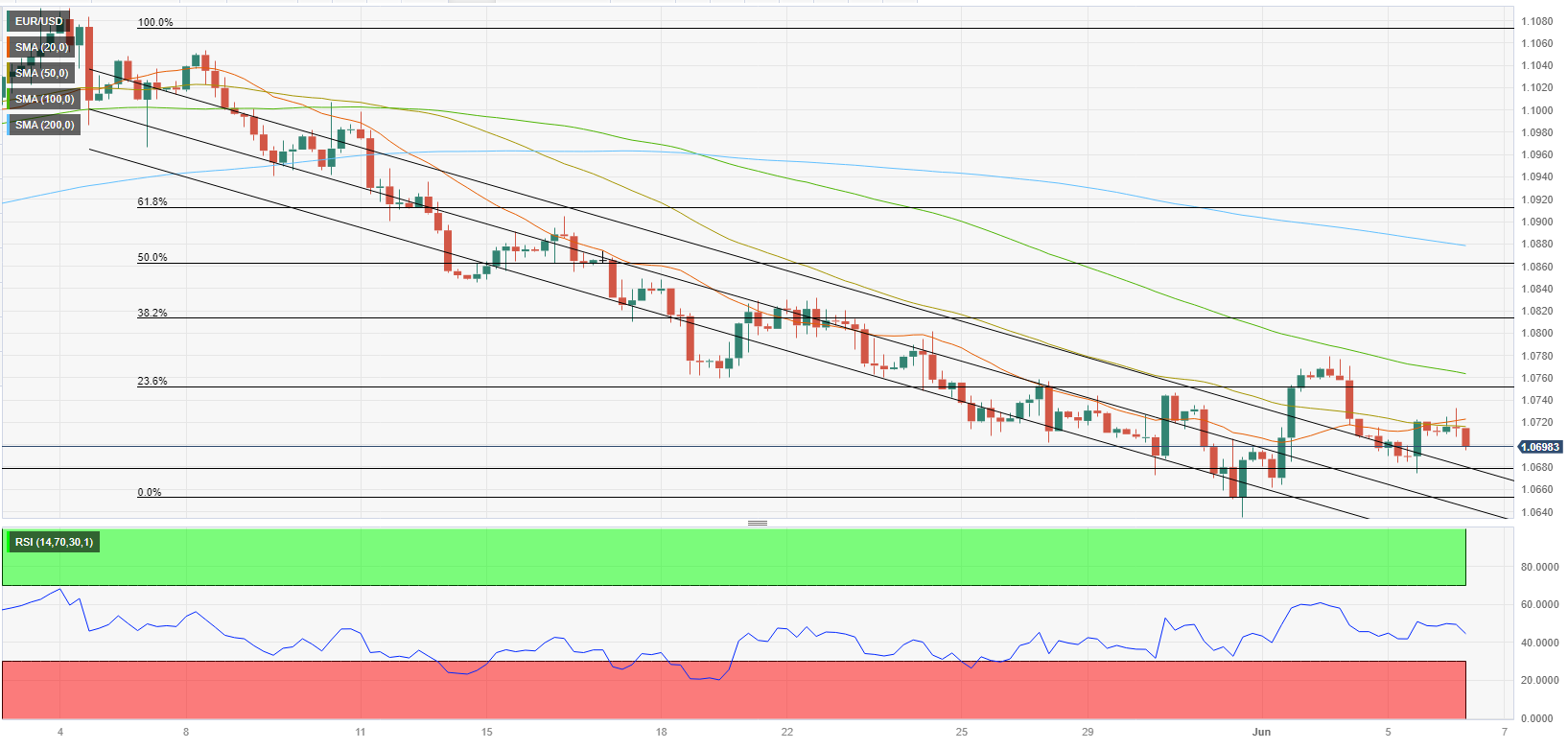
EUR/USD trades near the 20-period and the 50-period Simple Moving Averages (SMA) on the four-hour chart and the Relative Strength Index (RSI) stays slightly below 50, reflecting the lack of directional momentum.
On the downside, 1.0680 (upper-limit of the broken descending regression channel) aligns as immediate support. A four-hour close below this level could attract sellers and open the door for an extended slide toward 1.0650 (mid-point of the descending channel, end-point of the latest downtrend) and 1.0600 (psychological level, lower-limit of the descending channel).
The 1.0720 threshold (20-period SMA, 50-period SMA) forms interim resistance ahead of 1.0750/60 (100-period SMA, Fibonacci 23.6% retracement of the latest downtrend). Once EUR/USD rises above that level and confirms it support, it could be seen as a significant bullish development and trigger an extended rebound toward 1.0800 (Fibonacci 38.2% retracement, psychological level).
Premium
You have reached your limit of 3 free articles for this month.
Start your subscription and get access to all our original articles.
Author
Eren Sengezer
FXStreet
As an economist at heart, Eren Sengezer specializes in the assessment of the short-term and long-term impacts of macroeconomic data, central bank policies and political developments on financial assets.