EUR/USD Forecast: Euro could weaken further unless it stabilizes above 1.0950
- EUR/USD edged higher early Tuesday following Monday's decline.
- US Retail Sales data will be watched closely by market participants later in the day.
- The pair needs to confirm 1.0950 as support to shake off the bearish pressure.

EUR/USD dropped below 1.0900 for the first time since early July on Monday but managed to close the day a few pips above that level. The pair needs to clear 1.0950 hurdle and stabilize above that level to extend its rebound.
The broad-based US Dollar (USD) strength amid risk aversion weighed on the pair in the first half of the day on Monday. Following a bearish opening, however, major equity indexes in the US climbed into the positive territory and limited USD's gains.
Investors remain cautious early Tuesday but trading conditions on the Assumption Day holiday in Europe, causing trading conditions to thin out and not allowing EUR/USD to make a decisive move in either direction.
In the second half of the day, Retail Sales data for July will be featured in the US economic docket. Markets expect sales to grow 0.4% following June's 0.2% increase. Although a positive reading could help the USD find demand, the market reaction could remain short-lived. Big retailers, such as Home Depot, Walmart and Target, will be reporting earnings figures this week and an upbeat US Retail Sales data could help the risk mood improve, making it difficult for the USD to continue to outperform its rivals.
EUR/USD Technical Analysis
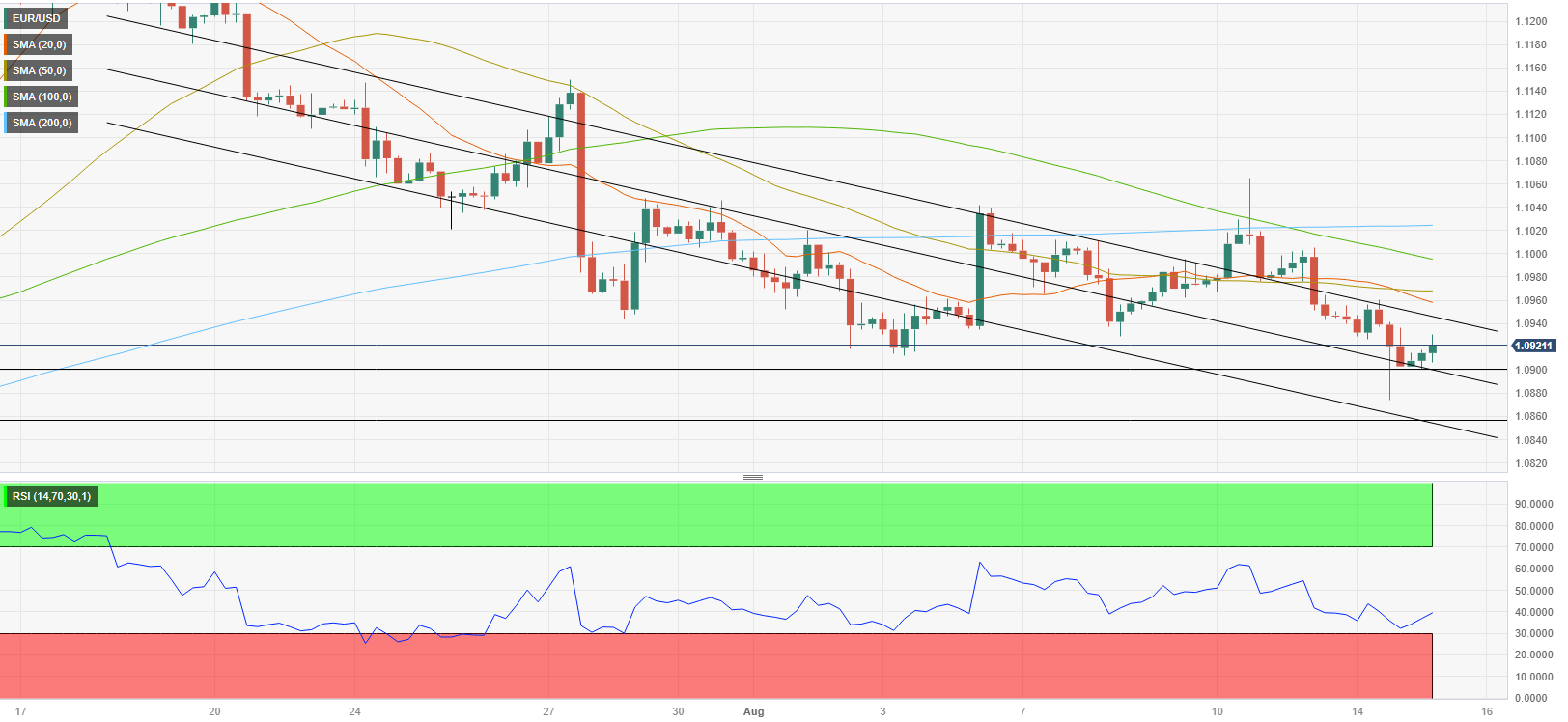
The Relative Strength Index (RSI) indicator on the 4-hour chart stays below 50, highlighting the lack of recovery momentum. On the downside, 1.0900 (psychological level, mid-point of the descending channel) aligns as immediate support ahead of 1.0860 (lower limit of the descending channel).
On the upside, 1.0950 (upper limit of the descending channel) aligns as critical resistance. This level is also reinforced by the 100-day Simple Moving Average (SMA). If EUR/USD rises above that level and confirms it as support, it could extend its recovery toward 1.1000 (psychological level, 100-period SMA on the 4-hour chart) and 1.1030 (200-period SMA).
Author

Eren Sengezer
FXStreet
As an economist at heart, Eren Sengezer specializes in the assessment of the short-term and long-term impacts of macroeconomic data, central bank policies and political developments on financial assets.















