EUR/USD Forecast: ECB’s doing too little, too late
- As the economic downturn continues, market fears ECB’s TLTRO won’t be enough.
- US-China trade´s back and forth to continue leading the way for the financial world.
- EUR/USD lost the 1.1000 critical threshold, next mid-term bearish target at 1.0820.

The shared currency has been again among the weakest these last few days, finishing the week below the 1.1000 figure against the greenback. It didn’t matter whether the risk was on or off, the EUR/USD pair fell five out of five days, weighed by a dismal mood at the beginning of the day, and by renewed dollar’s demand on an improved sentiment these last two days.
Why happened what happened?
The EUR was torn by speculation that the steepening economic downturn will make of the ECB’s upcoming third round of TLTRO look like too little too late. The European Central Bank is trying to keep credit flowing into local companies, hoping it can stimulate the economy and underpin inflation, which remains depressed. Concerns that the central bank won’t be able to prevent further economic slowing were exacerbated Thursday by comments from ECB’s Governing Council member Knot who said that the market expectations for the ECB's September decision were "overdone."
The escalation of the trade war during the past weekend, as the US and China announced new tariffs on imports from each other, kept investors on their toes. However, the Chinese Commerce Ministry poured cold water on the issue, announcing that they expect the US to cancel tariffs to avoid an escalation in the trade war, adding that they are willing to resolve the issue via a “calm attitude.” There were some talks between the two countries, with negotiations set to resume next September.
Germany confirmed the Q2 Gross Domestic Product at -0.1%, while the preliminary estimate of August annualized inflation came in at 1.0%. For the same period, inflation in the whole Union was up by a measly 0.9%. In the US, on the other hand, headline Durable Goods Orders surprised to the upside, up by 2.1% in July, although reading between the lines, the report shows that capital investment remains tepid. Core PCE inflation, Fed’s favorite inflation reading, held steady at 1.6% YoY in July.
What will happen next?
The trade war between the US and China is set to continue. Alongside Brexit woes, will continue to set the tone for major pairs. Referring to the first, nor China, neither the US are willing to give up an inch. That said, the market mood will tend to remain negative, with spikes of optimism meant to be short-lived.
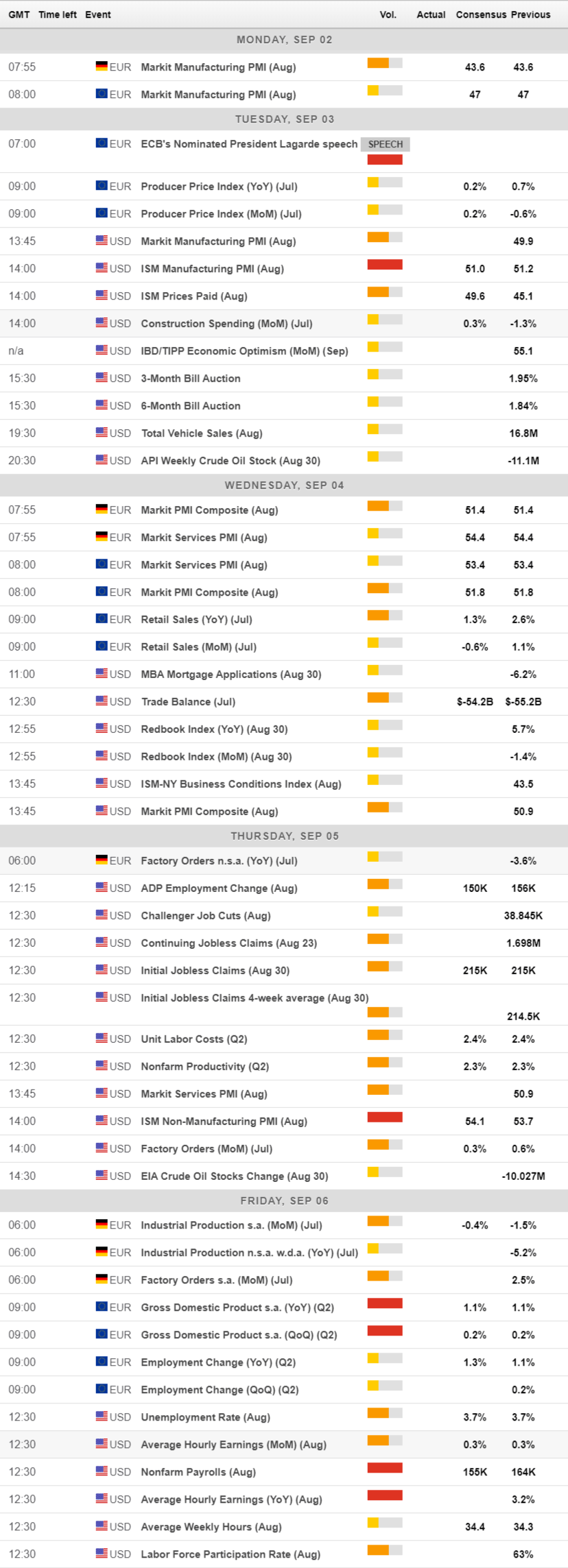
In the data front, the upcoming week will be a busy one, starting with the final versions of the August Markit PMI for the Union and the US. The US official PMI will be out next week, while the EU will publish a revision of its Q2 GDP, foreseen at 0.2%. The star of the week, however, will be the US Nonfarm Payroll report. The country is expected to have added 155K new jobs in August, the unemployment rate is seen steady at 3.7%, while wages are seen increasing by 0.3% MoM.
EUR/USD technical outlook
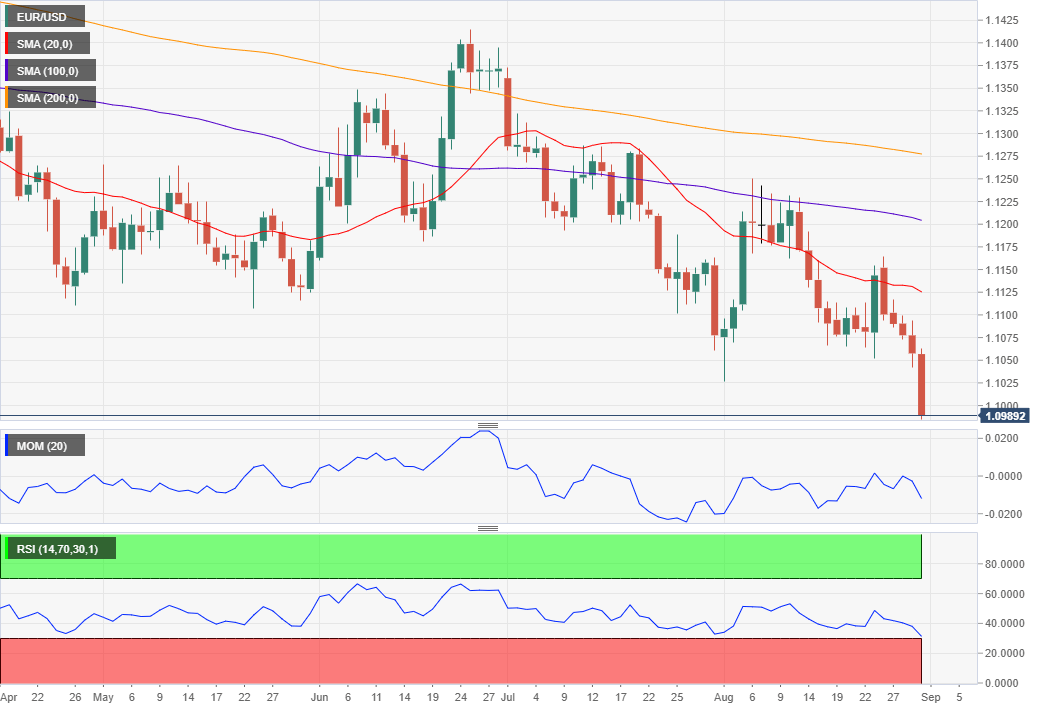
The EUR/USD pair is heading into the weekly close at fresh multi-year lows, at a level previously seen on May 2017. The weekly chart shows that the decline is set to continue, as technical indicators continue heading south within negative levels, while the pair is developing below all of its moving averages. The 20 SMA has been acting as a dynamic resistance since mid-July at around 1.1200, offering a modest downward slope below the larger ones, also skewing the risk to the downside.
In the daily chart, technical indicators head firmly lower within negative levels, approaching oversold readings but still with room to extend their declines, as the price develops below bearish moving averages, after a failed attempt to advance above the 20 DMA at the beginning of the week.
With the pair unable to regain the 1.1000 figure, there’s a good chance that the pressure will persist next week. A break below 10.960/80, would expose the 1.0820 region, where it has the next relevant mid-term support. At this point, resistances are located at 1.1050, followed by the 1.1100 figure. A recovery above this last could see the pair extending its advance up to 1.1160 in corrective mode.
EUR/USD sentiment poll
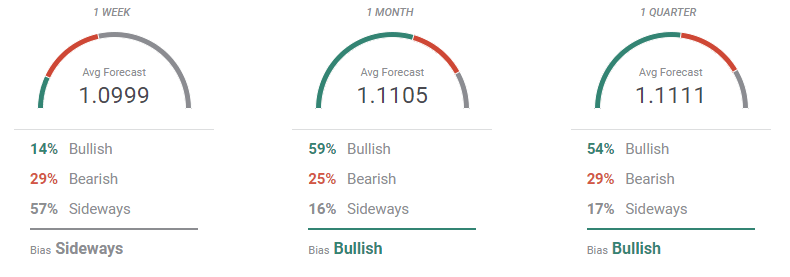
The FXStreet Forecast Poll shows that the pair is seen under pressure during the upcoming week, averaging 1.1000, although with the Overview chart clearly showing the persistent selling interest. On a monthly basis, however, there’s a wide spread of probable targets, without an outstanding level. The moving average, however, retains its bearish slope. In the longer-term perspective, the market is split, with many of the polled experts betting for a recovery up to 1.15, although those betting for a neutral-to-bearish stance are pretty much equal.
Much will depend on what happens this week, as if the pair remains below the 1.1000 figure, speculative interest will finally be able to give up and go with the flow.
Related Forecasts:
USD/JPY Forecast: Bears bracing for action in back-to-school-week
AUD/USD Forecast: no free-fall yet at sight, neither a relevant bounce
GBP/USD Forecast: Pound braces for battle on Brexit – in and outside parliament
Author

Valeria Bednarik
FXStreet
Valeria Bednarik was born and lives in Buenos Aires, Argentina. Her passion for math and numbers pushed her into studying economics in her younger years.
















