EUR/USD Forecast: Bulls seem in control, but then there is the election and the virus
- EUR/USD has been holding onto gains stemming from stimulus hopes.
- Foreign interference in the elections and rising COVID-19 cases could limit any gains.
- Thursday's four-hour chart is showing the pair exited overbought conditions and is ready to rally.

A rally, a necessary correction, and now another move higher? Technicals are pointing to a classic uptrend, but fundamental reality may disagree.
The main reason for the recent upswing comes from fiscal stimulus negotiations, which have weighed on the safe-haven dollar. House Speaker Nancy Pelosi reported progress and said they can now begin to "put pen to paper" on a generous stimulus bill after speaking with Treasury Secretary Steven Mnuchin. Can they bring an accord over the line with 12 days to go until the vote?
Senate Republicans would prefer to focus on the Supreme Court – and some are also reluctant to back generous welfare. Both sides have begun talking about approving new measures only after election day, November 3. However, the monumental event could turn everything upside down. Getting anything done in the "lame-duck session" – the period after the vote and before the newly elected officials assume office – seems unlikely. Markets could be too optimistic.
The election process also looks murkier. First, US security officials revealed that both Iran and Russia have obtained voter registration files and have sent threatening messages to voters. While they assured that the election infrastructure is resilient, the news of foreign intervention has already weighed on sentiment and boosted the greenback.
Is this just a short-lived news story that would allow markets to rise once it fades? That is still to be seen.
Another source of uncertainty comes from the outcome of the vote – recent opinion polls have been pointing to a tighter race, with Trump narrowing the gap in both national and state polls. It is essential to remember that challenger Joe Biden's advantage is still higher than in late September, but below the peak seen last week.
See:
- Trump is showing signs of a comeback, will the dollar follow?
- Handicapping the US 2020 Election: Polls, registration and the shy Trump voter
Trump and Biden are scheduled to clash in the last President Debate late on Thursday. Can it change the picture in either way? Around 44 million Americans have already voted, some 32% of the total vote count in 2016. Moreover, there are fewer undecideds than back then.
Overall, the president's comeback has been limited and time is short. FiveThirtyEight's model is pointing to an 87% chance of Biden winning, marginally lower.
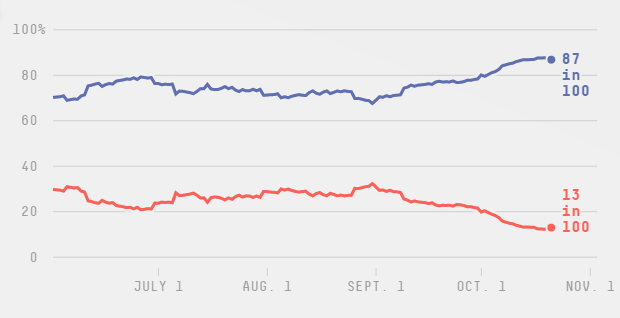
Source: FiveThirtyEight
Another source of concern is COVID-19. Cases have been rising for long weeks, but infections have accelerated recently, prompting additional restrictions from national, regional, and local authorities. Spain has surpassed one million cases and while Germany's infection load leaped – even reaching Health Minister Jens Spahn.
The winter wave of the pandemic in Europe may limit the euro's advance while an increase in US hospitalizations is also a factor that could keep EUR/USD in check due to haven flows.
Apart from politics and the virus, US jobless claims are set to move markets on Thursday. After a leap to 898,000 applications, a drop is on the cards. The data is for the week ending October 16, which is when the Non-Farm Payrolls surveys are taken.
See US Initial Jobless Claims Preview: Losing the prediction panache
EUR/USD Technical Analysis

The Relative Strength Index on the four-hour chart has dropped below 70 – exiting overbought conditions. That is only the latest bullish sign joining others. Euro/dollar is trading above the 50, 100, and 200 Simple Moving Averages and benefits from upside momentum.
Resistance awaits at the fresh high of 1.1880, which was also a peak back in mid-September. The next lines to watch also date back to that time – 1.19 and 1.1920.
Support is at the daily low of 1.1840, followed by 1.1795, a stepping stone on the way up. The next levels to watch are 1.1760 and 1.720.
See 2020 Elections: Seven reasons why this is not 2016, time to focus on the Senate
Author

Yohay Elam
FXStreet
Yohay is in Forex since 2008 when he founded Forex Crunch, a blog crafted in his free time that turned into a fully-fledged currency website later sold to Finixio.