|

EUR/USD Forecast: Bulls hesitate but don’t give up

EUR/USD Current Price: 1.1882

  • EU June Producer Price Index was up by 10.2% YoY, missing the market’s expectations.
  • The market mood is still sour, but the dollar is out of investors’ radar.
  • EUR/USD could extend its gains but only once above 1.1920.
The EUR/USD pair trades in the 1.1880 price zone, mildly higher on a daily basis and still confined to familiar ranges. The market’s mood is sour, limiting advances for high-yielding assets. Yet at the same time, the greenback keeps suffering the echoes of a dovish Fed, unattractive even in risk-off scenarios.

European indexes are marginally higher, but US futures aim to open in the red as demand for government bonds persist. Yields ticked higher but remain subdued, with the yield on the 10-year US Treasury note currently around 1.17%.

The EU published the June Producer Price Index, which rose 1.4% MoM as expected. The annual reading printed at 10.2%, below the market’s expectations. The US macroeconomic calendar includes June Factory Orders, the July ISM-NY Business Conditions Index and IBD/TIPP Economic Optimism for August.

EUR/USD short-term technical outlook

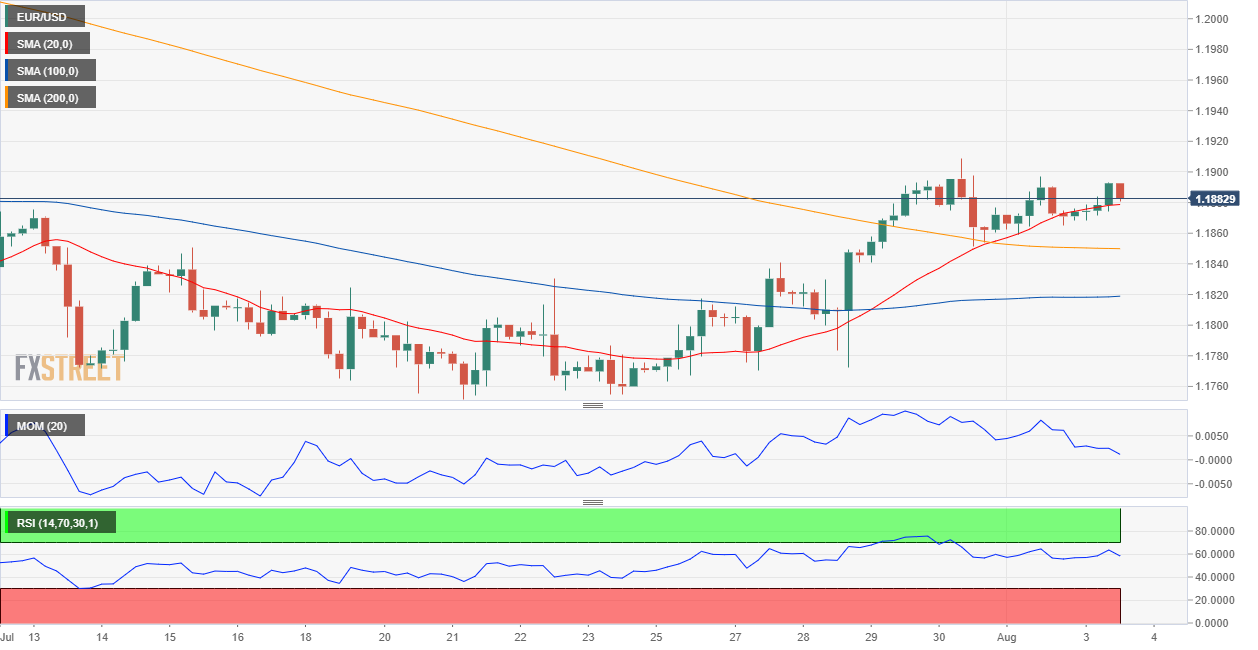
The EUR/USD pair is neutral-to-bullish in the near-term but still needs to break above the 1.1920 resistance level to confirm a new leg higher. The 4-hour chart shows that the price keeps hovering around a mildly bullish 20 SMA, which advances above the longer ones. However, technical indicators lack directional strength, the Momentum stuck to its midline and the RSI at around 59.

Support levels: 1.1840 1.1790 1.1750

Resistance levels: 1.1920 1.1960 1.2000

View Live Chart for the EUR/USD

Author

Valeria Bednarik

Valeria Bednarik was born and lives in Buenos Aires, Argentina. Her passion for math and numbers pushed her into studying economics in her younger years.


More from Valeria Bednarik
Share:

Editor's Picks

GBP/USD defends 1.3300 after strong UK Retail Sales data

GBP/USD is defending its renewed uptick above 1.3300 in the European session on Friday, helped by stronger-than-expected UK Retail Sales data for June. The pair snaps a five-day losing streak but the upside potential could be limited amid heightened military tensions in the Middle East.


EUR/USD holds steady below 1.1400 amid Middle East tensions

EUR/USD is keeping its range below 1.1400 in European trading on Friday. Despite a brief rebound, the pair is trading with caution amid escalating conflicts in the Middle East and following the ECB's no rate change decision.

Gold sticks to intraday losses below $4,050 amid Fed hike bets, bullish USD

Gold remains under some selling pressure for the second straight day, and weakens further below the $4,050 level during the Asian session. Escalating US-Iran tensions support elevated crude oil prices, fueling inflation fears and bolstering expectations of higher-for-longer US interest rates. This helps the US Dollar preserve its strong weekly gains to a nearly one-month high, touched on Thursday, and turns out to be a key factor undermining the non-yielding bullion.

Ethereum: Derivatives interest in ETH improves, but signs of caution remain

Ethereum is hovering slightly below the $1,900 level, down 3% on Thursday following a slight expansion in derivatives interest. The top altcoin's open interest has increased to 14.60 million ETH, marking a 600K ETH increase over the past two days and its highest level since June 7.

Crypto Market Overview: Bitcoin tests 50-day EMA support – Pi Network and Sky lead losses

The broader cryptocurrency market faces headwinds with rising tensions between the US and Iran, pushing Bitcoin down to its 50-day Exponential Moving Average support around $65,135 on Friday. Under pressure, Pi Network and Sky emerge as the worst-performing crypto assets over the last 24 hours.

US Dollar mid-year outlook: Exceptional currency, exceptional risks?
The US Dollar enters the second half of 2026 in a markedly different position from a year ago. The King currency has recovered, reflecting persistent US inflation, changing expectations for Fed policy, geopolitical tensions and renewed demand for defensive assets.















