|

EUR/USD Forecast: bouncing modestly but at risk to retest the yearly low

EUR/USD Current price: 1.1404

  • EU Markit PMI indicated the lowest rate of growth in two years.
  • US data and Fed speakers to keep traders busy today.
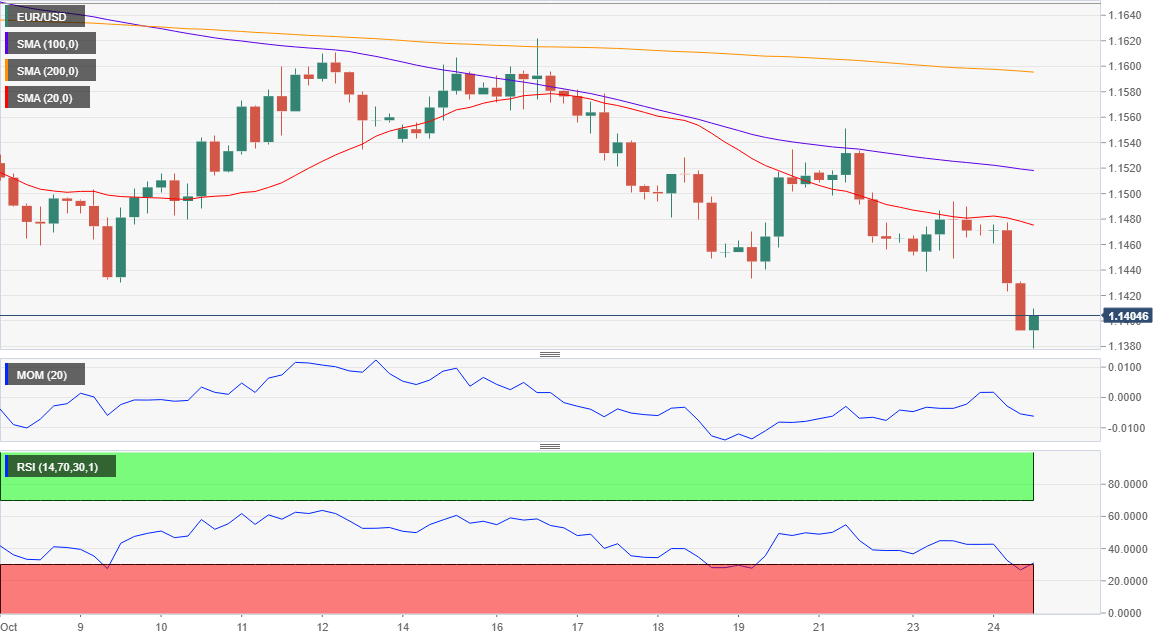
The EUR/USD pair fell below the 1.1400 level, as despite market's mood improved, European jitters remain at the eye of the storm, after the EU rejected Italian's coalition government draft budget, claiming that the deficit target and overly optimistic growth estimates posed a serious threat to economic stability in Europe. The country has three weeks to submit a revised version. Is the first time the European Commission asks a member state to review its budget.

Adding pressure on the common currency, the preliminary October Markit PMI missed expectations, with only positive numbers in France. The Manufacturing and the Services sectors all saw decreased activity resulting in the EU Composite PMI coming in at 52.7, the slowest rate of growth in two years, led by an export slowdown and weakness in the services sector.

Ahead of the opening, US indexes are up, with the DJIA roughly 150 points and would be interesting how the dollar reacts against its rivals, as even with stocks up, the high-yielding Aussie is under pressure. The US calendar will offer today October preliminary Markit PMI, September New Home Sales, seen declining for 1.4% MoM, while several Fed's members will give separate speeches throughout the session.

The EUR/USD pair accelerated once it broke 1.1430, its former October low, and has now little in the way toward 1.1300, the yearly low posted mid-August. The pair recovered some pips after bottoming at 1.1378 but maintains a strong bearish stance according to technical readings in the 4 hours chart, as the decline accelerated after multiple failed attempts to overcome its 20 SMA. The Momentum indicator maintains its sharp downward slope while the RSI also heads south within oversold levels, maintaining the risk lean to the downside despite the ongoing bounce.

Support levels: 1.1375 1.1330 1.1300

Resistance levels:  1.1430 1.1470 1.1510

View Live chart for the EUR/USD

Author

Valeria Bednarik

Valeria Bednarik was born and lives in Buenos Aires, Argentina. Her passion for math and numbers pushed her into studying economics in her younger years.


More from Valeria Bednarik
Share:

Editor's Picks

GBP/USD bounces off lows, back above 1.3200

After bottoming out near 1.3160, GBP/USD manages to regain a bit of shine and reclaim the 1.3200 mark and beyond at the end of the week. Stronger-than-expected UK Retail Sales data seem to be helping the British Pound limit its losses, while the chaotic UK political environment keeps the bulls at bay for now.

EUR/USD declines to near 1.1450 amid concerns over progress for US-Iran peace deal

The EUR/USD pair drifts lower to around 1.1460 during the early Asian session on Monday. Concerns about progress for the US-Iran peace deal and expectations of higher US interest rates boost a safe-haven currency such as the US Dollar against the Euro. European Central Bank President Christine Lagarde is set to speak later on Monday.  

$4,100 in sight: Gold appears vulnerable on bumpy US-Iran talks

Gold licks wounds early Monday, following a 1.5% weekly loss and eyeing more declines. The US Dollar stands tall on strained US-Iran peace talks after Trump’s threats, Strait of Hormuz closure. Gold looks to attack $4,100 amid a bearish technical setup on the daily chart.

Breaking: Iran closes the Strait of Hormuz amid ceasefire deal violation
Iran says it is closing the Strait of Hormuz after accusing the United States (US) and Israel of violating the ceasefire. According to Iran, the decision came over the continued Israeli strikes in Lebanon. The Iranian Revolutionary Guard Corps Navy issued a warning to all vessels: "Do not approach the Strait of Hormuz; otherwise, your security will be jeopardized."
Week ahead: Fed’s hawkish tilt and Iran deal turn focus to PCE inflation and PMIs
New Fed Chair Kevin Warsh didn’t waste any time in his first FOMC meeting in prioritizing the need for the central bank to bring inflation back within the Fed’s 2% objective, unsettling markets just as subsiding geopolitical risks had lifted the mood in the past week.
Regime change: Inside Kevin Warsh's first move to make the Fed unreadable on purpose

The rate did not move. That was the least interesting thing about Kevin Warsh's first meeting in charge of the Fed. The FOMC held its benchmark at 3.50%-3.75% for the fourth straight meeting, exactly as priced, and then the new chair used his first press conference to dismantle the machinery the market has leaned on for a decade.