EUR/USD Forecast: Bearish outlook is back as Double Top confirms downward trend


- EUR/USD has drawn a very bearish chart pattern, looks to the downside.
- A lighter economic calendar in the upcoming days should favor an extension of the recent slide.
- ECB's monetary policy stance is out-dovishing the Fed's one, which keeps driving the pair.
EUR/USD has built a double-top formation which opens up another bearish scenario. The consecutive upbeat releases from the US jobs report and both the ISM Manufacturing and Non-Manufacturing PMIs have finally propelled some US dollar buying, stopping the greenback's route from October. The month of November has started on the downward path and a lighter economic calendar for the upcoming days indicates that bears could ride their trend back for some time, as they keep profiting from the monetary policy and macroeconomic differential between the US and the Eurozone.
EUR/USD 1H chart: Double top puts bears back in the driving seat
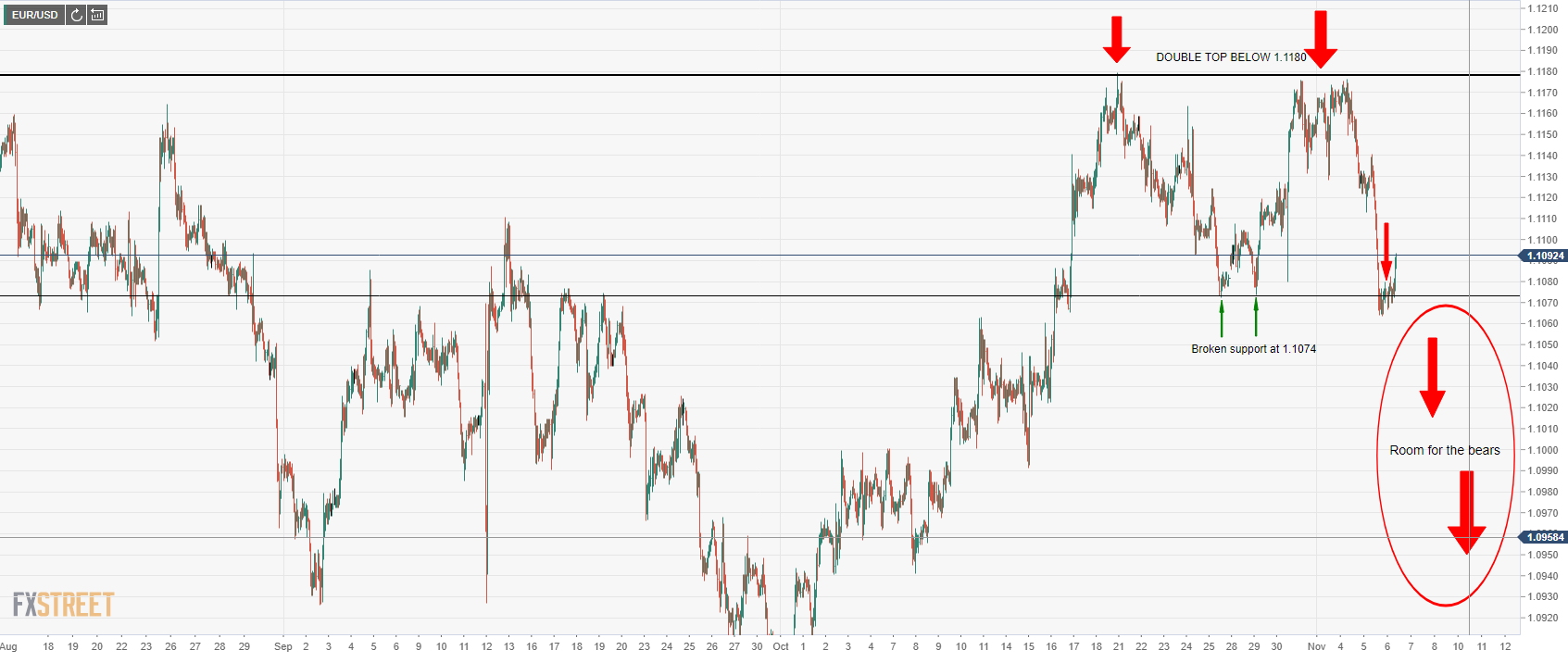
The euro dollar 1-hour chart comes in handy to picture the current double-top formation. It is showing the textbook chart pattern, confirmed by looking at the Investopedia definition of what a double top means: "extremely bearish technical reversal pattern that forms after an asset reaches a high price two consecutive times with a moderate decline between the two highs. It is confirmed once the asset's price falls below a support level equal to the low between the two prior highs".
A meaningful high was set at 1.1180, where EUR/USD bulls were rejected on Friday after better-than-expected Non-Farm Payrolls figures. From then on, sellers have taken over, breaking below the support level located at the lows set between October 25th and October 29th around 1.1075. A weak recovery after some positive data from Germany and the Eurozone seen in the last hours confirms that the bias is clearly bearish.
This double-top formation has some acute EUR/USD bearish potential, particularly taking into account that the economic calendar will take a step back from the exhilarating sequence of high-impact events that we have seen for the last week. Germany is set to release Industrial Production figures on Thursday and we will get from the US the preliminary results from November's University of Michigan Consumer Sentiment survey, but those are events a tier below from the high-top ones we have got in the last seven days. That should help the market set a stable trend favoring more downside momentum, as the bullish steam gathered in October is reversed.
EUR/USD Daily chart: The downtrend is relentless
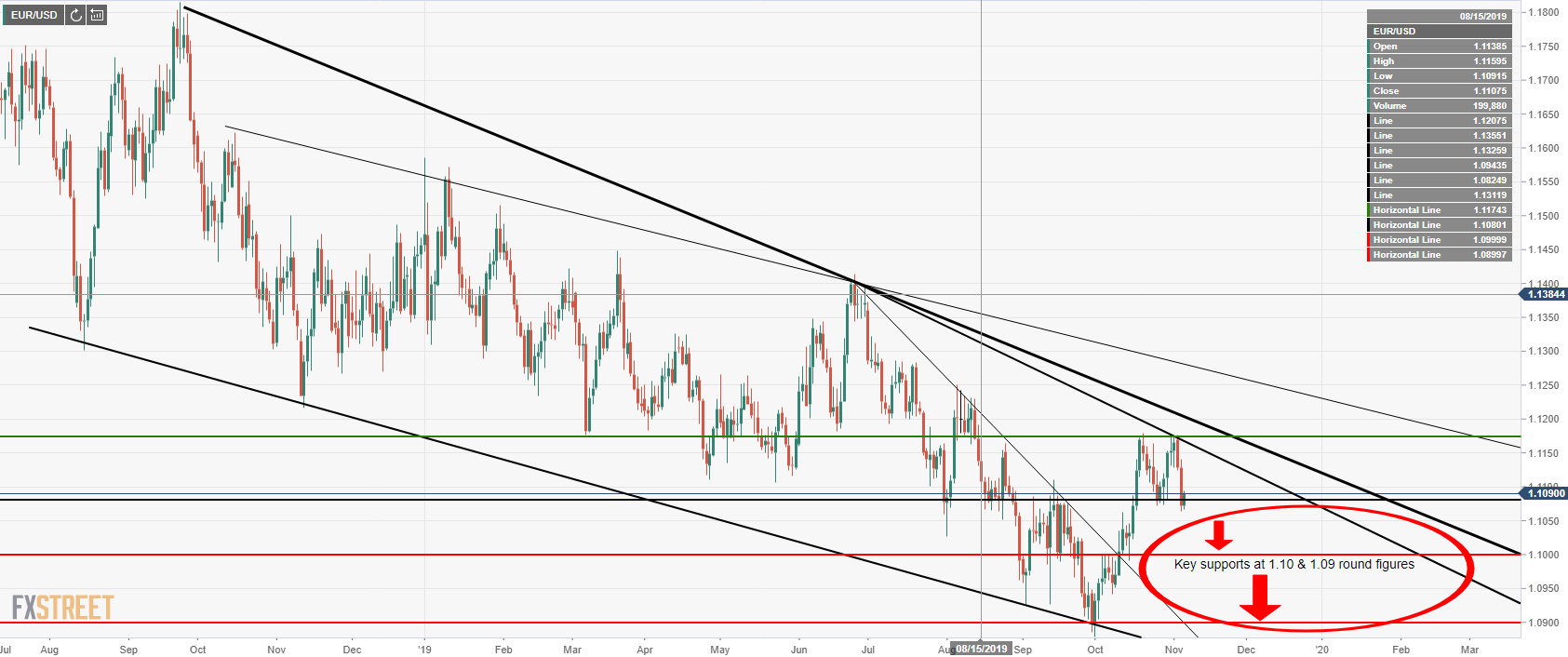
Euro dollar's daily chart shows that the recent double-top fits quite nice within the long-term bearish trend that the pair has been riding for the last year and a half. It is a slow but deliberate slide that has just provided another strong confirmation signal. Therefore, bears should be targeting a return to the psychological 1.10 figure before staring at the just-below 1.09 lows set at the end of September.
These targets should be reachable during November, as there's some cyclical demeanour going on that downward trend that relates well to the current picture. Let's take a look at the monthly data.
Fed expected to pause interest rates, good news for USD bulls
By gaining around 270 pips, October has been the most bullish month in the euro dollar since the start of 2018 – there have only been seven bullish months out of 22 in such period, with last June being the only one close to that gain, which was quickly reversed with a 310-pip slide in July, when the Fed started cutting its interest rates. That one could be a similar scenario to the one we are now facing, as the Fed has hinted a pause to its three consecutive rate cuts while the ECB, under Christine Lagarde's new leadership, is set to continue looking for unconventional (and unsuccessful) ways to stimulate the economy.
All in all, it's easy to see why the market keeps coming to the same point: the fact that the European Central Bank keeps out-dovishing the Federal Reserve, which was the case again in October, is the most relevant factor to keep pulling EUR/USD lower. There is not an end at sight for this monetary policy differential and while this lasts, the long-term forecast will always tend to favor the US dollar.
US-China trade and Brexit, the only risks for the upside
Risks to the upside could be located on the risk that the US-China trade negotiations – reportedly working more smoothly lately – were to be derailed, which could trigger some USD short-term selling. That could trigger some short-term USD sell-off, probably translating into some bad US consumer and business sentiment surveys, although in the mid- and long-term, the greenback is much better equipped to work as a safe-haven asset than the euro and its other counterparts.
On the euro side, an ordered Brexit finally happening could provide some relief to the common currency, so December 12th UK election has to be seen as a key date. Markets would look like a positive a stabilizing result – at this point, only a Boris Johnson comfortable win would probably do that – but even that effect would be limited until Brexit is confirmed. The UK is now expected to leave the European Union on January 31st. Any other outcome which triggers more uncertainty and likely further delays to the Brexit deadline should be looked as EUR-negative, so there's even more downside potential looming there.
Author
Jordi Martínez
FXStreet
Jordi Martínez is the Editor in Chief at FXStreet, leading editorial operations at the company, before being promoted to the role in 2023, he worked in several editorial positions at FXStreet, including roles as Senior